
Table of Contents


Manhattan Project: Lessons for Public Policy and Emerging Technologies
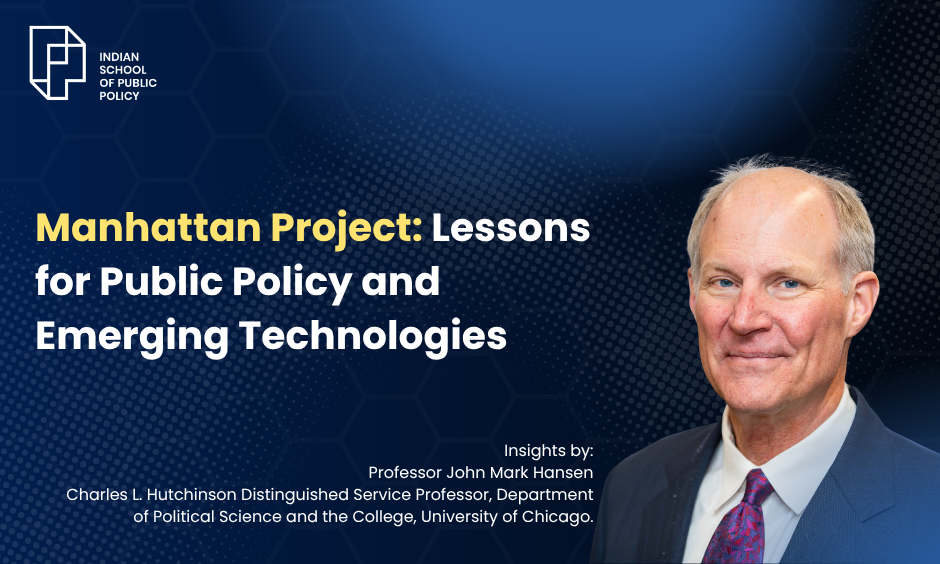

On April 9th, 2026, the Harris Lecture Series brought Professor John Mark Hansen of the University of Chicago to the Indian School of Public Policy. His subject was the Manhattan Project, the wartime effort that built the first atomic bomb. He did not come to recount the physics. He came to ask how a society governs a discovery powerful enough to destroy it. For a room full of future policy practitioners, the question landed uncomfortably close to the work we are training to do.
Professor Hansen holds the Charles L. Hutchinson Distinguished Service Professorship at the University of Chicago, and he has spent a career studying how institutions make hard choices under pressure. His lecture carried a quiet title, “Existential Moments: Navigating Risk at the Dawn of the Nuclear Age,” and a large question underneath it. When knowledge changes the world, who decides what we do with it?
The Harris Lecture Series, organised by ISPP in collaboration with the Harris School of Public Policy, exists for conversations like this one. It puts students in Delhi in the same room as scholars who study how societies govern themselves. Hansen chose the Manhattan Project as his case study. By the end of the evening, that choice felt less like history and more like a mirror held up to the present.
Manhattan Project Lessons for Today’s Policy Challenges
A short version of the story helps here, because many of us know the ending without knowing the shape of what came before it.
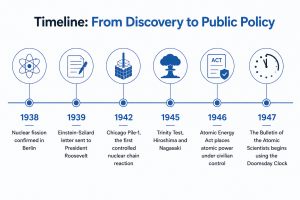
In 1938, two chemists in Berlin split the uranium atom. They did not fully grasp what they had done. The physicist Lise Meitner, working in exile, supplied the explanation, and the world learned that a single reaction could release an extraordinary amount of energy. Within a year, scientists understood that one split atom could trigger others in a chain, and that a chain could be turned into a weapon.
What followed was not inevitable. It was a sequence of decisions. In 1939, Albert Einstein signed a letter, drafted with the physicist Leo Szilard, warning President Franklin Roosevelt that Germany might build such a weapon first. The Einstein-Szilard letter set the American government in motion. By 1942, the United States had launched the Manhattan Project, a secret programme that would eventually employ more than 130,000 people and cost two billion dollars in wartime money.
Some of that work happened a short walk from where Hansen now teaches. Beneath the stands of an old football field at the University of Chicago, a team led by Enrico Fermi produced the first controlled nuclear chain reaction on December 2, 1942. Three years later, the Trinity test lit the New Mexico desert before dawn, and the bombs fell on Hiroshima and Nagasaki.
Hansen spent little time on the mushroom clouds. He was after something less visible. The bomb, he argued, created not one existential risk but several, and only one of them threatened human life directly. The others threatened the institutions, professions, and ideas that hold a free society together.
Four Questions That Outlived the War
The lecture moved through four of these risks. Each began in the 1940s. Each is still open.
First: When discovery outruns the institutions meant to manage it.
Fission was understood years before any government knew what questions to ask about it. The science arrived first, and the rules came limping behind. Hansen traced the scramble that followed, from advisory committees to research offices to an entire wartime bureaucracy, all chasing a discovery that had already left the laboratory.
The pattern should feel familiar. Artificial intelligence systems now enter public life faster than legislatures can study them. Gene editing tools sit in university labs while parliaments are still debating definitions. The gap between what we can do and what we have agreed to do is the oldest problem in technology governance, and the Manhattan Project drew it in sharp relief.
Second: Whether universities can serve the nation and remain themselves.
This was the part of the evening that seemed to unsettle the room most. The University of Chicago took on secret weapons work under its president, Robert Maynard Hutchins, a man who had built his reputation defending the university as a place of open inquiry. Federal money poured in. Federal secrecy came with it.
Hansen read from an account of Hutchins during those years. Informed only in outline, forbidden from asking the scientists questions, one account described the president as reduced to the custodian of a half-billion-dollar project he barely understood. The institution gained enormous resources and surrendered a measure of its independence in the same transaction.
Universities everywhere now live with a version of that bargain. Research funding flows from states and corporations carrying their own priorities. The question Hutchins faced, how to take the money without losing the mission, has not disappeared. It has multiplied.
Third: Who gets to govern a technology once it exists.
By 1944, some of the scientists who built the bomb had begun to worry about how it would be used, and by whom. A group at Chicago drafted what became known as the Franck Report in June 1945. It argued that the atomic bomb was a problem of long-range policy rather than a battlefield tool, and it urged the government to demonstrate the weapon rather than drop it on a city without warning.
The report did not change the decision. Yet it established something that lasted. The people closest to a powerful technology accepted responsibility for its consequences, and they carried that argument into the open.
That instinct produced durable institutions. The Atomic Energy Act of 1946 placed nuclear power under civilian rather than military control. The same period saw the founding of the Bulletin of the Atomic Scientists, whose Doomsday Clock still measures how close we stand to catastrophe. The same debate now runs through artificial intelligence governance and biotechnology. Should the engineers decide? The generals? The elected representatives? Hansen let the question hang, because no society has answered it cleanly.
Fourth: Whether openness can survive alongside secrecy.
Science depends on sharing. National security depends on concealment. The Manhattan Project forced the two into the same building. General Leslie Groves ran it on a rule of compartmentalisation, in which each person knew only what their own task required. One Chicago physicist joked that unless the army loosened its grip, the scientists might as well study the colour of butterfly wings. Fermi put it plainly. Research that is not free will not stay excellent.
After the war, the scientists pushed back, and the country settled into an uneasy compromise. Some knowledge would stay classified. The wider enterprise of open science would continue, supported by new public institutions. The tension was managed rather than resolved.
It returns whenever a discovery carries both promise and danger at once. Researchers in artificial intelligence now argue over how much of their work to publish. Biologists weigh the value of sharing a method against the risk that someone misuses it. The dilemma that Groves and Fermi fought over has only changed its vocabulary.
Why This Lecture Mattered for Public Policy
What stayed with me was Hansen’s refusal to treat any of this as settled.
It would be comforting to file the Manhattan Project under history, a thing that happened to other people in another century. The lecture made that impossible. Every dilemma the project raised is sitting in a committee room somewhere right now, dressed in the language of a newer technology.
For students at ISPP, the lesson was practical as much as moral. Policy is not made in the calm after a discovery. It is made in the rush, under pressure, with limited information and competing loyalties. The leaders who governed the atomic age did not always act wisely, but the best of them understood that scientific power and public responsibility cannot be pulled apart. That understanding is where good governance begins, and building it is much of what a school of public policy is for.
We will spend our careers facing emerging technologies that move faster than the rules written to contain them. The Manhattan Project is not a warning to memorise. It is a set of questions to keep asking.
The Harris Lecture Series continues to create space for conversations that connect history with contemporary public policy. Professor Hansen’s lecture demonstrated that understanding the Manhattan Project is not simply about revisiting the past. It is about preparing future policy leaders to navigate the ethical, institutional, and governance challenges of emerging technologies.
Timeline: From Discovery to Public Policy
Fact Box: The Manhattan Project by the Numbers
- More than 130,000 personnel across dozens of sites
- Roughly US$2 billion in wartime cost (about US$41 billion in today’s money)
- The University of Chicago, home of the project’s Metallurgical Laboratory
- The first controlled nuclear chain reaction, achieved beneath a Chicago football stadium in 1942
Then vs Now
| Theme | The Manhattan Project (1940s) | Artificial Intelligence (today) |
| University and government partnerships | Universities such as Chicago ran classified weapons work under federal contract | Universities and private labs partner with governments and large firms on frontier research |
| Technology governance | The Atomic Energy Act created civilian oversight of nuclear power | Governments draft rules for AI while the technology keeps changing under them |
| Scientific secrecy | Compartmentalisation limited what any single researcher could know | Labs debate how much model detail and method to release publicly |
| Global coordination | Scientists called for international control of atomic energy | States seek shared standards for AI and biotechnology across borders |