
Table of Contents


India’s Rural-Urban Binary, Is Already Broken & the Policy Hasn’t Caught Up
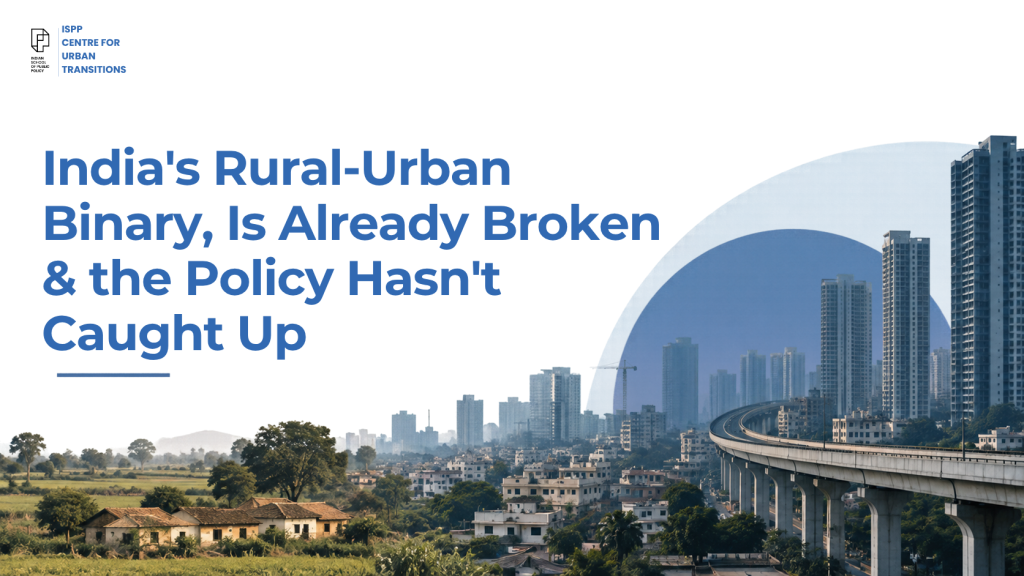

A place qualifies to be urban only if it crosses three thresholds simultaneously: a population above 5,000, a density above 400 people per square kilometre, and at least 75% of its male workforce outside agriculture. India’s Census still asks a settlement to prove it is urban before it is allowed to be treated as one. By failing in any one criterion a settlement remains legally rural even if, by every functional measure, it has already become a town.
It is the reason India’s urbanisation debate has spent two decades arguing without a reliable number to argue about. The 35% urban population figure is almost certainly wrong
Alternative measures night-time satellite lighting, built-up area detection, the Degree of Urbanisation framework the OECD and European Commission now use consistently suggest India is considerably more urbanised than its Census admits. The Economic Survey 2025-26 itself leans on these methods and concludes that India’s true urban footprint is substantially larger than the ~35-36% headline figure, a phenomenon researcher have started calling India’s hidden urbanisation. An EAC-PM working paper published earlier this year makes the same argument from a different angle: administrative boundaries have simply failed to keep pace with where people actually live and work.
This gap matters because governance follows classification, not reality. A settlement that is economically and demographically urban but administratively rural does not get a municipal corporation, does not get urban infrastructure grants, does not get planning oversight for water, sanitation, or land. The result, as the Economic Survey itself now concedes, is that “high density manifests as congestion, informality, and service stress rather than productivity gains” India is getting the costs of urban density without the institutional capacity to manage them.
The scale of this mismatch is not marginal. Between the 2001 and 2011 Census rounds, the number of Census Towns nearly tripled, from 1,362 to 3,894, with their combined population more than doubling to 54.3 million. And because the next full Census has been delayed, this is a decade-old snapshot of a problem that has almost certainly grown larger in the interim.
We should stop treating the urban and rural separately
-
The growth-dividend argument
International evidence suggests that urbanisation only pays off economically when cities can capture agglomeration economies efficient labour markets, connected infrastructure, coordinated institutions. India’s urban infrastructure investment has structurally lagged the economic weight its cities already carry: cities generate roughly 70% of GDP from about a third of the population, yet have received a fraction of the corresponding capital investment. The World Bank estimates India needs roughly $840 billion in urban infrastructure spending by 2036.
-
The concentration-risk argument
Urban growth in India is structurally concentrated in Class 1 Cities (100,000+ population), with over 70% of the urban population residing there. Compounding this, expansion is now happening outward rather than upward peri-urban sprawl is growing faster than city cores, which raises infrastructure and transport costs. Villages on a city’s edge get absorbed into its economic orbit commuting, informal housing, land speculation years before any formal reclassification or municipal takeover occurs.
-
The distress-migration argument
If small towns and large villages remain starved of the infrastructure and non-farm employment that would let people build a life there, migration toward five or six saturated metros continues by default, not by design. NITI Aayog’s evaluation of rural infrastructure missions has found that closing basic service gaps in situ measurably reduces this push migration.
The Shyama Prasad Mukherji Rurban Mission, launched in 2016, is India’s most direct policy attempt to deliver urban-grade infrastructure to rural clusters. But the Mission’s reach is limited by real structural weaknesses: poor inter-departmental convergence with schemes like MGNREGA and PMGSY, cluster selection that has sometimes leaned political rather than purely need-based, weak third-party monitoring that makes outcomes hard to verify beyond output counts, and a basic scale mismatch, since 300 clusters barely dent the nearly 4,000 census towns undergoing this transition.
Where the reform conversation is heading now
-
Reform the classification system itself, and do it on a rolling basis
Reclassification currently depends on a Census that itself runs a decade behind. Adopting continuously updated, satellite- and administrative-data-based urban classification (following the Degree of Urbanisation approach already used internationally) would let municipal status, funding, and planning oversight follow actual settlement patterns rather than a stale headcount.
-
Fix municipal finance and governance before adding more infrastructure schemes
The Economic Survey’s single sharpest line on this may be that persistent governance deficits in urban local bodies have blocked India from realising the agglomeration benefits its own cities should be generating.
-
Liberalise land and housing supply constraints
The Survey flags Floor Space Index (FSI) restrictions as a structural cause of urban stress: Indian cities typically cap FSI at 1.5–2.5, against 8–12 in comparable Asian metros, which constrains housing supply, inflates prices, and pushes lower-income populations to poorly connected peripheries with the weakest governance. The recommended fixes FSI liberalisation, metropolitan-level land pooling, and transit-oriented development around transport corridors are aimed at easing this pressure while making secondary-town growth viable.
-
Build up Tier-II and Tier-III cities deliberately, rather than waiting for overflow
Focus investment, migration, and growth toward secondary cities and city-regions rather than allowing it to default toward five or six already-overloaded metros.
The resistance to becoming urban is political as much as technical. Reclassification usually brings heavier property taxes in place of a lighter rural cess, and residents along with local politician’s resist paying more. Villages also lose access to MGNREGA guaranteed employment and certain rural subsidies once notified urban a real income loss for poorer residents, even if urban infrastructure eventually offsets it. Compounding this, there’s no automatic trigger: a Census Town can sit in limbo for decades because no state law forces conversion, and state governments have little incentive to take on new municipal liabilities. Sarpanches and panchayat members, who lose their positions when a Gram Panchayat dissolves into a municipality, often actively lobby against the change.
Conclusion
India looks at urbanisation as administrative exercise, not the economic transition it actually is. Fixing this needs whole-systems coordination: data, investment, land policy, and incentives moving together as one strategy, not siloed schemes. And it needs political will. The solutions aren’t complex treating cities as economic engines, not administrative categories, is what’s missing.
FAQs
References:
-
- Ministry of Finance, Government of India — Economic Survey 2025–26, Chapter 15: Urbanisation — https://www.indiabudget.gov.in/economicsurvey/doc/eschapter/echap15.pdf
- IBEF — Economic Survey 2025-26, Analysis and Key Findings — https://www.ibef.org/economy/economic-survey-2025-26
- EAC-PM — India’s Hidden Urbanisation and Its Policy Implications, Working Paper 44/2026 — https://eacpm.gov.in/wp-content/uploads/2026/03/EAC-PM-Working-Paper-Indias-Hidden-Urbanisation-Its-Policy-Implications-120326.pdf
- Indian School of Public Policy — India’s Urbanisation Curve: A Narrow Window to Act — https://www.ispp.org.in/before-the-curve-bends-indias-narrowing-window-on-urban-planning/
- BharatNotes — Urbanisation — Problems & Remedies — https://bharatnotes.com/subjects/society/indian-society/urbanisation-problems-remedies/
- World Bank — Gearing up for India’s Rapid Urban Transformation (2024) — https://www.worldbank.org/en/news/opinion/2024/01/30/gearing-up-for-india-s-rapid-urban-transformation
- Outlook Business — India’s Urbanisation: Key Trends, Regional Disparities and the Path Ahead — https://www.outlookbusiness.com/columns/indias-urbanisation-key-trends-regional-disparities-and-the-path-ahead
- IMPRI — Bridging The Divide: The Shyama Prasad Mukherjee Rurban Mission — https://www.impriindia.com/insights/bridging-the-divide-the-shyama-prasad-mukherjee-rurban-mission/
- IMPRI — The State of India’s Urbanisation — https://www.impriindia.com/event-report/india-urbanization/
- Drishti IAS — Shyama Prasad Mukherji Rurban Mission — https://www.drishtiias.com/daily-news-analysis/shyama-prasad-mukherji-rurban-mission
- Ministry of Rural Development, Government of India — SPMRM press release — https://rural.nic.in/press-release/shyama-prasad-mukherji-rurban-mission-0
- Press Information Bureau — 4th Anniversary of SPMRM (2020) — https://www.pib.gov.in/PressReleseDetailm.aspx?PRID=1603885
- Press Information Bureau — SPMRM explainer (Feb 2023) — https://static.pib.gov.in/WriteReadData/specificdocs/documents/2023/feb/doc2023221161301.pdf
- ResearchGate — Role of Census Towns in Rising Urbanisation of India — https://www.researchgate.net/publication/340645628_Role_of_Census_Towns_in_Rising_Urbanisation_of_India
- ResearchGate — Census Towns in India: Current Patterns and Future Discourses — https://www.researchgate.net/publication/325284041_Census_towns_in_India_-_Current_patterns_and_Future_Discourses
- Wikipedia — Census Town — https://en.wikipedia.org/wiki/Census_town