
Table of Contents


India–EU FTA: What’s in store for both trading partners?
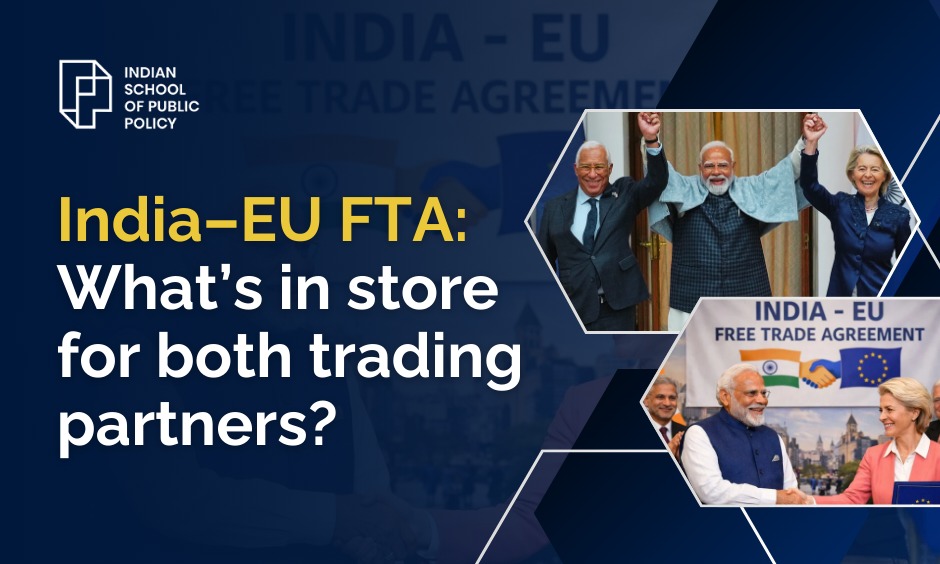

Early this week the India–European Union Free Trade Agreement (India–EU FTA) concluded at the 16th India–EU Summit, marking a milestone in India–EU economic relations. It is the largest trade agreement that two trade partners have ever concluded. This comes at a time when the US has been unilaterally spoiling its relationship with several trading partners, including India, through imposition of irrationally high tariffs.
This FTA comes after the recently concluded India UK FTA. The India-UK CETA 2025 agreement included a wide-ranging package covering Information Technology /IT enabled services, business consulting, financial and professional services that will unlock high-value opportunities and job creation. Earlier in August 2025, India and Russia pushed to accelerate progress on the USD 100 billion bilateral trade target by 2030, including work on the India-EAEU FTA (Eurasian Economic Union Free Trade Agreement)
The India-EU FTA 2026 got executed after intense negotiations since the re-launch of negotiations in 2022. The announcement has demonstrated the political will o both sides and to deliver a balanced and rules-based economic and trade partnership1.
India–EU Trade Relationship: Scale and Significance
In 2024–25, India’s bilateral trade in goods with the EU stood at USD 136.54 billion with exports worth USD 75.85 billion and imports amounting to USD 60.68 billion. India-EU trade in services was at USD 83.10 billion in 2024. Together, they account for one-third of global trade2.
India has surpassed Japan to become the world’s fourth-largest economy with a GDP of USD 4.18 trillion and is the fastest-growing major economy and with geo-political scenario changing fast this trade deal could not have come at a better time. More recently, India’s trade policy is shifting to bilateral and regional cooperation. This is also a period of assertion, faith in its strategy and that of its trading partners3.
As a result of this deal the EU will eliminate tariffs on over 90% of tariff lines and India will eliminate tariffs on 86% of tariff lines. Additionally, both sides will partially liberalise a significant additional number of lines, thus bringing the overall coverage of trade liberalisation to 96.6% for India and 99.3% for the EU4.
Sectoral Gains for India and the European Union
Key benefits for the EU include agri-food, chemicals, pharmaceuticals, machinery, medical devices, avionics and automotive industries. For India it will be fisheries, chemicals, textiles, footwear gems and jewellery, handicrafts and pharmaceuticals.
India will remove high duties on industrial products (which, on average, are above 16%), such as chemicals, cosmetics, plastics, auto parts, ceramics, machinery and boats5. These duty reductions will provide better access to EU exports of these products which found it difficult to enter the Indian market given the high tariff barriers.
As regards India this will bolster the ‘Make in India’ initiative and benefit the small and medium enterprises. Besides, this deal will enable movement of skilled Indian professionals and unlock high-value commitments in services.
On automobiles, it will allow EU auto makers to introduce their models in India in higher price bands. The reciprocal market access in EU market will also open up opportunities for India made automobiles to access EU market6.
The FTA is also expected to facilitate cooperation in critical areas such as Artificial Intelligence, clean technologies, and semiconductors, supporting India’s technological advancement.
India’s Expanding FTA Strategy
EU becomes India’s 22nd FTA partner. The Government in the last decade has signed trade deals with Mauritius, UAE, UK, EFTA, Oman and Australia, and announced trade deal with New Zealand. In 2025, India signed trade deal with Oman and UK7. The competitiveness of India’s industry of late has given its export sector the necessary strength and confidence to increasingly go in for regional and bilateral trade8.
The agreement will benefit several key EU agri-food exports, such as:
- Olive Oil (current tariff up to 45 %, to be eliminated at entry into force or after a 5-year staging)
- Non-alcoholic beer and several fruit juices (current tariff up to 55 %, to be eliminated in 5 years)
- Processed food such as confectionary, breads, pastry, pasta, chocolates, pet food (current tariff 33%, to be eliminated at entry into force or after staging)
- Sheep meat (current tariff 33%, to be eliminated over staging)
- Market access improvement for wine, spirits, beer, as well as fruits
Frequently Asked Questions (FAQs)
References:
- https://www.pib.gov.in/PressReleasePage.aspx?PRID=2219065®=3&lang=1
- https://www.pib.gov.in/PressReleasePage.aspx?PRID=2219065®=3&lang=1
- https://www.ispp.org.in/economics-of-indias-international-trade/
- https://policy.trade.ec.europa.eu/eu-trade-relationships-country-and-region/countries-and-regions/india/eu-india-agreements/memo-eu-india-free-trade-agreement-chapter-chapter-summary_en
- https://policy.trade.ec.europa.eu/eu-trade-relationships-country-and-region/countries-and-regions/india/eu-india-agreements/memo-eu-india-free-trade-agreement-chapter-chapter-summary_en
- https://www.pib.gov.in/PressReleasePage.aspx?PRID=2219065®=3&lang=1
- https://www.pib.gov.in/PressReleasePage.aspx?PRID=2219065®=3&lang=1
- https://www.ispp.org.in/economics-of-indias-international-trade/