
Table of Contents


Rethinking Political Violence
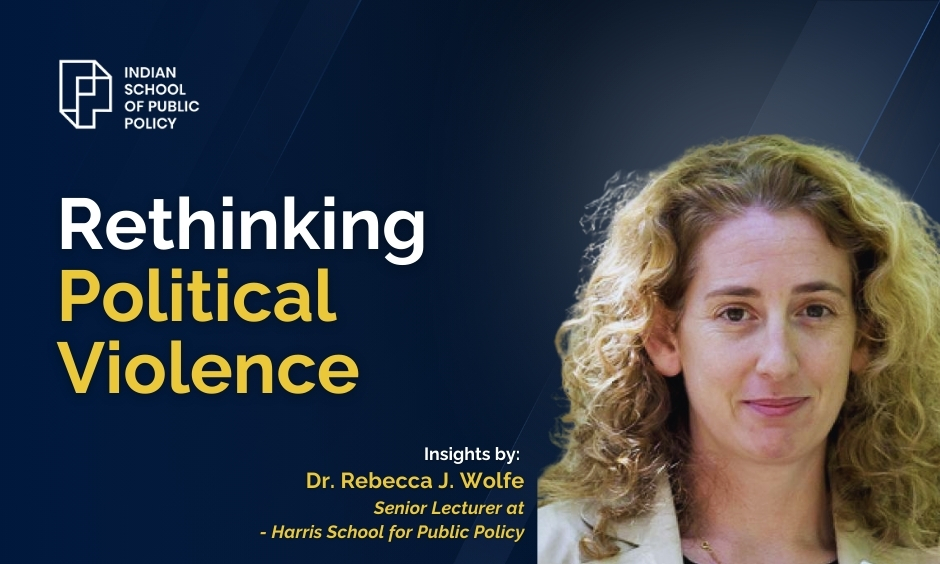

A Recap of the Harris Lecture Series at ISPP
For decades, the international policy consensus has been simple: if you have a job and a full stomach, you’re not going to snatch a gun. But as we experienced in our recent Harris Lecture Series session, the reality is so much more nuanced.
Dr. Rebecca J. Wolfe, senior lecturer and executive director of International Policy & Development at the University of Chicago Harris School for Public Policy, was a guest speaker in early February at ISPP. Wolfe took a deep dive into the political violence of action and behaviour in her lecture.
She drew on classic research, as well as her own data from the chaotic regions of Afghanistan and Somalia, to challenge the notion that poverty is the only parent of revolution. Wolfe is an expert on political violence, conflict and violent extremism. She has published research on how development-related interventions can be designed to reduce support for violence, as well as on the effectiveness of peacebuilding interventions.
The poverty myth
One of the most eye-opening takeaways from Wolfe’s lecture was the rejection of the “economic opportunity” model. She highlighted that although macro-level data indicated a link between low GDP and civil war, this often does not hold at the micro-level. She cited an example as given below.
- The Uganda study: Chris Blattman’s study found that grants and vocational training increased income and employment but had no impact on social cohesion. His study is based on northern Uganda, where rebel recruitment was studied. The element of conscription (by abduction) leads to significantly greater political participation later in life. The determinant of this increased political participation may be due to violence1.
- The takeaway: A job, per se, does not necessarily “cure” us of our political discontent or our yearning for a better future.
The Design of Intentionality
Wolfe cited that in India, we like to talk about cash transfers as a “silver bullet” to address the issue of poverty and deprivation that can bring in stability amongst the impoverished.
- Afghanistan case study: Wolfe drew our attention to a provocative study from Afghanistan that found a backlash effect. She added that unconditional cash initially increased support for the government, but support collapsed nine months later, probably because of “unfulfilled expectations”.
- The takeaway: Paradoxically, it was the combination of cash and vocational training that built long-term trust. She added, the message that the government sends, i.e., that you invest in your future, rather than count the dollar amount, does the trick.
Identity and the “Altruism” of Violence
The most uncomfortable part of the discussion was that a lot of people commit collective violence not because they are “bad people” but because of group-based altruism, as described below:
- Group Norms: Violence is a moral response to discrimination / perceived threat to the group, and
- Social Connection: Humans crave belonging. Identifying with a group is a powerful mobiliser.
- The takeaway: Leaders who are aware of these dynamics are better at shifting norms than one who just believes in rewarding good behaviour monetarily.
Changing the Story
What if we can’t stop violence by changing the price of living? Wolfe suggested we consider behavioural interventions that aim at changing social norms rather than individual attitudes. She gave the example of a Rwandan radio programme that changed the public’s perception of reconciliation, showing that you don’t necessarily have to change what people think in private; you just have to change what they think is ‘socially acceptable’ in public.
Bottom line:
Wolfe suggested that we need to think beyond the balance sheet to prevent violence. Good policy will require an understanding of group identity and of the psychological effects of government initiatives, and also the subtle motivations that bring young people to look for meaning in conflict.
“Policymakers should understand and acknowledge the altruistic motivations for group-based violence, rather than labelling participants as ‘bad people’.”
All these concerns raise a pertinent question. Is Behavioural Science poised to replace economic aid for peacebuilding? Or should societies and governments adopt a more holistic approach?