
Table of Contents


UDAN Scheme: Connecting people and regions

The Indian civil aviation industry had demonstrated an urban bias till 2016, with commercial air transport services being restricted to and centred around six metro airports. The rest of India, including smaller cities, rural areas, mountainous and island regions, was either unserved or poorly served through air transport. Recognizing this skewed provision, the National Civil Aviation Policy (NCAP), 2016 identified regional connectivity of air transport services as a key public policy imperative. The policy associated accessible air transport with inclusive economic development and equal access to opportunities (Ministry of Civil Aviation, Government of India, 2016).
In keeping with this policy agenda, the Ministry of Civil Aviation introduced the Regional Connectivity Scheme (RCS) – UDAN (Ude Desh ka Aam Naagrik) in October 2016. The central idea of the RCS-UDAN scheme was to encourage airlines to have operations in regional and remote routes through enabling policies and by extending incentives1. RCS-UDAN was designed to improve accessibility to areas historically underserved or unserved by commercial airlines but they were important for overall economic development. In short, it was brought to support more inclusive and geographically balanced connectivity across India. The first RCS flight between Shimla and Delhi was inaugurated on April 27, 2017.
The scheme aimed to overcome market barriers that have been discouraging airlines from operating on regional routes, largely due to low demand, high costs of operation, and a lack of adequate airport infrastructure. The UDAN scheme was designed in such a way that it relied on a market-led approach, unlike direct state intervention to implement a policy that would serve a large number of people. To ensure the business viability of the scheme, the government devised a slew of measures that would encourage airlines to serve regional and remote areas.
One such measure included Viability Gap Funding (VGF), funded through the Regional Air Connectivity Fund of the government. Other measures include concessions offered by the central and state governments, optimization of airport fees, and waiving off certain kinds of taxes/duties. The scheme, by design, promotes long-term sustainability with a gradual phase-out of government assistance.
Objectives of the UDAN Scheme
On the basis of the NCAP framework, the background and objectives of the UDAN scheme include the following2:
- Enhancement of Regional Air Connectivity: To provide greater access to air services by operationalizing scheduled commercial flights to unserved and underserved airports.
- Promotion of Affordable Air Travel: To provide greater access to air travel by fixing lower fares on regional routes through a mix of demand and supply side assistance to airlines.
- Revival and Optimal Utilisation of Aviation Infrastructure: To revive airports, airstrips, heliports, and water aerodromes that have been lying dormant or underutilized by upgrading essential facilities.
- Remedying Market Failures in Regional Aviation: Through a transparent and competitive bidding process and funding remedy.
- Promoting Long-Term Viability of Operations: To develop sustainable regional air transport services that can function without government assistance in the future.
- Indirect Support for Regional Development: To support economic development, tourism, and disaster preparedness in regional and remote areas.
Components of UDAN Scheme include the following:
- Viability Gap Funding (VGF): Financial support to airlines to ensure affordable fares.
- Airfare Cap by airlines to ensure affordability.
- Collaborative Governance between the Centre, States, Airport Authority of India (AAI), and private airport operators.
- Stakeholder Incentives: Measures to attract airlines to operate flights in less viable sectors. Such incentives include the following:
- Airport Operators: Waiving landing and parking charges for RCS flights, non-levy of Terminal Navigation Landing Charges (TNLC) by the AAI on these flights. Application of Discounted Route Navigation and Facilitation Charge (RNFC).
- Central Government: For the first three years, excise duty on Aviation Turbine Fuel (ATF) purchased at RCS airports is capped at 2%. Airlines are also encouraged to enter code-sharing agreements to expand their reach.
- State Governments: States have committed to reducing VAT on ATF to 1% or less for ten years, besides essential services such as security, fire services, and utility services at reduced rates.
Expanding Airport Connectivity Under UDAN
A key success of the UDAN scheme has been its rapid expansion of regional airports and their connectivity with metros. According to the Government figures 3:
- As of 21 October 2025, 649 regional routes have been made operational under UDAN.
- These routes link a total of 93 unserved and underserved aerodromes across India.
- Among these 93 destinations, 15 heliports and 2 water aerodromes are also included, demonstrating the scheme’s broader focus beyond standard airports
- Of the 93 airports/heliports over 50% belong to the AAI, followed by State governments, defence forces and private sector 4.
The Scheme has led to regional development across several states. For instance, Bihar, Jharkhand, Odisha and West Bengal benefited from the scheme in East India, HP, UP, Rajasthan, Punjab and Haryana in North India, Manipur, Meghalaya, Nagaland Sikkim and Arunachal Pradesh in North East and Tamil Nadu, Gujarat and Maharashtra in Western India, Andhra Pradesh, Kerala, Karnataka in Southern India, Chhattisgarh and Madhya Pradesh in Central India besides the Union Territories of Lakshwadeep, Daman & Diu and Puducherry.
UDAN thus ensures equitable spread across India’s diverse topography, covering states/UTs with priority to underserved regions. For instance it covers Himachal Pradesh and Uttarakhand through heliports, in the South it has a water aerodrome in Andhra Pradesh, in the West it has a water aerodrome at the statue of unity and in the North east it has several heliports and airport services 5.
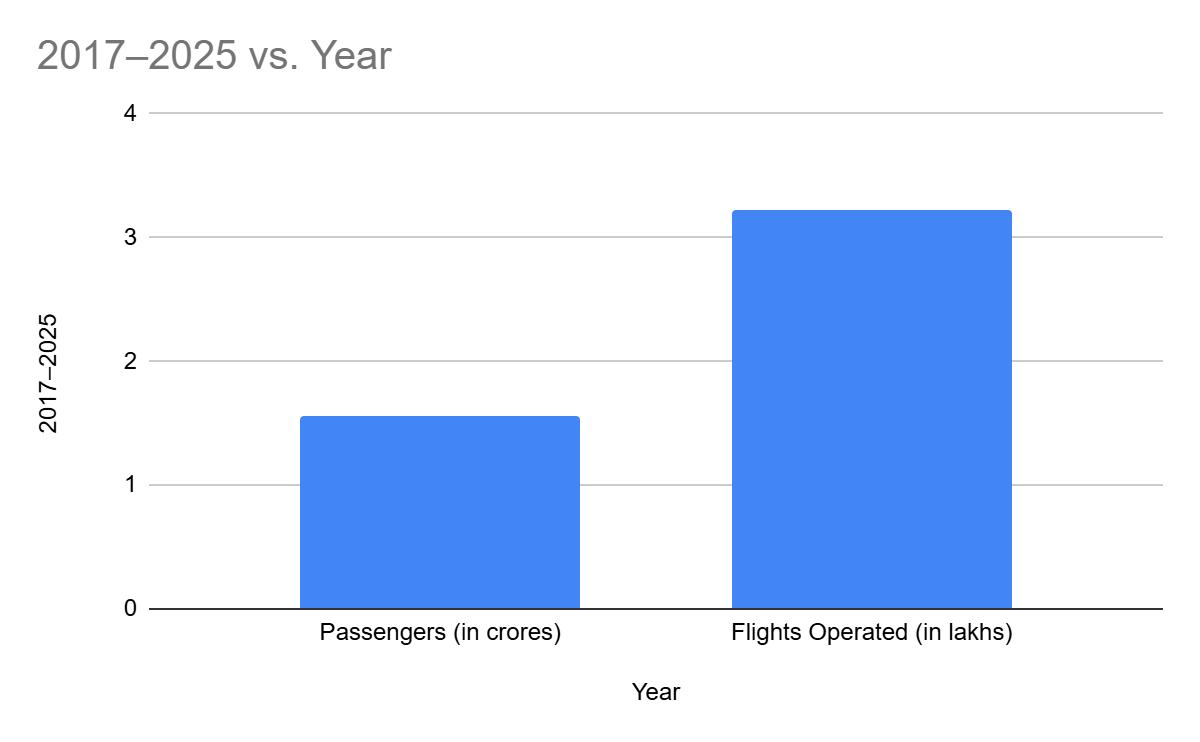
In this process it facilitated over 1.56 crore passengers through 3,23,000 UDAN flights by connecting several flights to these destinations in nine years (2017-2025) 6. The government envisions increasing RCS-UDAN airports to 350-400 by 2047.
Figure 1: UDAN Passenger Traffic & Flight Operations
Source: Press Information Bureau
This chart visually represents how passenger traffic growth mirrors operational flight increases, illustrating UDAN’s operational scale.
Phased development of the UDAN scheme
UDAN has evolved through multiple rounds since 2017, and each round has led to the expansion of routes and infrastructure 7.
| Phase | Launch Year | Key Features |
|---|---|---|
| UDAN 1.0 | 2017 | 5 airline operators awarded 128 routes to 70 airports, including 36 new airports. |
| UDAN 2.0 | 2018-19 | Expanded the scheme to include 73 underserved and unserved airports. For the first time, helipads were connected into the UDAN network. |
| UDAN 3.0 | 2019-20 | Introduced Tourism Routes in coordination with the Ministry of Tourism. Several routes in the North-East Region came under the ambit of the scheme. Incorporated Seaplane operations to connect Water Aerodromes. |
| UDAN 4.0 | 2020-21 | Focused on hilly regions, North-Eastern States, and island territories. Enhanced emphasis on helicopter and seaplane service. |
| UDAN 5.0+ | April 2023 | Continuation of the scheme beyond April 2027 through an Expanded UDAN Framework. Focus on category 2 and 3 aircraft, removal of the cap of 600 km, improved turnaround time, and efficiency |
| UDAN 5.1 | May 2023 | Focus on helicopter services. VGF cap increased |
| UDAN 5.2 | July 2023 | Focus on rural tourism and less than 20 seater aircrafts |
| UDAN 5.3 and 5.4 | Jan 2024, August 2024 | Rebidding discontinued. Opened skies to all aircrafts thus introducing flexibility |
| UDAN 5.5 | February 2025 | Refined route allocation including sea plane operations |
Source: Press Information Bureau
Helicopter Services
UDAN’s helicopter segment has a special role to play in connecting remote areas and difficult terrains not conducive for fixed-wing flights. They service at fares 20-30% below the market prices. Given below for illustration purposes are some helicopter routes and their fares by Heritage Aviation 8.
| Region | Sample Route | Fare (₹ one-way) | Distance (km) |
|---|---|---|---|
| North/Himachal | Shimla-Kullu | 3,500 | 120 |
| Uttarakhand | Dehradun- Naukuchiatal | 3,500 | 250 |
| Uttarakhand | Haldwani-Munsiyari | 5,000 | 280 |
| Northeast | Guwahati-Tawang (planned) | ~4,000 | 300 |
Source: HeritageAviation
Geographic Expansion
AIRLINES’ CONTRIBUTION IN PHASES
Prominent airlines that have contributed to UDAN include Alliance Air Aviation Ltd, which was the leading carrier in UDAN 1. The total UDAN route won by the company was 109 by 2021. Of the allotted routes, the Company operated 73 routes as on 31st March 2021. Out of the total route operated by Alliance in 2020-21, around 56% were under the UDAN scheme 9.
IndiGo and SpiceJet were the leaders in UDAN 2 (2018-19). Currently, Indigo has the highest routes under the UDAN Scheme. More recently, IndiGo announced it will operate direct flights connecting Hindon with nine major Indian cities: Ahmedabad, Bengaluru, Chennai, Goa, Indore, Kolkata, Mumbai, Patna, and Varanasi 10.
Airlines operating under the UDAN Scheme include the following:
- Major Carriers: IndiGo, SpiceJet, Alliance Air.
- Regional/Specialized Airlines: Flybig, Star Air, IndiaOne Air, Fly91, TruJet, Air Odisha, and Deccan Charters.
- Helicopter/Charter Operators: Pawan Hans.
UDAN bidding process:
UDAN bidding is an open, two-stage e-bidding process administered by the Ministry of Civil Aviation (MoCA) through the Airports Authority of India (AAI), where carriers bid for routes that they find feasible. Carriers register on the UDAN website and bid for route networks identified after demand analysis, with aircraft type. 11.
While the bidding procedures are well laid out, UDAN’s implementation process is not free from criticism. The Comptroller and Auditor General (CAG) came up with a critical analysis of the scheme’s implementation through its report in 2023 has found several anomalies 12.
Findings of the CAG report:
The CAG 2023 report on the UDAN scheme found several loopholes in the implementation of the scheme. It suggested a monitoring mechanism for internal controls. It also talked about room for improvement in compliance with the tender documents, compliance with Airlines agreements, management of the RCF Fund, as well as the disbursement of viability gap funding.
Given below are the key findings of the CAG report 13:
- Upto UDAN-3, 52% (403) of the 774 awarded routes could not commence operations and from the 371 commenced routes, only 112 routes (30%) completed the full concession period of three years 14.
- Only 54 routes (7% of the awarded 774 routes) connecting 17 RCS Airports could sustain the operations beyond the concession period of three years (as of March 2023).
- VGF (subsidy) and airport upgrades were delayed for many new airports.
- For helicopter services, the report found that no exercise was carried out by MoCA/ AAI to identify eligible heliports and that the majority of heliports identified for operations either remained un-utilised/under-utilised 15.
However, the CAG report acknowledged that the Scheme has the potential to contribute towards economic development, tourism promotion, optimisation of natural resources, and preparedness during emergencies for unserved areas 16. The number of passengers travelled on RCS routes increased from 2.63 lakh in 2017-18 to 24.97 lakh in 2022-23. It added that the implementation of RCS needs to be improved to fully leverage the benefits envisaged 17.
GAG made 16 recommendations touching various aspects of audit, which will help the Ministry in better implementation of the scheme in the future. For policymakers, there are several takeaways that suggest devising a flagship programme is not that difficult. The problem lies in proper implementation and keeping the momentum in a sustained way.
Some key recommendations include the following:
A mechanism be devised to assess the feasibility of routes for sustainability of operations in the long run and for identification of unserved/underserved airports, considering the stage length, other modes of transportation, terrain, socio-economic scenario, and tourism potential, etc 18.
As regards heliports, it suggested a mechanism be devised based on the feasibility of the operations and sustainability of the same in the long run, on the basis of experience gained so far 19.
Civil Aviation Ministry devises a mechanism to monitor the RCF levy collected by airlines and ensure that the amount collected from the passengers is not more than the amount to be remitted to the Government and does not become a source of profit to the airlines 20.
A suitable mechanism should be devised to reconcile the VGF claims lodged by the airlines from the flight data available with Airport operators instead of disbursing the VGF on a self-certification basis 21.
Conclusion:
Based on research jointly conducted by faculty and scholars, ISPP’s analyses suggest that policies can be ambitious and have welfare considerations, but their implementation is important. For this, the involvement of public policy institutions and individuals holding expertise in the said domain is important to give the right perspective. Besides, international case studies should be referred to while framing the policy. And after each round of implementation, lessons should be drawn, and corrections need to be made for the success of the next rounds.
ISPP scholars Pragya Saini, Baldeep Singh, Gargi Dave, Annapurna Mishra, Shivendra Mishra, Shalini, Vartika Rai and Swarupa Salvi contributed to this article.
References:
- https://www.civilaviation.gov.in/sites/default/files/migration/UDAN-Manual.pdf
- https://www.aai.aero/sites/default/files/rcs_udan/UDAN_5.2_Scheme.pdf
- https://www.pib.gov.in/PressReleseDetailm.aspx?PRID=2181310®=3&lang=2
- https://www.aai.aero/sites/default/files/rcs_news_notifications/93-RCS%20Airports%20operationalized%20as%20on%2010.10.2025.pdf
- https://www.aai.aero/sites/default/files/rcs_news_notifications/93-RCS%20Airports%20operationalized%20as%20on%2010.10.2025.pdf
- https://www.newsonair.gov.in/udan-scheme-enables-over-1-56-crore-passengers-in-9-years-says-civil-aviation-ministry/
- https://www.pib.gov.in/PressReleasePage.aspx?PRID=2124459®=3&lang=2
- https://www.heritageaviation.in
- https://plone.allianceair.in/allianceair/en/assets/annual-report-and-mgt9/annual-report-aaal-2020-21.pdf
- https://aviationweek.com/air-transport/airports-networks/indigo-serve-nine-domestic-routes-hindon-airport
- https://www.civilaviation.gov.in/sites/default/files/migration/UDAN-Manual.pdf
- https://cag.gov.in/webroot/uploads/download_audit_report/2023/Report-No.22-English-064d5dc4be9bf67.48739275.pdf
- https://cag.gov.in/webroot/uploads/download_audit_report/2023/Report-No.22-English-064d5dc4be9bf67.48739275.pdf
- https://cag.gov.in/webroot/uploads/download_audit_report/2023/Report-No.22-English-064d5dc4be9bf67.48739275.pdf
- https://cag.gov.in/webroot/uploads/download_audit_report/2023/Report-No.22-English-064d5dc4be9bf67.48739275.pdf
- https://cag.gov.in/webroot/uploads/download_audit_report/2023/Report-No.22-English-064d5dc4be9bf67.48739275.pdf
- https://cag.gov.in/webroot/uploads/download_audit_report/2023/Report-No.22-English-064d5dc4be9bf67.48739275.pdf
- https://cag.gov.in/webroot/uploads/download_audit_report/2023/Report-No.22-English-064d5dc4be9bf67.48739275.pdf
- https://cag.gov.in/webroot/uploads/download_audit_report/2023/Report-No.22-English-064d5dc4be9bf67.48739275.pdf
- https://cag.gov.in/webroot/uploads/download_audit_report/2023/Report-No.22-English-064d5dc4be9bf67.48739275.pdf
- https://cag.gov.in/webroot/uploads/download_audit_report/2023/Report-No.22-English-064d5dc4be9bf67.48739275.pdf
- Comptroller and Auditor General of India. (2023). Compliance audit of Regional Connectivity Scheme (UDAN) (Report No. 22 of 2023). Government of India.
- Government of India. (2016). National Civil Aviation Policy, 2016. Ministry of Civil Aviation.
- Desk, I., & Jadeja, B. (2024, October 22). Bridging the Skies: The Success and Challenges of UDAN-RCS (2017) – IMPRI Impact and Policy Research Institute. IMPRI Impact and Policy Research Institute. https://www.impriindia.com/insights/udan-rcs-2017/#:~:text=Phase%201%20of%20the%20scheme,2017%20from%20Shimla%20to%20Delhi
- Ministry of Civil Aviation. (2026). UDAN stats. https://www.civilaviation.gov.in
- Press Information Bureau. (2025). UDAN scheme (Press Release No. PRID=2124459). https://www.pib.gov.in/PressReleasePage.aspx?PRID=2124459
- Heritage Aviation. (2026). RCS UDAN Helicopter Services in Uttarakhand & Himachal. https://www.heritageaviation.in/udan
- MoCA Homepage UDAN Stats (Feb 2026): 93 airports (15 heliports, 2 water aerodromes), 657 routes, 10 operators, 3.34 lakh flights, 159 lakh passengers, ₹4,472 Cr VGF. https://www.civilaviation.gov.in
- UDAN Manual (Bidding Process): E-bidding stages, VGF caps, route proposals, SAO roles. https://www.civilaviation.gov.in/sites/default/files/migration/UDAN-Manual.pdf
- PIB Revamped UDAN (Apr 2025): 120 new destinations, 4 Cr passengers, North-East/helipads. https://www.pib.gov.in/PressReleasePage.aspx?PRID=2124459
- PIB 9th Anniversary (Oct 2025): Alliance Air first flight (Delhi-Shimla, Apr 2017). https://www.pib.gov.in/PressReleasePage.aspx?PRID=2181310
- PIB Round 4 Awards (2020): FlyBig/Air Taxi routes. https://www.pib.gov.in/PressReleasePage.aspx?PRID=1657813
- Press Information Bureau (PIB), Government of India. UDAN – Demand Driven Scheme for Affordable Air Travel. Press Release, September 21, 2020. Available at: https://www.pib.gov.in/PressReleasePage.aspx?PRID=1657813