
Table of Contents


From Sarkaar to Bazaar: Can Market-Based Solutions Solve Delhi’s Air Pollution Crisis?
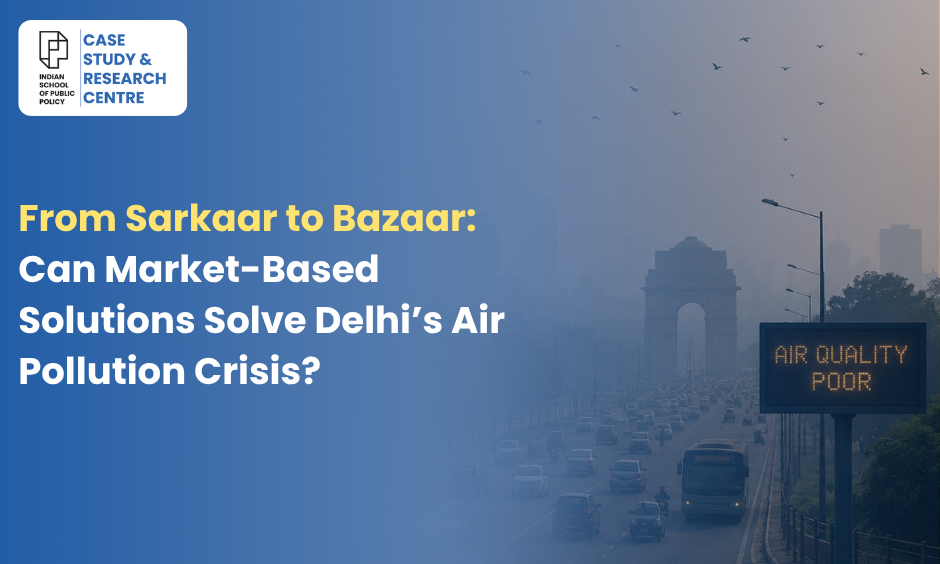

In Delhi, air pollution has been a major, documented problem since the 1990s. Delhi’s toxic air has become a full-blown public health emergency, with local emissions and the winter air trapping pollutants driving the worst Air Quality Index (AQI) levels in years. The winter spike in the AQI is caused by a variety of factors. Extremely high levels of local pollutants are continuously released into the atmosphere from multiple emission sources such as vehicles, industries, construction activities, and biomass burning. This is because Delhi and the entire NCR region experience rapid urbanisation, high energy demand, increasing construction, heavy traffic, solid fossil-fuel dependence, and inadequate waste management systems.
Why current measures fall short
Delhi has attempted to address its air pollution crisis through several fragmented measures. The Commission for Air Quality Management (CAQM) and Graded Response Action Plans (GRAP) are Delhi’s key air pollution control mechanisms, with CAQM being the authority that implements GRAP, a set of stage-wise emergency actions (Stages I-IV) based on AQI levels in the Delhi-NCR region, involving bans on construction, vehicles (trucks, private), and promoting public transport when pollution spikes, as seen with recent invocations and revocations of Stage IV actions in late 2025.
The Central Pollution Control Board, in collaboration with State Pollution Control Boards, the Delhi Pollution Control Committee, and other agencies, set up Continuous Ambient Air Quality Monitoring Stations. This initiative is a part of the National Clean Air Programme, aimed at monitoring real-time air quality in cities. Before this, the most significant measure was the Odd-Even Scheme. It was a temporary traffic rationing measure implemented by the government to curb severe pollution and traffic congestion.
Under this rule, private cars with odd-numbered license plates were allowed out on odd-numbered dates, and cars with even-numbered plates on even-numbered dates.
Typically, emergency vehicles, public transport, CNG-powered vehicles, and electric vehicles were exempt. However, the scheme faced several operational problems, and it became what policy scholars call a “signal policy”, demonstrating government action during a crisis rather than solving root causes.
Why carbon markets are not enough
Despite decades of government-led interventions, Delhi’s air pollution crisis persists with alarming intensity. Many of these approaches have struggled due to fragmented enforcement, weak monitoring capacity, inter-state coordination challenges, and the sheer scale of emission sources embedded within everyday economic activity. Currently, there is growing interest in complementing state action with more market-based mechanisms that use incentives to drive change.
There are relevant examples of market-based interventions. Carbon markets are trading systems where carbon credits are bought and sold to put a price on greenhouse gas emissions, typically encouraging companies to reduce their carbon footprint. India has had some experience with carbon markets previously; through the Clean Development Mechanism under the Kyoto Framework, where clean technology projects generated Certified Emission Reduction credits.
However, carbon markets have certain limitations. They remain focused on removing carbon emissions from the atmosphere, while air pollution can be attributed more to the presence of local pollutants like PM2.5 and PM10. For India’s air pollution scenario, carbon markets may only work as a partial strategy, because it is primarily a greenhouse gas removal mechanism.
Almost all the identifiable root causes for air pollution point towards local emissions of PM2.5 and PM10 being its major components. Therefore, tackling emissions seems to be more urgent in reducing air pollution than carbon and greenhouse gases. In light of this, a more workable solution is required– one that focuses more on the extraction and removal of local pollutants to lessen air pollution.
Surat’s particulate trading model
An alternative can be found in a particulate matter emissions market. This approach was pioneered in Surat, Gujarat. The Jameel Abdul Lateef Poverty Action Lab (J-PAL) conducted a study in Gujarat where the Gujarat Pollution Control Board (GPCB) collaborated with the research team and NCDEX e-Markets Limited (NeML) to introduce an Emissions Trading Scheme (ETS) in the industrial city of Surat, where the majority of polluting firms were part of the textile industry. Around 30% of these firms were polluting more than the national standard. The average level of fine particulate matter in the air near the plants was between ten and twenty times higher than the WHO’s recommended maximum concentration.
The Surat ETS pilot demonstrated that market-based mechanisms can effectively reduce industrial air pollution in India while maintaining economic efficiency. Introduced in partnership with the GPCB, the ETS targeted particulate matter emissions from highly polluting industrial plants, particularly textile industries in Surat.
Participating firms were equipped with Continuous Emissions Monitoring Systems (CEMS), which recorded real-time particulate emissions and transmitted the data directly to regulators. Under the scheme, firms were allocated emission permits, with each permit allowing the release of 1 kg of particulate matter during a 4–6 week compliance period. Initially, firms received permits covering around 80% of their historical emissions, while the government imposed an overall cap on total emissions in the market.
How is the ETS a novel approach?
The ETS differed significantly from India’s traditional command-and-control regulatory system. It created economic incentives for firms to reduce emissions wherever it was cheapest to do so. Smaller or more efficient firms could profit by selling unused permits, while firms facing higher abatement costs could temporarily buy permits instead of making expensive immediate upgrades.
Strict penalties for non-compliance ensured credibility and resulted in very high compliance rates among participating firms. The study found that firms under the ETS emitted 20–30% less particulate matter than firms regulated under the conventional system, without major increases in abatement costs.
Researchers concluded that the combination of real-time monitoring, enforceable emission caps, and permit trading made pollution reduction both flexible and cost-effective. The success of the pilot has since encouraged the Gujarat government to scale the ETS to additional industries and cities, highlighting its potential as a scalable industrial air pollution control mechanism in India.
Could an ETS work for Delhi?
Even though air pollution in Delhi is a recurring issue, there is a clear absence of a targeted policy. This can be attributed to reasons like lack of effective coordination, lack of strong political will, and a reliance on stop-gap, reactive measures rather than comprehensive, long-term policy. When moving towards market-oriented solutions, an ETS targeted specifically at PM2.5 and PM10 would likely be more effective in addressing Delhi’s air pollution because it directly regulates local pollutants. Since PM2.5 and PM10 are the pollutants most closely associated with hazardous air in Delhi, the ETS approach would create more immediate and measurable improvements in local air quality.