
Table of Contents


Breathing Risk: A Health-Centred Approach to India’s Air Pollution Crisis
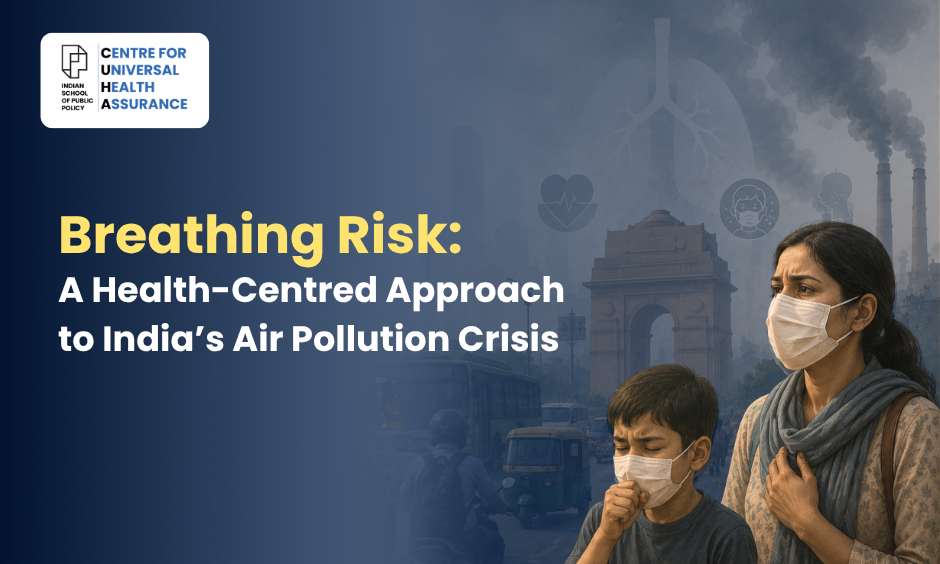

Air pollution in India is frequently viewed through an environmental or meteorological lens. It is often characterized by smog-filled winter skylines and hazardous Air Quality Index (AQI) readings. However, this perspective risks obscuring the most critical consequence: it’s devastating impact on human health. To effectively address this crisis, it must be reframed as a leading determinant of disease and a fundamental public health and governance challenge.
The Human and Economic Toll
The scale of the health burden is immense, with air pollution responsible for approximately 1.67 million deaths in India in 2019. It accounts for nearly 11.5% of total disability-adjusted life years (DALYs) lost nationwide, placing it on par with major risks like malnutrition and tobacco use.
Beyond well-known respiratory issues, long-term exposure to fine particulate matter (PM₂.₅) and nitrogen dioxide is linked to:
- Cardiovascular diseases, strokes and lung cancer
- Chronic conditions such as diabetes and cognitive decline
- Adverse birth outcomes
From an economic perspective, air pollution represents a classic example of a negative externality. The health costs generated by polluting activities are borne not only by polluters but by society at large. These costs are reflected in increased healthcare utilisation, reduced labour productivity, school absenteeism, lower cognitive performance and premature mortality. The economic consequences are substantial. Poor air quality reduces workforce participation and productivity, also increasing both public and private expenditure on healthcare. In a country seeking to harness its demographic dividend, environmental risks that undermine human capital should be viewed as a development challenge rather than only an environmental one.
The Equity Gap: Vulnerability and Social Justice
The impacts of air pollution are not distributed equally. Vulnerable populations including children, the elderly, outdoor workers and low-income households face the highest exposure. They also possess fewer resources to mitigate the associated risks. Consequently, air pollution functions as a driver of social inequality, reinforcing existing health and socioeconomic disparities.
A Governance Challenge
Despite increasing recognition of the problem, policy responses are still limited. Air quality management cuts across multiple sectors, including transport, energy, urban development, agriculture and health, yet governance structures often operate in silos. The National Clean Air Programme (NCAP) has brought the issue into the policy spotlight but there is a long way to go. Air quality targets are frequently measured through emissions and pollutant concentrations, whereas their implications on the health system receive comparatively less attention.
The Solution: A Health-Centred Framework
A more effective approach would position health at the centre of air quality governance. This would involve strengthening environmental health surveillance systems, incorporating health impact assessments (HIA) into policy design, improving inter-sectoral coordination, investing in cleaner energy and sustainable urban transport systems. For incorporating vulnerability assessment into policy response, it will be important to have human exposure measures rather than focusing only on identification of emission sources. Importantly, the success of air pollution policies should be evaluated not only by reductions in emissions but also by measurable improvements in population health and well-being.
Conclusion
As India navigates the dual challenges of economic growth and environmental sustainability, air pollution offers a critical reminder that development and health are deeply interconnected. Cleaner air is not simply an environmental objective. It is a prerequisite for healthier populations, more productive economies and more equitable societies. Recognising air pollution as a governance and public health challenge rather than solely an environmental issue is essential for building a healthier and more resilient future.
Read more in From Sarkaar to Bazaar: Can Market-Based Solutions Solve Delhi’s Air Pollution Crisis? which looks at market-based approaches to Delhi’s air pollution crisis.
FAQs
References:
GBD 2019 Risk Factors Collaborators. 2020. “Global Burden of 87 Risk Factors in 204 Countries and Territories, 1990–2019: A Systematic Analysis for the Global Burden of Disease Study 2019.” The Lancet 396 (10258): 1223–1249.
Guttikunda, Sarath K., Puja Jawahar, Edward Roden, Shivani Mandapaka, and Urvashi Nagpal. 2019. “National Clean Air Programme (NCAP) for Indian Cities: Review and Outlook of Clean Air Action Plans.” Atmospheric Environment: X 4: 100046.
Author
Somrwita Mondal
Somrwita Mondal works as a Coordination and Research Associate at the Centre for Universal Health Assurance at the Indian School of Public Policy. Her research interests include environmental health, health financing and universal health coverage, with a broader interest in evidence-informed policy research for equitable, efficient and resilient health systems.