
Table of Contents


Why Professional Regulation in India Fails
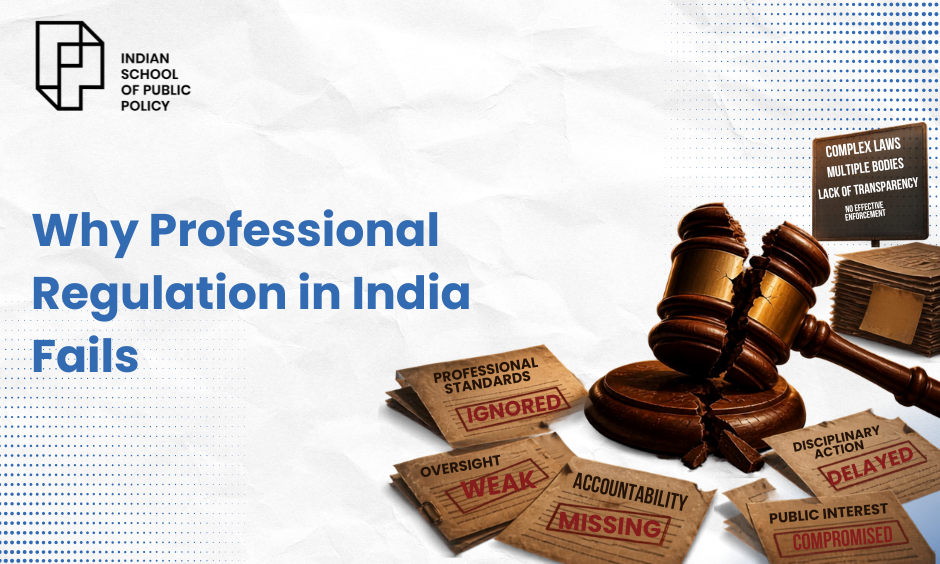

There is a question that sits quietly behind most debates on professional regulation in India, rarely voiced directly: when a user cannot assess the quality of a service, who should stand in their place, and on what institutional logic?
A few months back, I participated in an Indian School of Public Policy guest session on professional regulation in law, medicine, and accountancy, presented by Prashant Narang from the TrustBridge Rule of Law Foundation. The discussion clarified a tension I had been circling: Indian policy discourse on regulated professions often oscillates between two extremes, the state should control more, or the profession should govern itself. Both framings miss the prior question, which is structural rather than ideological.
Why professional services are different
Professional services possess three features that distinguish them from ordinary markets: the user cannot judge quality at the point of delivery; the consequences of failure are often severe and irreversible; and enforcement, even when rules exist, remains uneven and slow.
These are not incidental features; they are constitutive. They define the problem a regulatory system must solve. A patient cannot evaluate if a treatment was necessary; a litigant cannot judge the competence of their advocate; an investor cannot verify an auditor’s conclusions until a firm has already collapsed.
“The real policy challenge is not state versus self-regulation. It is designing institutions that can credibly balance access, expertise, accountability, and enforceability, under genuine resource constraints.”
This framing matters because it shifts our design focus. Standard reform in India often leans toward strengthening entry barriers, tightening licensing and raising thresholds. These are “Type I” interventions: they restrict supply in the name of quality. The more critical, and often ignored, problem is “Type II”: the failure to discipline those already inside. Rules are present; performance is not.
Involvement versus evolution: The Indian institutional trap
When mapping the three professions, identifying who controls the regulator, where power resides, and whether adjudicative and investigative functions remain bundled, a clear pattern emerged: India’s regulatory bodies often exhibit “institutional involvement without institutional evolution.”
Involvement means the profession is deeply embedded in its own regulation. The Bar Council is composed of lawyers; State Medical Councils are composed of doctors; the ICAI’s disciplinary apparatus is composed of accountants. This approach emphasizes epistemic legitimacy: the belief that only those with domain expertise can judge professional conduct. While there is merit to this, it creates a known structural pathology. When the body governing entry also governs discipline, and membership is drawn from the same professional class, capture becomes a feature of the design rather than a risk.
History bears this out. Parliamentary Standing Committee reports on the Medical Council of India (MCI) for years highlighted how concentrated authority without independent oversight led to systemic failure. This underscores three core systemic weaknesses:
- Incentive Misalignment: When the profession controls the regulator, incentives favor protecting the peer group over the public.
- Structural Bias: Bundling investigative and adjudicative functions prevents impartial oversight.
- Enforcement Gaps: The absence of transparency creates a culture where rules exist on paper but remain unenforceable in practice.
“Evolution,” by contrast, requires institutions to redesign their functions, not just their rules, to correct these failures. It means disaggregating regulatory functions: separating the investigative arm from the adjudicative body, introducing lay members with genuine decision-making authority, and publishing enforcement outcomes for public scrutiny. These are institutional design changes, not ideological ones. They do not require a choice between state control and professional autonomy; they require a choice of mechanism.
What the comparative analysis reveals
No system maximizes all outcomes simultaneously. The pre-reconstitution MCI was a case study in concentrated authority with diffuse accountability. The Bar Council system distributes power across state councils but lacks the infrastructure to make discipline credible. ICAI maintains robust entry examinations but suffers from a lack of functional separation in its disciplinary processes.
Critically, we found that design and performance often diverge. Two systems with formally identical rules can produce vastly different outcomes based on administrative capacity and the political economy of enforcement. India does not lack professional regulation; it lacks regulatory institutions whose design supports performance.
Furthermore, we must address the tension between enforcement and access. Strengthening disciplinary mechanisms should not be a zero-sum game that restricts supply in underserved areas. Genuine reform requires grounding these improvements in clear training capacity and geographic distribution strategies. Ultimately, we must remember that high-quality enforcement does not just protect the public; it creates market trust, which is the primary driver of demand for professional services.
A practical reform agenda
The policy implication is narrow: reforms that improve enforcement credibility are more valuable, at the margin, than reforms that tighten entry. We need:
- Transparency Metrics: Mandatory, real-time publication of complaint volumes, investigation timelines, and disciplinary outcomes.
- Functional Separation: Legally mandating the separation of investigation from adjudication within professional bodies.
- External Oversight: Introducing user-facing grievance mechanisms with clear time limits and external review rights.
None of this is radical; it is administrative. What makes it difficult is that it threatens the institutional comfort of the bodies tasked with implementing it. Effective reform requires either significant external pressure or internal coalitions willing to trade discretion for transparency.
Why this matters for teaching at a public policy school
The session format itself produced an unexpected benefit. By asking scholars to diagnose real regulators—finding the biggest risk in an actual institutional design and proposing one feasible, modest reform rather than a comprehensive overhaul, the discussion moved quickly past ideology toward precision.
Ambitious redesigns often fail; targeted repairs accumulate. The Indian professional regulation landscape is not short of problems; it is short of this kind of diagnostic precision. The ISPP session was a reminder that academic forums can produce exactly this, not through abstraction, but through structured comparative analysis grounded in institutional specifics. That is a model worth extending.
Disclaimer: The views expressed in this article are those of the scholar/guest speaker and do not necessarily represent the views of the Indian School of Public Policy (ISPP). ISPP assumes no responsibility for any errors, omissions, or opinions expressed in this blog.