
Table of Contents


Carbon Credits, Climate Costs, and the Price We Often Overlook

What if the price you pay for everyday goods is incomplete?
That was the central question explored during a guest lecture by Yash Kothari on carbon credits and carbon markets at ISPP. Consider something as routine as the price of steel. It accounts for labour, raw materials, energy, and manufacturing costs. But what about the environmental damage caused by the greenhouse gases released during production, or the health impacts experienced by nearby communities? These costs are real, yet they are rarely reflected in the price consumers pay.
Economists describe this as a market failure, a situation where the price of a product does not capture all the costs it creates for society. The lecture argued that climate change is not only an environmental challenge but also an economic one, because markets often fail to account for the hidden social costs of pollution.
“Climate change is not only an environmental problem, but it also reflects a failure to account for the true social costs of pollution.”
Pricing the invisible: how carbon markets work
One-way governments attempt to address this gap is through carbon markets. These markets create mechanisms through which greenhouse gas emissions reductions can be assigned an economic value, encouraging businesses to reduce emissions by making climate impacts part of economic decision-making.
At the centre of these markets are carbon credits. Under India’s Carbon Credit Trading Scheme (CCTS), a carbon credit certificate represents one tonne of carbon dioxide equivalent (tCO2e) of greenhouse gas emissions reduction or removal.
Countries are adopting different approaches to carbon markets depending on their climate goals, economic priorities, and industrial structures. India, too, has been developing its own carbon market through the Carbon Credit Trading Scheme, 2023 (CCTS), notified by the Government of India under the Energy Conservation Act.
The scheme is being developed as part of India’s broader Indian Carbon Market, with the Bureau of Energy Efficiency (BEE) playing a central role in its implementation. The framework includes a compliance mechanism for obligated entities and an offset mechanism for eligible projects outside the compliance system.
Rather than simply placing a fixed price on every tonne of emissions, the compliance mechanism initially focuses on greenhouse gas emissions intensity, the amount of greenhouse gases released for a given unit of production. In simple terms, industries are encouraged to produce more efficiently while reducing the emissions generated for each unit they produce.
Returning to the earlier example of steel, a factory that adopts cleaner technology and reduces the emissions intensity of its production could be rewarded through the carbon market, provided it meets the applicable requirements. This illustrates how carbon markets aim to create an economic incentive for cleaner production while encouraging industries to become more efficient.
Do carbon markets actually deliver?
This is where the lecture moved beyond the basic idea of carbon markets and examined the conditions needed for them to work effectively. Simply creating a market for carbon credits is not enough, its credibility depends on how accurately emissions reductions are measured, verified, and reported.
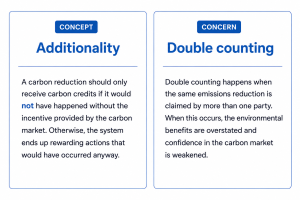
Two concepts discussed during the lecture were additionality and double counting. If an emissions reduction would have happened even without the incentive of a carbon market, awarding carbon credits does not create any real environmental benefit. Likewise, if the same reduction is claimed by more than one party, the system overstates its climate impact and loses credibility.
These challenges highlight an important point: carbon markets are not just economic mechanisms. Their success depends on strong regulation, transparent monitoring, and public confidence that the system is fair and accountable.
Challenges in Practice
The lecture also highlighted that reducing emissions is becoming increasingly complex as new industries and technologies continue to expand.
One example discussed was the growing electricity demand associated with AI-enabled data centres and other digital infrastructure, which has renewed debates about how economies can balance technological progress with climate goals.
This makes an important policy question even more relevant: Can carbon markets encourage meaningful emissions reductions, or should they be viewed as one part of a broader climate strategy?
Rather than presenting carbon credits as a complete solution, the lecture emphasised that they work best when combined with clear regulations, reliable monitoring, and sustained efforts to reduce emissions at their source.
What made the lecture particularly valuable was its balanced perspective. Instead of presenting carbon credits as either the answer or the problem, it showed that their effectiveness ultimately depends on policy design, implementation, and institutional credibility.
As India develops its Carbon Credit Trading Scheme, ensuring transparency and environmental integrity will be just as important as creating the market itself.
“Carbon markets are an imperfect but important attempt to assign a cost to pollution.”