


Table of Contents


A System That Works: Or One That Makes People Work?
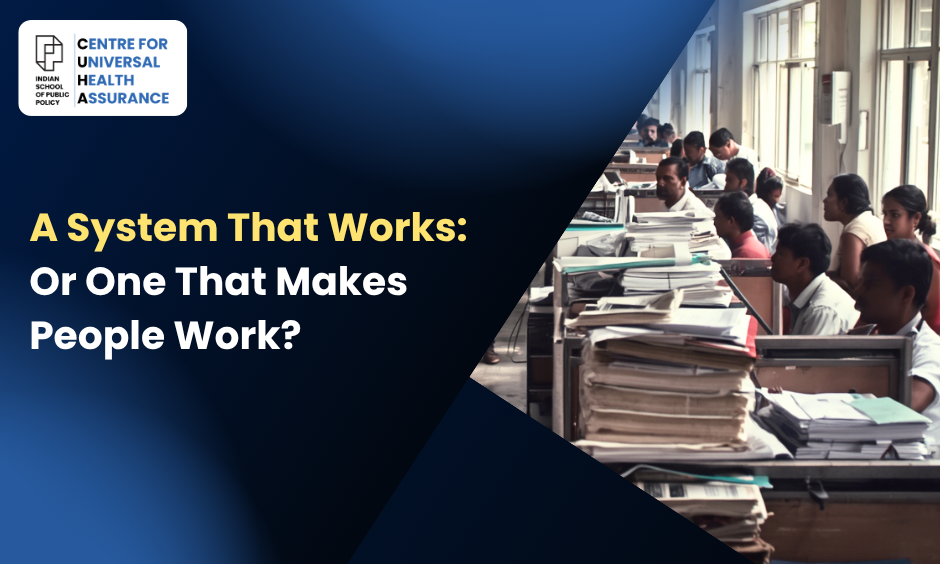

Public Service Delivery in India: Are Systems Working for Citizens?
India measures public service delivery by outputs: hospitals built, schemes launched, beneficiaries enrolled. But citizens judge the state by their daily experience, not outputs. Yet for citizens, the state is not endured through outputs; it is experienced through processes.
The wait at a clinic, the clarity of instructions, and the certainty of receiving care define healthcare service delivery far more than policy intent. However, another reality is progressively becoming apparent. In many systems, the burden of making services function has quietly shifted from the state to the citizen.
Navigating protocols, managing documentation, and bridging gaps between providers have all become implicit requirements. The question, then, is not only whether systems deliver, but also who is doing the work to make them deliver.
The Shifting Burden
For decades, reforms in India’s public healthcare system have focused on expanding access. The logic was straightforward: more infrastructure, more personnel, wider coverage.
While indispensable, this approach has revealed its limits. Access does not guarantee usability, and availability does not ensure health outcomes.
What matters is system performance, how reliably, predictably, and coherently services function in practice.
This disparity between provision and experience in public healthcare is not abstract; it is visible in everyday system design. Consider outpatient departments in public facilities, where patients often navigate multiple, poorly sequenced steps: registration, consultation, diagnostics, and pharmacy.
In many cases, the absence of a clear patient flow leads to repeated queuing and delays, even when resources are available. The issue is not always scarcity; it is often a failure of coordination.
Similar patterns appear at the system level. Fragmentation across programmes such as maternal health, immunisation, and chronic care, often results in parallel processes that do not speak to each other.
A patient’s interaction with the health system becomes episodic rather than continuous, requiring them to restart processes at each touchpoint. Instead of absorbing complexity, public service delivery systems frequently transfer it outward, requiring citizens to navigate, reconcile, and persist through processes that should function seamlessly.
These inefficiencies are not incidental; they are design outcomes.
What Works: Lessons from Practice
Where health systems have attempted to address these gaps, the gains are instructive.
In states like Tamil Nadu, Central Medical Services Society (CMSS)’s streamlined drug procurement and supply chain management have significantly reduced stock-outs, ensuring that patients receive medicines at the point of care.
Correspondingly, models such as Kerala’s strengthened primary healthcare network have improved continuity by positioning local facilities as the first and consistent point of contact.
These healthcare reforms in India do not rely solely on expanding infrastructure; they focus on making existing systems function predictably and efficiently.
Globally, the lesson is similar. Brazil’s Family Health Strategy, built around community-based teams responsible for defined populations, has improved both coverage and health outcomes by embedding continuity and accountability into service delivery.
In the United Kingdom, the National Health Service’s emphasis on general practitioners as gatekeepers has reduced unnecessary hospital burden while maintaining coordinated care pathways.
These models differ in context but converge on a shared principle: health systems perform better when they are organised around the user, not the institution.
From Expansion to Integration
Improving healthcare service delivery in India requires a shift from expansion to integration. Integration is not merely about connecting facilities; it is about aligning workflows, incentives, and information across levels of care.
India’s efforts under the Ayushman Bharat scheme to strengthen Health and Wellness Centres (HWCs) reflect this intent, moving from episodic care to comprehensive primary healthcare. However, the challenge lies in ensuring that these centres are not just additional nodes, but function as coordinated entry points into the health system.
Financial design reinforces this challenge. High out-of-pocket healthcare expenditure in India continues to shape access, particularly for vulnerable populations.
While insurance-based models have expanded financial protection, their effectiveness depends on how seamlessly they integrate with service delivery. When empanelment, claims processing, and referral systems are fragmented, financial coverage does not translate into actual access. Here again, the issue is not policy intent, but implementation coherence.
At its core, public service delivery reform is not only about what is delivered, but how systems are organised to deliver it.
This brings governance to the centre. Effective healthcare governance in India relies on clear accountability, standardised protocols, and real-time monitoring.
States that have invested in simple but robust management practices, such as facility-level dashboards, patient feedback systems, and decentralised decision-making, have shown improvements in both service delivery efficiency and user satisfaction. The common thread is not technological sophistication, but institutional clarity and responsiveness.
A user-centric approach sharpens this further. Mapping the patient journey often reveals bottlenecks that remain invisible in administrative design: unnecessary steps, unclear communication, and poorly sequenced processes.
In response, even modest interventions, such as single-window registration, defined patient pathways, or task-shifting among staff have demonstrated measurable reductions in waiting time and congestion in public healthcare facilities.
Reconfiguration, Not Accumulation
What these examples collectively show is that healthcare service delivery improves not through accumulation, but through reconfiguration. The tendency in public policy has often been to add new schemes, layers, and processes. But effective systems are those that subtract removing redundancies, clarifying pathways, and ensuring that services are predictable and consistent.
In such systems, complexity is managed internally rather than externalised onto citizens.
The Core Question
This distinction is critical. A system built for scale may reach many people, but a system built for people ensures that what it reaches actually works.
Ultimately, service delivery is not defined by the presence of services, but by the effort required to use them. When systems function well, this effort is minimal and often invisible. When they do not, it is the citizen who compensates.
And this brings us back to the central question: If citizens must work to make systems function, can we really say the system is working?