


Table of Contents


Forgone Care: The Missing Metric in India’s Health System

India’s healthcare discourse has, for good reason, focused on expanding insurance coverage, improving service availability and strengthening health outcomes. One critical dimension remains underexamined: forgone care. Forgone care refers to situations in which individuals who need healthcare delay, avoid or do not seek it at all. This gap between health need and healthcare utilisation is not merely a matter of missed access. Delayed treatment can worsen illness, increase the complexity of care required and ultimately raise out-of-pocket expenditure (OOPE) once care is finally sought. As such, forgone care is a direct indicator of exclusion within a health system.
In the Indian context, this gap is particularly important. Progress towards Universal Health Coverage (UHC) has been uneven, coexisting with persistent inequalities in access. Institutional deliveries have increased and financial protection mechanisms such as Ayushman Bharat have expanded coverage for hospitalisation. However, many vulnerable populations still do not receive essential care due to a mix of financial constraints, geographic barriers and social factors. If UHC is to move beyond formal coverage towards meaningful access, forgone care needs to be taken seriously.
Why Forgone Care Matters?
Forgone care has consequences that extend well beyond immediate access. When care is delayed or avoided, illnesses often become more severe, increasing the complexity and cost of treatment at a later stage. What begins as missed preventive care or primary care can easily escalate into an emergency or catastrophic health need.
The economic implications are equally significant. Delayed or interrupted treatment can reduce productivity, increase lost workdays and weaken labour force participation. Individuals living with chronic conditions such as diabetes or hypertension, missed follow-ups and irregular treatment can accelerate complications and increase long-term care needs, deepening household financial vulnerability.
At the system level, forgone care can also undermine efficiency. Conditions that could have been managed early through primary care often require more expensive secondary or tertiary interventions when treatment is delayed. This increases avoidable healthcare expenditure and places greater strain on already overstretched public health infrastructure. In this sense, forgone care is not only a question of equity, but also of economic and health system efficiency.
Available evidence also points to clear inequalities. Forgone care is more common among low and middle income households; women; rural populations; and socially marginalised communities. NFHS-5, for instance, shows improvements in utilisation, but important gaps remain: only about 58% of pregnant women have received four or more antenatal visits and rural populations continue to lag in accessing complete maternal care. Similarly, a significant proportion of children with common illnesses are not taken for timely treatment.
These are not isolated service delivery issues. They point towards unmet need, care that should have happened but did not. Without capturing this dimension, improvements in coverage risk overstating actual progress.
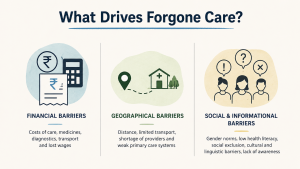
What Drives Forgone Care?
The reasons behind forgone care are layered and often reinforce one another.
- Financial Barriers: Out-of-pocket expenditure continues to shape decisions about whether to seek care. Even when services are nominally available, the combined costs of consultation, medicines, diagnostics, transport and lost wages can be prohibitive. For households in informal employment, seeking care often involves immediate trade-offs, which leads to postponement or avoidance. Insurance schemes have expanded protection for hospitalisation, outpatient care, but chronic disease management is still a significant financial burden.
- Geography: In many rural and remote areas, distance to facilities, limited transport and shortages of providers make access difficult. These challenges are especially pronounced for conditions that require repeated visits or continuity of care. Over time, weak or unreliable primary care systems can also reduce trust of people. As a result, people will be less likely to seek care even when it is needed.
- Social and informational Barriers: Health-seeking behaviour is shaped by gender norms, education, health literacy and social exclusion. Women may delay care due to limited autonomy; tribal and marginalised communities may face linguistic or cultural barriers. In some cases, lack of awareness about entitlements suppresses demand altogether. These factors, in tandem with poverty and geography, deepen exclusion.
The Blind Spot in UHC Measurement
Current UHC monitoring frameworks tend to focus on two main indicators: service coverage and financial protection. While both are essential, they do not fully capture whether people who need care are actually receiving it. This is where forgone care becomes important. Service coverage can indicate that interventions are available and financial protection can reflect reduced catastrophic spending. But neither tells us whether individuals are avoiding care altogether.
This creates a subtle but important policy challenge. Lower out-of-pocket expenditure is often interpreted as a positive sign. However, if households are spending less because they are not seeking care in the first place, this may indicate suppressed demand rather than genuine financial protection. In such cases, improved indicators can mask underlying exclusion. Recognising forgone care as a third dimension alongside coverage and financial protection offers a more complete picture of health system performance.
Moving Forward
Addressing forgone care requires both better measurement and more responsive policy design.
- Unmet needs must be measured more systematically. Integrating questions on forgone care into national surveys and routine monitoring systems would make this dimension visible. What remains unmeasured rarely becomes a policy priority.
- Strengthening primary healthcare is essential. Ayushman Arogya Mandirs (AAMs) under Ayushman Bharat provide a promising platform, but their effectiveness depends on reliable staffing, availability of medicines and better referral systems. Experiences from countries such as Thailand and Brazil suggest that strong primary care networks, combined with proactive outreach, can significantly reduce exclusion.
- Financial and social barriers need to be addressed. Expanding insurance alone is not enough. Transport support, access to affordable medicines, telemedicine solutions and targeted outreach for vulnerable groups can help reduce practical barriers. At the same time, broader investments in women’s empowerment, health literacy and social inclusion remain critical for improving care-seeking behaviour.
Conclusion
Forgone care remains one of the least visible yet most consequential challenges in India’s health system. It highlights where service availability does not translate into real access and where financial protection remains incomplete. More importantly, it reveals who continues to be left behind.
If Universal Health Coverage is to be meaningful, it must ensure not just that services exist, but that people are able and willing to use them when needed. Bringing forgone care into the centre of policy discussions would improve how progress is measured and help redirect attention towards those who remain excluded. In essence, reducing forgone care is not a peripheral concern; it is central to achieving equitable healthcare.
To know more about forgone care, explore chapter 8 of Road to Viksit Bharat: From Achieving Universal Health Coverage to Attaining Universal Health Assurance
FAQs
Sources:
Author
Somrwita Mondal
Somrwita Mondal works as a Coordination and Research Associate at the Centre for Universal Health Assurance at the Indian School of Public Policy. Her research interests include environmental health, health financing and universal health coverage, with a broader interest in evidence-informed policy research for equitable, efficient and resilient health systems.