


Table of Contents


India’s Railways: And Miles to go!

By ISPP Research Team
Introduction
India’s railway network, one of the large five networks in the world, by route length has witnessed considerable transformation over the past decade. By 2032 India will complete 200 years of the conception of railways which started during the British rule largely to carry raw materials for trade. Considerable expansion and repair of existing tracks, geographical reach were achieved before Independence, but post-independence developments are more about high-speed trains, intensified electrification, connecting remote and mountainous regions and engineering marvels.
Railways are often considered a typical example of a natural monopoly because of heavy investments of laying track and building networks, as well as high costs of buying or leasing trains. These factors would often deter the entry of a competitor. Moreover, to society, the costs associated with building and running a rival network would be wasteful expenditure. If the same were privately owned the monopolist would try to maximize profits, rather make super-normal profits. Therefore ownership and regulation by the state is a natural choice.
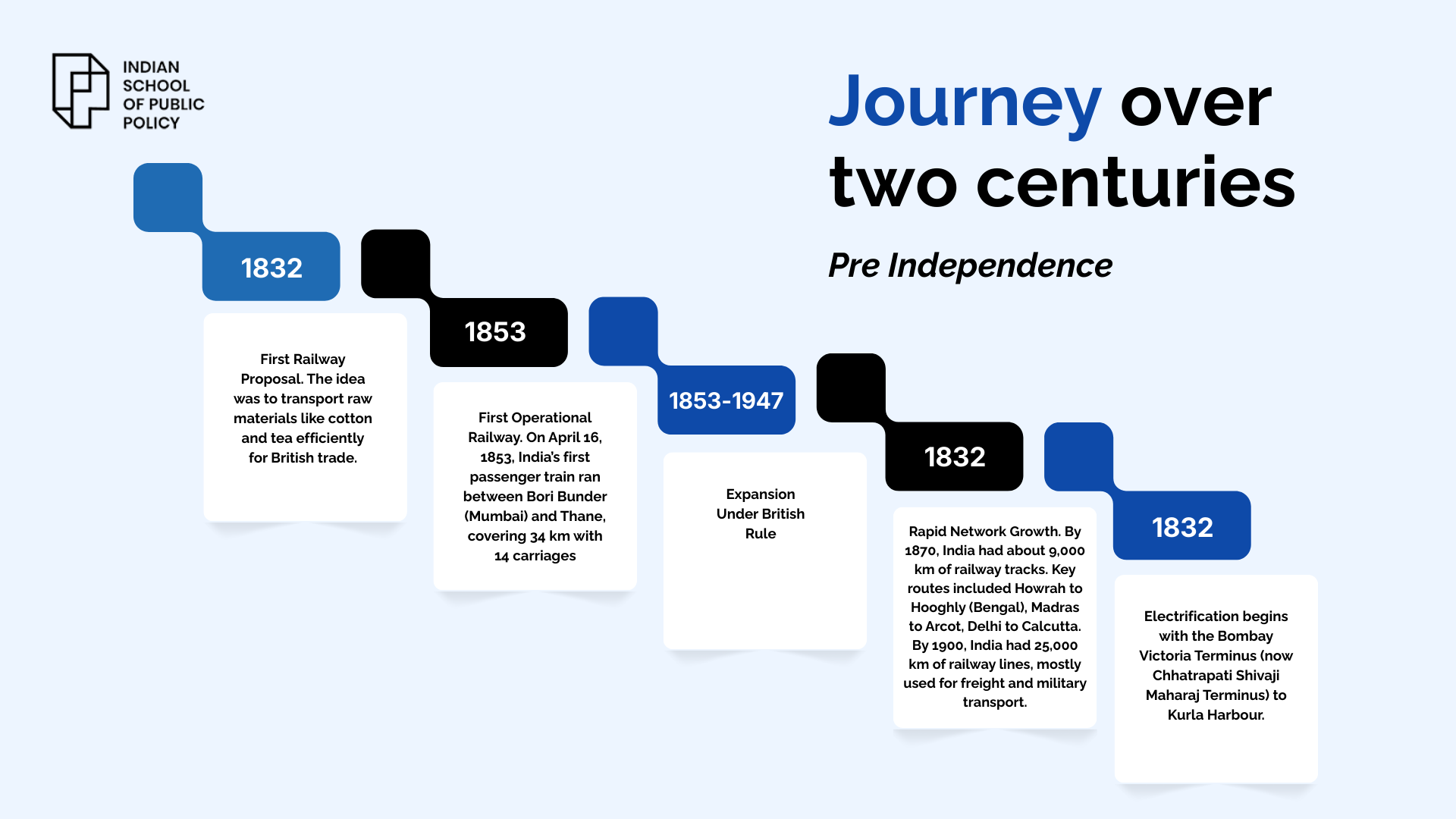
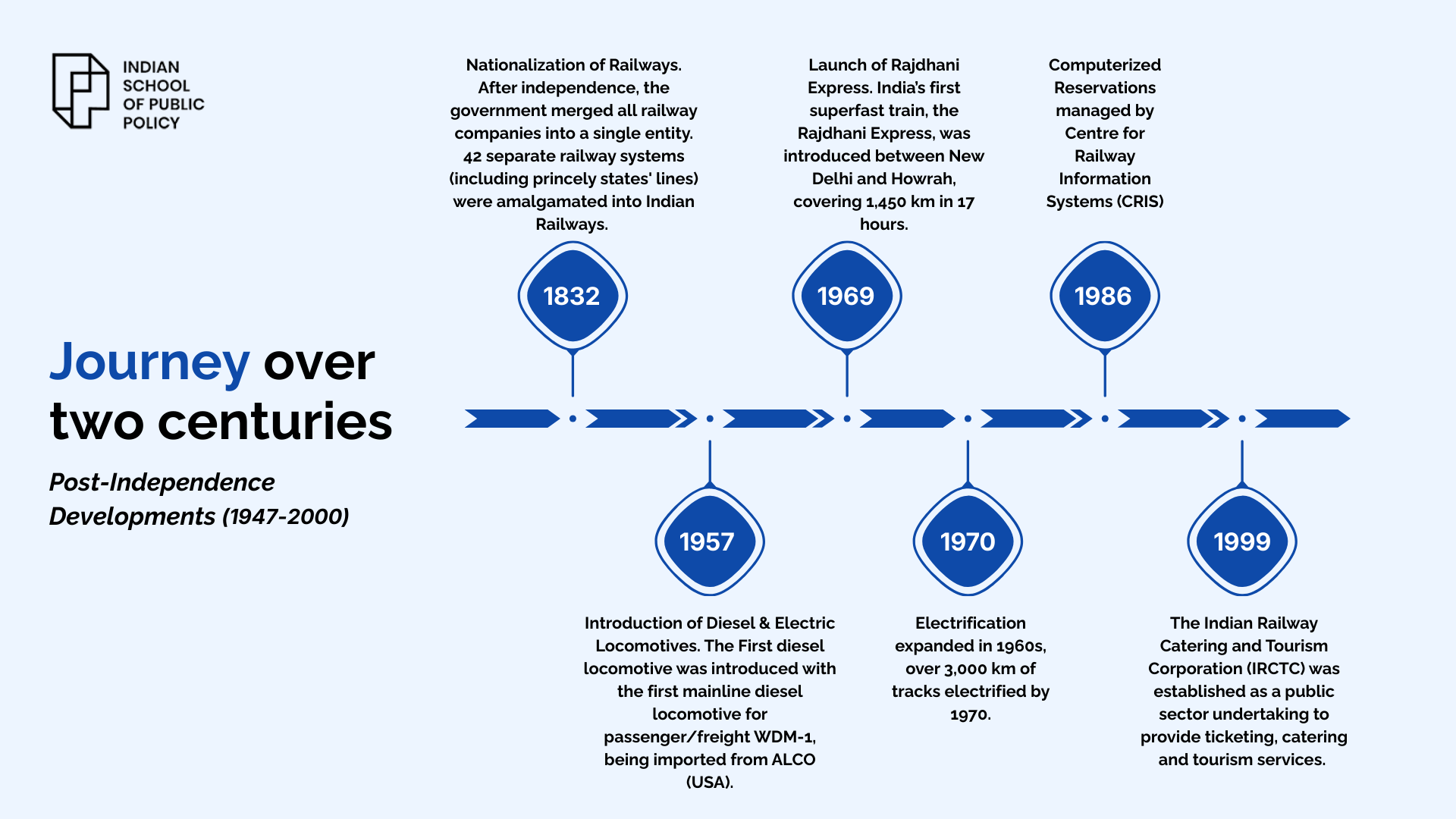
Several countries operate their railway networks under state ownership, managing both the rail infrastructure and operations to ensure public service. These include China, India, Russia, Germany, France, and Italy. Operations are largely carried on through national companies. In India Nationalization of Railways took place in 1951 whereby the government merged all railway companies into a single entity. In the process 42 separate railway systems (including princely states’ lines) were amalgamated into Indian Railways. Since then the Indian railways has expanded by length and breadth and several milestones were achieved such as enhanced electrification, connecting mountainous regions, tough all weather railway bridges and modern railway stations. And the process continues. India is all set to roll its first bullet train, part of the 508-km Mumbai-Ahmedabad High-Speed Rail (MAHSR) project in 2027.
Modernisation of Railways
As part of the modernisation process the Indian Railways has prepared a National Rail Plan (NRP) for India – 2030 to create a ‘future ready’ railways system by 2030. The plan is aimed to formulate strategies based on both operational capacities and commercial policy initiatives to increase modal share of the Railways in freight to 45% from current 27-29% and create capacity that will be able to meet demand upto 20501. To achieve this objective all possible financial models including Public Private Partnership (PPP) are being considered.
As part of the NRP, Vision 2024 was launched for accelerated implementation of certain critical projects by 2024 such as 100% electrification, multi-tracking of congested routes, upgradation of speed to 130 kmph on all Golden Quadrilateral-Golden Diagonal (GQ/GD) routes and elimination of all Level Crossings on all GQ/GD route2.
Identification of new Dedicated Freight Corridors and new High Speed Rail Corridors are other focus areas under NRP. Also, in focus are sustained involvement of the private sector in areas such as operations and ownership of rolling stock, development of freight and passenger terminals, development/operations of track infrastructure etc.
A review of the modernization process in the last decade reflects considerable progress. Since 2014, Indian Railways has laid 31,000 km of new tracks and renewed more than 45,000 km tracks, averaging 14 km of track laid daily in 2022-233. Electrification of broad-gauge tracks has increased from 21,801 km before 2014 to 45,922 km by 2025, surpassing the total electrification achieved in the six decades following India’s independence. This initiative aligns with reducing carbon emissions and achieving net-zero goals4.
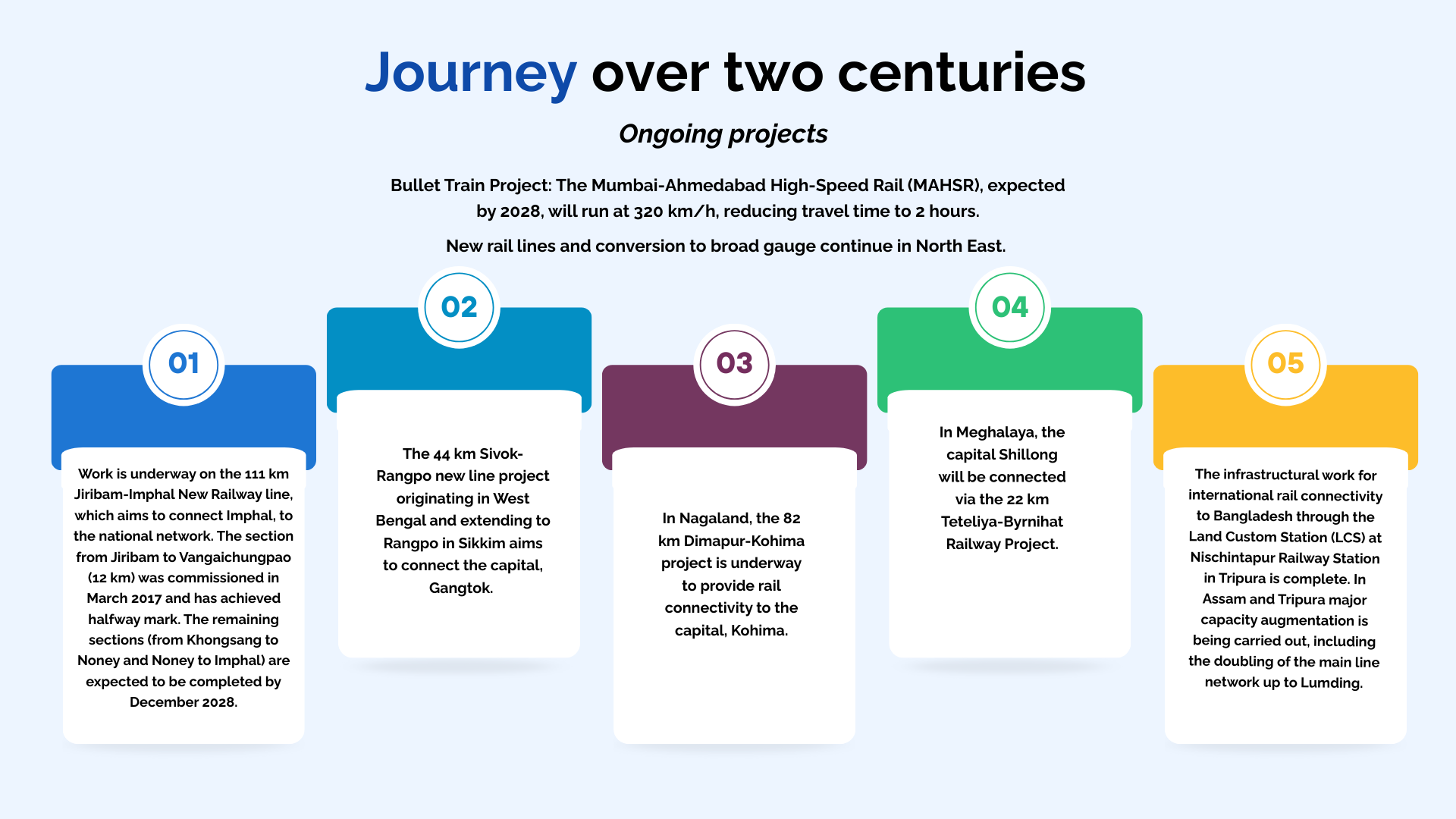
The introduction of trains such as the Vande Bharat Express—now with over 130 trains operational—along with other superfast trains has improved passenger travel and travel experience. Besides, production of safer Linke-Hofmann-Busch (LHB) coaches has increased from 2,209 units from 2006-14 to 31,956 from 2014-235.
The Amrit Bharat Station Scheme launched in 2022 is upgrading over 1,300 stations with world-class facilities, enhancing passenger experience and accessibility. Thus rail travel is on the path to becoming more inclusive.
The Dedicated Freight Corridors (DFCs) that streamline cargo movement, reduce logistics costs, and enhance supply chain efficiency include Eastern Dedicated Freight Corridor (EDFC) from Ludhiana to Sonnagar (1337 Km) and the Western Dedicated Freight Corridor (WDFC) from Jawaharlal Nehru Port Terminal (JNPT) to Dadri (1506 Km). According to Government reports out of total 2843 Km, 2741 Route Kilometers (96.4%) has been commissioned and operational6.
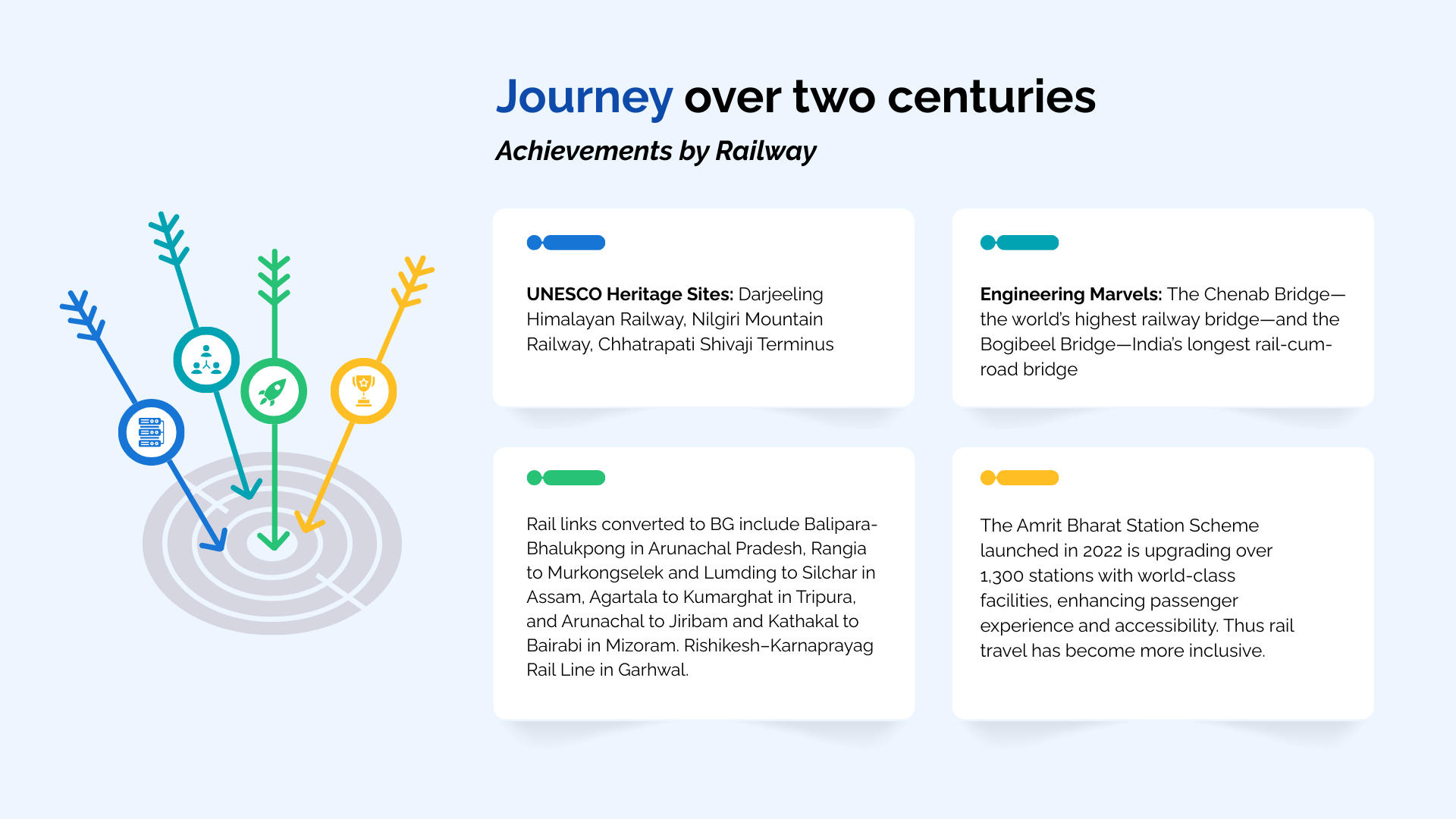
The Chenab Bridge in Jammu and Kashmir—the world’s highest railway bridge commissioned in 2025—and the Bogibeel Bridge in Assam—India’s longest rail-cum-road bridge commissioned in 2018—underscore India’s engineering excellence while improving connectivity in challenging terrains. Besides, the PM Gati Shakti National Master Plan, optimises rail infrastructure projects by integrating multimodal connectivity and expediting clearances. The Indian railways are also being consulted by countries in Africa and South East Asia for development projects7.
Expansion of Railways in the North Eastern Region
The expansion of Indian Railways in the North Eastern Region (NER) of India over the past decade has been driven largely by Government’s renewed focus on infrastructure development, although to connect the region through railway network has for long been in discussion within relevant ministries given the region’s strategic importance. Recent years have been those of intensified capital investment, the completion of gauge conversion projects, and a mission-mode approach towards connecting the state capitals in the region.
Over the past decade, long-pending projects have moved from blueprint to opening of new stations and connecting the North East capitals to the national network. With projects worth Rs 77,000 crore the region is witnessing a large wave of investment. In Mizoram, Nagaland and Manipur delayed projects are linking state capitals to the national grid8. In Tripura, railway line the has reached the borders, Meghalaya witnessed its first railway station, while Arunachal Pradesh, Sikkim, and Assam are witnessing new lines, electrification, and doubling works9.
Historically, the North-East held only approximately 4% of India’s railway network. While the Ministry of Railways had been consistently increasing its spending in the region other Central Ministries/Departments are mandated to spend at least 10% of their Gross Budgetary Support (GBS) to Central Sector and Centrally Sponsored Schemes for the North Eastern Region (NER) for the region’s overall growth.
The Railways GBS in 2023-24 for New Line Projects in North Eastern and Northeast Frontier Railways crossed 23%10. Providing rail connectivity to this region, which is strategically located and shares international borders with China, Myanmar, Bhutan, and Nepal, have economic, strategic and military benefits and has been accorded priority by the Government.
Since 2014, there has been an intensive focus on the upgradation and modernization of transportation and logistics infrastructure in the North-East. This focus is reflected in the significant financial outlays. Between 2014-20 Rs 27,655 crore of capital investment was made by Indian Railways in projects in the North East which is 160% more than the capital investment of Rs 10,610 made during 2009-1411.
The Rail-Vision for the region focuses on transforming the region from a geographically isolated area into a central hub for trade, commerce, and tourism. Its objectives include connectivity to all state capitals, establishing a Uni Gauge (broad gauge) network, strengthening international borders, and augmenting the network capacity to meet future traffic growth.
Under the Government’s Act East Policy and National Rail Plan (NRP) 2030, the aim is also to create transnational links through the North East.
Key achievements include early step in modernizing the network by converting existing lines to Broad Gauge (BG) to ensure a uniform network throughout the region12. Rail links converted to BG include Balipara-Bhalukpong in Arunachal Pradesh, Rangia to Murkongselek and Lumding to Silchar in Assam, Agartala to Kumarghat in Tripura, and Arunachal to Jiribam and Kathakal to Bairabi in Mizoram. Currently, the capitals of Tripura, Assam, and Arunachal Pradesh have already been connected with rail networks13.
The primary focus in recent years has shifted to providing rail links to the remaining state capitals. Five major rail projects have been identified for this purpose.
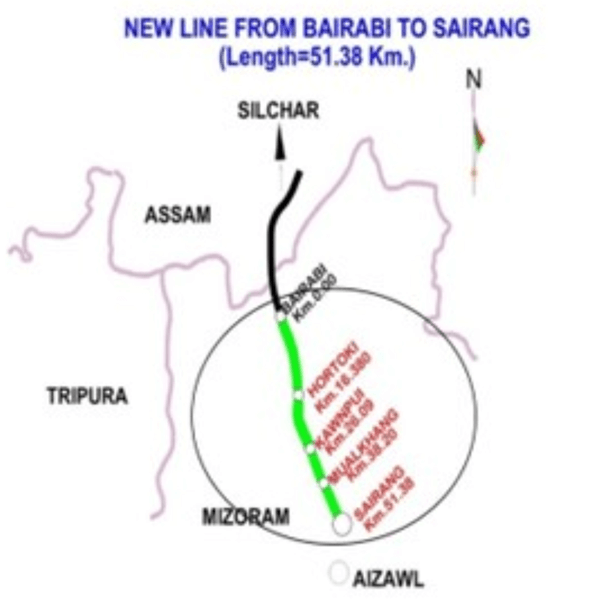
Image Source: Indian Railway
1. Mizoram: Bairabi-Sairang Project
One of the most significant recent milestones is the commissioning of the Bairabi-Sairang Railway line, a 51.38 km engineering marvel connecting Aizawl, Mizoram’s capital, to the national network for the first time. The extension work beyond Bairabi started in 201414. This project, initially expected to be completed by 2023, culminated in 2025. The route includes 55 major bridges and 45 tunnels, navigating geographically challenging terrain.
The completion of this project has already had a measurable impact on trade and economy. Following the inauguration, the first cargo consignment arrived at Sairang station, carrying commodities like cement, stone, sand, and automobiles. The safe, swift, and cost-effective movement of goods is reducing commodity costs and increasing availability in local markets. Furthermore, indigenous products are reaching new markets; the first parcel consignment, consisting of Anthurium flowers, was booked from Aizawl to New Delhi on September 19, 202515.
2. Manipur: Jiribam-Imphal Railway Project
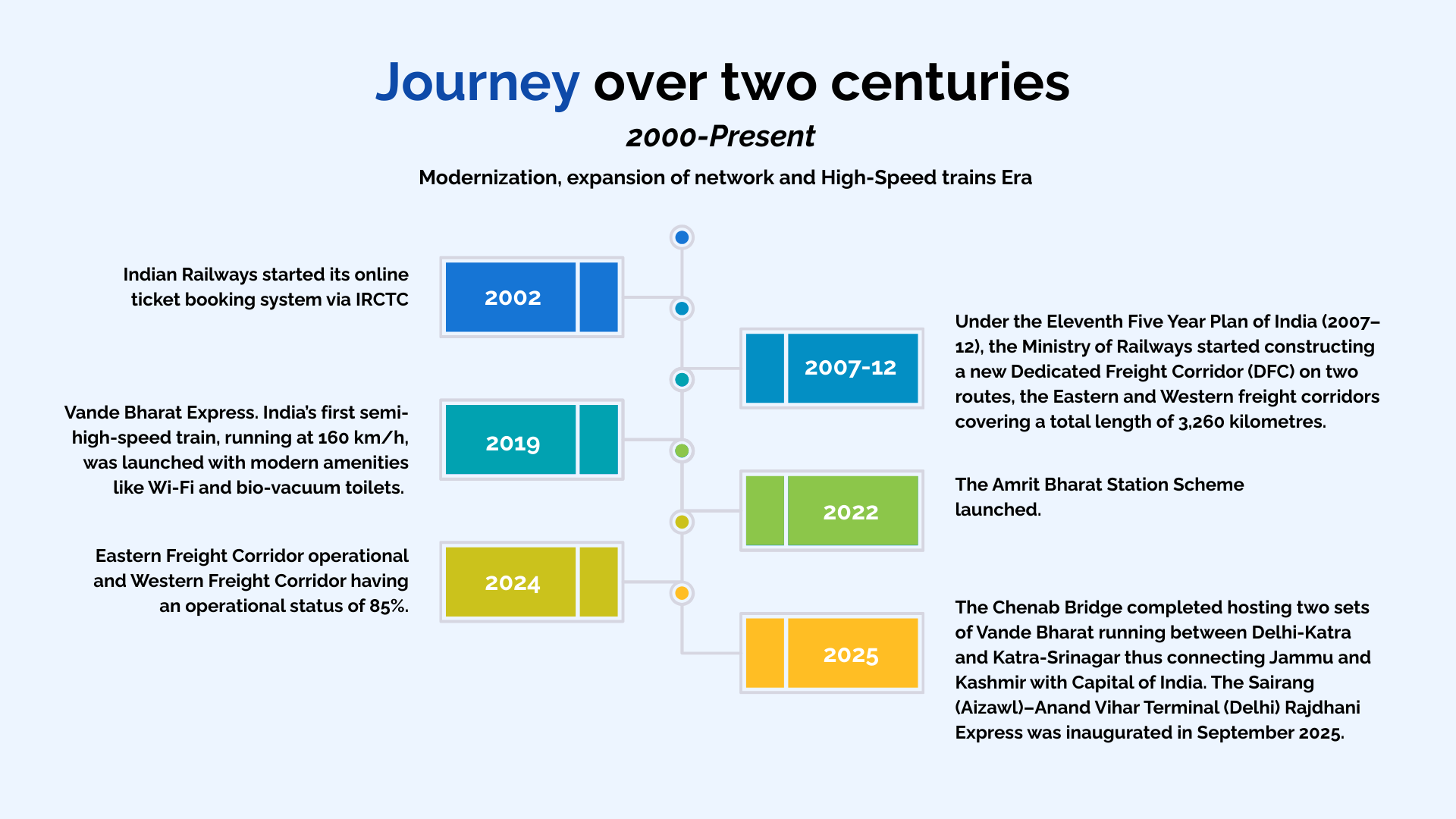
Work is underway on the 111 km Jiribam-Imphal New Railway line, which aims to connect Imphal to the national network. The section from Jiribam to Vangaichungpao (12 km) was commissioned in March 201716. Currently, over half the length has been commissioned. The railway line has served as a crucial lifeline during recent civil protests in Manipur, facilitating the transport of essential commodities. The remaining sections (from Khongsang to Noney and Noney to Imphal) are expected to be completed by December 202817.
3. Sikkim: Sivok-Rangpo Railway Project
The 44 km Sivok-Rangpo new line project originating in West Bengal and extending to Rangpo in Sikkim aims to connect the capital, Gangtok. This challenging project involves 86 percent of the length consisting exclusively of tunnels and bridges18. While initially expected to be completed by 2023, it is now expected to be completed by the end of 2027. A survey for further extension of the line from Rangpo to Gangtok is also in progress19.
4. Nagaland and Meghalaya Projects
In Nagaland, the 82 km Dimapur-Kohima project is underway to provide rail connectivity to the capital, Kohima. In Meghalaya, the capital Shillong will be connected via the 22 km Teteliya-Byrnihat Railway Project, though the Target Date of Completion (TDC) for this project is not yet fixed20.
Augmentation and Future International Links
In Assam and Tripura, where the railway network is already extensive, major capacity augmentation is being carried out, including the doubling of the main line network up to Lumding, with plans to extend soon to Furkating and Dibrugarh21.
The expansion efforts are designed not just for domestic connectivity but also to enhance linkages with neighboring countries and support the role of the North-East as the gateway to Southeast Asia.
Future plans include:
- Sairang – Hbichhuah: A survey is underway for the proposed 223 km extension from Sairang to the southernmost border of Mizoram, which holds the potential to enable direct trade with Myanmar via the Sittwe port22.
- Imphal – Moreh: A survey has been sanctioned for a new line from Imphal to Moreh, which will extend connectivity to the Myanmar border23.
- Tripura – Bangladesh: The infrastructural work for international rail connectivity to Bangladesh through the Land Custom Station (LCS) at Nischintapur Railway Station in Tripura has been completed 24. Although currently on hold due to political instability in Bangladesh, this line, which extends to Sabroom, is expected to provide a major boost for trade with Bangladesh and Southeast Asian countries via the port of Chattogram (Chittagong).
Economic Impact
The railway connectivity projects undertaken in the past decade hold the potential to transform the economic environment in the North East. The success of projects like the Bairabi-Sairang line demonstrates the shift toward rapid movement of goods, which is vital for the region’s agricultural, horticultural, and mineral-rich economy. This transformative change is expected to provide the framework for increased trade and commerce by 2030.
However, the infrastructural framework alone is insufficient; there is an urgent need for supporting trade facilitation arrangements, including credit organizations, aggregators (like Farmer-Producer Organisations), multi-modal logistics parks, and export agencies to maximize the multiplier effect of this railway expansion. The completion of these major projects through a mission mode approach, as previously agreed upon by stakeholders, is expected to unleash the enormous development potential of the region.
The overall expansion effort is like constructing new, high-capacity arteries into a historically isolated region, moving beyond basic access to establish the robust circulatory system necessary for economic growth.
Integrating Kashmir railway through rail link
For decades Kashmir valley remained isolated from the rest of India in terms of railway link. Mountainous regions, extreme climatic conditions, seismic zone and to some extent cross border terrorism were some deterrents which kept policy making in this regard on low priority. Although the policy makers had this on their drawing boards for long.
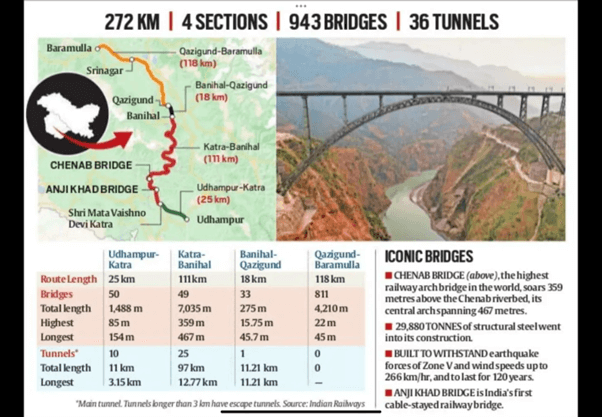
The Udhampur-Srinagar-Baramulla Rail Link (USBRL) is India’s most ambitious mountain railway project, spanning 272 km from Udhampur in Jammu to Baramulla in Kashmir Valley at a total cost of ₹43,780 crore ($5 billion), and fully operational25. Sanctioned in 1994-1997 with an initial estimate of ₹2,500 crore (built at a cost of approx. Rs 44,000 crore) and declared a National Project, the construction spanned nearly 28-30 years due to extreme Himalayan challenges including seismic zones V-VIII, young geology, high water ingress, landslides, and sub-zero temperatures.
The project comprises 36 tunnels totaling 119 km (44% of route), 943 bridges covering 31 km (13% of alignment), and remaining conventional tracks through Shivalik Hills and Pir Panjal range, achieving 100% electrification for sustainable, all-weather connectivity26. It reduces Katra-Srinagar travel from 6-7 hours (200+ km road via NH44) to 3 hours (191 km rail), revolutionizing regional integration through Vande Bharat Express27.
Prime Minister Narendra Modi inaugurated the full line on June 6, 2025, flagging off two pairs of Vande Bharat Express trains. The final 111-km Sangaldan-Katra section connected Jammu plains to Kashmir Valley for the first time by rail.
Highlights of the rail include the following:
Engineering Marvels: Record-Breaking Infrastructure
- Chenab Bridge – stands as the world’s highest railway arch bridge at 359 meters above riverbed (35 meters taller than Eiffel Tower’s 324m). It is a 1,315-metre-long steel arch bridge engineered to withstand seismic and wind conditions28.
- Anji Khad Bridge – The Anji Bridge is India’s first cable-stayed rail bridge that will serve the nation in a challenging terrain29. It anchors the Katra-Banihal section.
- Tunnels – T-49 tunnel(12.75 km) from Sumber to Seeran village in Khari Tehsil area of Ramban district of Jammu and Kashmir is the longest transportation tunnel in the country. Besides, there are three other tunnels on this project, the length for which are close to that of tunnel T-4930.
Historical Development Timeline
- 2014 (July 4): Udhampur-Katra (25.6 km, ₹1,132.75 crore, 10.9 km tunnels, 36 bridges); modern Katra station (4 platforms, 550m shelters, footbridge); Shri Shakti Express (Delhi-Katra); 700 landowners employed.
- Feb 2024: Banihal-Sangaldan (48 km, ballastless track); first Kashmir electric train; 185.66 km Baramulla-Sangaldan electrified.
- Jan 2025: Jammu Railway Division created (from Ferozepur, HQ Jammu, 11 goods terminals for J&K/Ladakh/Himachal/Punjab); Banihal-Katra safety inspections.
- June 6, 2025: Full inauguration (₹46,000 crore projects). Two pairs of semi-high-speed Vande Bharat trains operate Katra-Srinagar (191 km) at average 63 km/h maximum 160 km/h. Winter-optimized with heated windshields, advanced heating, insulated bio-toilets, ice-cutting pantographs, and dedicated snow removal trains ahead; seismic dampers for safety.
Socio-Economic and Strategic Impacts
Economic Boost: Intensifies tourism (Vaishno Devi pilgrimage, scenic Kashmir routes), cuts transport costs for apples, saffron, dry fruits, pashmina, handicrafts to mainland markets, movement of labour and employment.
Social Development: Year-round healthcare/education access for population of remote areas; permanent jobs in railways for those whose land were acquired; modern stations under Amrit Bharat Scheme (Katra/Jammu/Udhampur/Budgam redeveloped) with women-friendly amenities and also for the disabled.
Strategic Importance: Enhances troop movement, creates logistics and infrastructure Support
Integrating hilly regions of Rishikesh-Karnaprayag by rail
A significant connection project in Uttarakhand called the Rishikesh–Karnaprayag Rail Line aims to connect India’s larger railway network with the Garhwal Himalayas. Started in 2018 it is a complicated mountain rail project with a 125 km alignment and a project cost of Rs450 crore31. Being constructed by Larsen and Toubro Rishikesh-Karnaprayag Railway Line project connects Rishikesh, Devprayag, Srinagar (Uttarakhand), Rudraprayag, Gauchar, and Karnaprayag across five Himalayan districts, cutting travel time from seven hours to two thus boosting the Char Dham Yatra32.
From 3.68 crore visitors in 2018 to 5.96 crore in 2023—a roughly 62% rise—Uttarakhand has witnessed a remarkable surge in tourism33 (NBT Tourism Data, 2023). The state experienced a tourism boom with 23 crore tourists in three years between 2022–2025 indicating a high demand for mobility34.
Socio-Economic Impact:
Economic Gains: Improved rail connectivity will stabilise supply chains, minimize price volatility in construction related commodities, and widen market access for local companies. This will also boost tourism and therefore growth in the hotel, homestay, food services, besides expected increased demand for handicraft sectors in towns like as Devprayag, Gauchar, and Karnaprayag.
Tourism and Pilgrimage Development: By directly facilitating access to the Char Dham pathways, the train line will improve travel safety, reduce traffic, and shorten travel times for pilgrims and seasonal tourists.
Benefits to local population: Having dependable, year-round access to places where roads are regularly closed will enhance the effectiveness of emergency response, healthcare access, and worker and student mobility.
Aspects of sustainability and the environment: The project minimizes surface-level disturbance and lessens the requirement for forest area diversion by designing roughly 105 km of the route as underground tunnels. The use of contemporary tunneling technologies reduces ecological impact and improves slope stability.
Inclusive Growth: The rail line has the potential to promote inclusive and sustainable growth by further integrating remote hill areas into Uttarakhand’s development trajectory.
Konkan Railways: largest network in post-independent India
The first proposal for a railway line in the Konkan region was mooted as early as 1894. The project was deemed financially unviable by the British colonial government given the difficult terrain of the region which posed considerable engineering challenges35. It was also found economically unviable for a long period. The first proposal was surveyed in 1920. In 1957 an aerial survey was conducted of the area between Dasgaon, Raigad District in Maharashtra and Mangalore in Karnataka36.
Between 1960’s and 1970’s, the National Highway (NH) 17 (currently renumbered to NH 66) was somewhat considered to be filling the gap although the need for the rail link was still felt. It runs north to south along the western coast roughly parallel to the Western Ghats.
The need for a railway line connecting Mumbai to Mangalore was, however, acutely felt and demanded by the people of the Konkan region, with frequent mentions of this being a “missing link” and a “dream project”. The first phase of the Konkan Railway was the was cleared by the Government and the project was included in the 1978-79 budget at an estimated cost of ₹11.19 billion37. The project is the biggest achievement of the Indian Railways since Independence, a large part of the railway network was laid during British rule.
The project gained momentum when two prominent leaders from the Konkan region, George Fernandes and Madhu Dandavate (from Karnataka and Maharashtra respectively) became Minister of Railways. Dandvate served as Minister of Railways in the Morarji Desai ministry (1977-79), and as Minister of Finance in the V P Singh ministry (1989-90). Fernandes was the minister of railways between 1989-9038.
Operational since 1998, the railway stretches over 760 km along the Konkan region of three West Indian states of Maharashtra, Goa and Karnataka. The Government set up Konkan Railway Corporation Limited in 1990 headed by E.Sreedharan for execution39. A key learning from the Konkan Railway was that political will matters considerably when executing projects of mammoth size involving heavy capital expenditure.
While the complete Konkan Railway line of 760 km became operational in January 1998, from 1993 onwards the Railway was opened up for traffic in phases from each end. Out of the total length of the line, 382km passes through the State of Maharashtra, 105km through Goa and 273 km through Karnataka. The project cost Rs. 3350 crores including financing cost40.
The KRCL was formed as a joint venture in which the Government of India held a 51% stake, Maharashtra 22%, Karnataka 15%, and Goa and Kerala 6% each. The line has been a major route ever since, with KRCL always existing as a distinct entity from the Indian Railways. It was established in 1990 as a special purpose vehicle in the Ministry of Railways to carry out the task of constructing railway lines through the rocky Western Ghats. Maharashtra’s decision clears the way for the complete integration of one of India’s most scenic and strategically vital railway lines into the larger national network41. There is a move to merge the Konkan Railways with the Indian Railways. The Maharashtra government was the last stakeholder to have agreed to the merger, with Goa, Karnataka and Kerala having already approved the merger42. The merger is aimed to reduce operational losses. KRCL has been suffering from a financial crisis for years. With low revenues and increasing infrastructure demands, the company has been finding it difficult to finance expansion or afford major upgrades.
Economic Impact
The Konkan Railway provides significant savings in terms of cost and time and over state transport buses for similar origin-destination combinations. The cost of transport by private buses generally tends to be more than state transport buses.
Freight performance
Currently, on an average daily 17 freight trains are being run on Konkan railway. The originating loading during the year 2024-25 was 2.478 Million Tonnes. The major commodities transported are Fertilizer, Petroleum products, Container, Coal, Bauxite and trucks in Roll “ON”-Roll ”OFF” (Ro-Ro)43.
Konkan Railway’s Roll-on Roll-off (Ro-Ro) services, introduced in January 1999, is a cost-effective freight solution that enables loaded trucks to be transported directly on railway wagons, reducing fuel consumption, driver fatigue, road congestion and carbon emissions.
Growth of passenger traffic
During 2024–25, Konkan Railway operated an average of 55 passenger and 17 freight trains daily, with a substantial number of special trains deployed to manage seasonal and festival rush, particularly during Ganapati festival and summer holidays44.
Modernisation of catering services
The Indian Railway Catering and Tourism Corporation ( IRCTC ) was formed in 1999 by Indian Railways to improve the catering and tourism services. The objective was to make catering services more professionalized. IRCTC is a public sector undertaking under the administrative control of the Ministry of Railways that provides ticketing, catering, and tourism services for the Railways.
In 2002-2003 the catering services were handed over to IRCTC with the same staff and under prevailing condition. In 2005 the Indian Railways issued a catering policy in 2005 giving directions to the IRCTC on catering related issues. Again in 2010 the railways revised catering policy with the aim to improve food quality, hygiene, and affordability by shifting mobile catering management to Zonal Railways, modernizing kitchens, introducing new outlets like food plazas, mandating third-party audits, etc45.
According to this policy the Railways would take over management of all mobile catering services including base kitchens and mobile catering through departmental catering in a phased manner. The Railway Board would determine the menu and tariff and that IRCTC will be primarily responsible for running of food plaza, food courts, fast food units within the ambit of this policy46.
The Indian Railways then introduced the Catering Policy 2017, shifting catering management to IRCTC, unbundling food prep (IRCTC-run base kitchens) from distribution (IRCTC/licensees), and focusing on quality/hygiene via modular stalls and better oversight47
IRCTC’s Existing business model includes:
- Departmental catering services – Mobile catering is managed under departmental catering services. DCS also manages the base kitchens which were earlier managed by the Indian railways.
- Licensing Catering services – The licensing catering services handles the operations of the statics unit of all food plazas, fast food units, executive lounges and E-catering services.
E-catering services – IRCTC eCatering started in 2014 provides travellers with the desired online food options supplied by various brands. Preferred meals can be booked through a website, mobile app or dialling a number. It provides an online food system where passengers can order online food and major players are Mcdonal’s, KFC and so on. Also in this process 300 plus railway stations are providing the services and there are plans to add more railway stations48.
Issues and challenges within catering services faced by IRCTC.
Frequent policy changes: In 2010, the catering work was taken away from IRCTC and given back to the Indian railways in 2017 due to procedural and administrative issues.
Food quality and Hygiene issues: As per the IRCTC data the complaints regarding food quality and hygiene issues are high. There have been complaints with respect to overcharging, quality, quantity, misbehaviour of staff, hygiene etc. More recently, IRCTC received 6,645 complaints related to food quality and hygiene in 2024-2549.
Limited infrastructure in Base kitchens and Pantry cars: There is a need for a developing base kitchens as for the modern standards.
Catering Waste management system: Leftover food and other catering waste need to be properly disposed of. But in general the waste is thrown out of the trains.
Conclusion
The Indian Railways have traversed the length and breadth of India covering challenging terrains and are now actively and is actively working on expanding its translink cross-border network. New projects include connecting India to Bhutan and existing routes serving Bangladesh and Nepal. Substantial upgradation work has also taken place and is ongoing besides considerable effort is made in developing the dedicated freight corridors. A seamless freight movement is key and will go a long way in faster movement of goods and decongest road networks.
O.P. Agarwal IAS (Retd), Professor of Practice & Director, ISPP Centre for Urban Transitions explains: “Given the ambitions of growing India into a $30 trillion economy the demand for freight transport will grow exponentially. Climate change concerns will require that most of this freight movement happens through cleaner modes like Railways. It is in this context that the efforts of the Indian Railways to expand their network and establish dedicated freight corridors, is indeed laudable.”
Rajiv Dutt former managing director Indian Railways Finance Corporation and Senior Fellow at ISPP says improved passenger experience is important. “For the foreseeable future, the Indian Railways will be the major mode for long distance travel. The emphasis on station up gradation and faster and improved passenger trains is welcome. Passenger traffic has been a loss making business. To ensure financial viability and long term sustainability, periodic rationalisation of fares is imperative.”
Contributed by ISPP faculty and scholars.
Research conducted by scholars namely, Shalini, Shivalika Bajpai, Sakshi Patel, Swarupa Salvi, Vedita Tiwari and Vartika Rai
References:
- https://www.pib.gov.in/PressReleasePage.aspx?PRID=1806617®=3&lang=2
- https://www.pib.gov.in/PressReleasePage.aspx?PRID=1806617®=3&lang=2
- https://www.narendramodi.in/reader/india-s-railway-revolution-a-decade-of-transformative-progress
- https://www.narendramodi.in/reader/india-s-railway-revolution-a-decade-of-transformative-progress
- https://www.narendramodi.in/reader/india-s-railway-revolution-a-decade-of-transformative-progress
- https://www.pib.gov.in/PressReleasePage.aspx?PRID=2112843®=3&lang=2
- https://www.narendramodi.in/reader/india-s-railway-revolution-a-decade-of-transformative-progress
- https://www.pib.gov.in/FactsheetDetails.aspx?Id=149283®=3&lang=1
- https://www.pib.gov.in/FactsheetDetails.aspx?Id=149283®=3&lang=1
- https://www.pib.gov.in/PressReleasePage.aspx?PRID=1907232®=3&lang=2
- https://economictimes.indiatimes.com/industry/transportation/railways/railways-spends-rs-27655-crore-in-capital-investment-in-northeastern-projects/articleshow/77043806.cms?from=mdr
- https://nfrlyconstruction.org/uploads/File/Press%20Release/25052018-22_141_25%20May%202018%20-%20NFR%20Construction%20PRO.pdf_1038727383.pdf
- https://www.pib.gov.in/FactsheetDetails.aspx?Id=149283®=3&lang=1
- https://www.pib.gov.in/FactsheetDetails.aspx?Id=149283®=3&lang=1
- https://ncr.indianrailways.gov.in/view_detail.jsp?lang=0&dcd=7464&id=0,4,268
- https://www.pib.gov.in/FactsheetDetails.aspx?Id=149283®=3&lang=1
- https://www.orfonline.org/expert-speak/northeast-india-s-emerging-railway-network-opportunities-for-trade
- https://nfr.indianrailways.gov.in/view_detail.jsp?lang=0&id=0,4,268&dcd=2256&did=1690809266456D5D46CF05CF905D75913D072147D6C65
- https://www.sikkimexpress.com/news-details/sevoke-rangpo-railway-project-85-complete-completion-targeted-by-2027
- https://www.nfrlyconstruction.org/Uploads/File/notification/24022023-08_147_ProjectDetails_Jan2023.pdf_1068258242.pdf
- https://www.orfonline.org/expert-speak/northeast-india-s-emerging-railway-network-opportunities-for-trade
- https://www.pib.gov.in/FactsheetDetails.aspx?Id=149283®=3&lang=1
- https://nfr.indianrailways.gov.in/cris/view_detail.jsp?lang=0&id=0,4,268&dcd=2272&did=1694435493312CE9F985928FCAF3221C0CD95D09F173A
- https://www.thehindu.com/news/national/tripura/maitri-setu-agartala-akhaura-rail-link-to-be-made-operational-soon-tripura-cm-manik-saha/article68189634.ece
- https://www.pib.gov.in/Pressreleaseshare.aspx?PRID=1911976®=3&lang=2
- https://www.pib.gov.in/PressReleasePage.aspx?PRID=2209846®=3&lang=2
- https://economictimes.indiatimes.com/industry/transportation/railways/vande-bharat-express-to-cut-katra-srinagar-journey-to-just-3-hours-cpro-northern-railways/articleshow/119840239.cms?from=mdr
- https://www.pib.gov.in/PressReleasePage.aspx?PRID=2133723®=3&lang=2
- https://www.pib.gov.in/PressReleasePage.aspx?PRID=2133723®=3&lang=2
- https://www.pib.gov.in/PressReleasePage.aspx?PRID=1883802®=3&lang=2
- https://indiainvestmentgrid.gov.in/opportunities/nip-project/705429
- https://www.larsentoubro.com/pressreleases/2025-04-21-lt-achieves-breakthrough-in-india-s-longest-rail-tunnel-on-rishikesh-karnaprayag-rail-line
- https://timesofindia.indiatimes.com/india/uttarakhands-tourism-boom-6-crore-visitors-driven-by-adventure-pilgrimage-and-ecology-expected-by-year-end/articleshow/115081835.cms
- https://travel.economictimes.indiatimes.com/news/destination/states/uttarakhand-sees-unprecedented-tourism-growth-with-23-crore-visitors-in-three-years/124841430
- https://pdfs.semanticscholar.org/7623/faea8b0a018a1ca698d7fc20f913ba097415.pdf
- https://www.railmitra.com/blog/konkan-railways-a-magical-journey
- https://en.bharatpedia.org/wiki/Konkan_Railway
- https://konkanrailway.com/en/the_beginning
- https://konkanrailway.com/
- https://konkanrailway.com/sites/default/files/2024-08/327_1996-97.pdf
- https://indianexpress.com/article/explained/konkan-railway-merge-indian-railways-10022253/
- https://indianexpress.com/article/explained/konkan-railway-merge-indian-railways-10022253/
- https://konkanrailway.com/sites/default/files/2025-06/Overview%20%26%20Functions.pdf
- https://www.pib.gov.in/PressReleasePage.aspx?PRID=2204802®=3&lang=2
- https://www.irctc.com/assets/images/Catering%20Policy%202010.pdf
- https://www.irctc.com/assets/images/Catering%20Policy%202010.pdf
- https://nwr.indianrailways.gov.in/uploads/files/1708586141024-catering%20policy.pdf
- https://www.ecatering.irctc.co.in/
- https://economictimes.indiatimes.com/industry/transportation/railways/irctc-received-6645-complaints-related-to-food-quality-in-2024-25-railway-minister/articleshow/122915834.cms?from=mdr