
Table of Contents


What Kaushik Deb’s Harris Lecture Revealed About India’s Energy Future
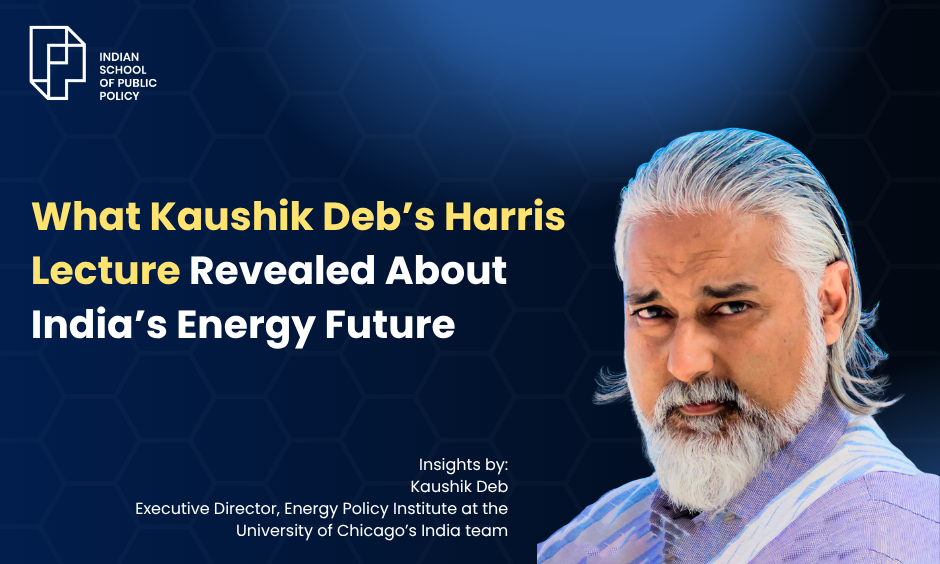

Key lessons from Kaushik Deb’s Harris Lecture on energy transition, energy security, and evidence-based public policy for India.
The global conversation on climate change often centres on ambitious targets – net zero by 2070, renewable energy expansion, decarbonisation. Yet, as Prof. Kaushik Deb reminded us during his talk in the Harris Lecture Series at the Indian School of Public Policy, the journey to a sustainable future is more nuanced than simply swapping one energy source for another.
Drawing on decades of experience in energy economics and policy, Prof. Deb unpacked one of the defining public policy challenges of our time: how can a country balance economic growth, energy security, and climate commitments at once? For scholars at ISPP, trained to think across disciplines and design solutions for complex governance problems, it was a question that landed close to home.
Energy Transition: More Than a Technological Shift
The lecture’s central theme was that the energy transition is not just about deploying cleaner technology – it is fundamentally about managing policy trade-offs.
This is where systems thinking becomes useful. Energy systems are deeply interconnected with industrial policy, urban planning, labour markets, and public finances, so a decision in one part of the system sends ripples across the others. India’s own numbers illustrate the point well.
The country met its Paris Agreement target of sourcing 50% of installed electricity capacity from non-fossil fuels in June 2025, five years ahead of schedule, and is now working toward 500 GW of non-fossil capacity by 2030. Yet capacity is not the same as output: as of early 2024, fossil fuels made up just over half of installed capacity but still generated more than three-quarters of the electricity actually consumed, because coal plants run far more consistently than solar or wind. The gap between what is installed and what is delivered is exactly the kind of feedback loop systems thinking asks policymakers to watch for.
For India, rising energy demand comes bundled with aspirations for industrial growth, urbanisation, and improved living standards. Cleaner energy cannot come at the cost of affordability or reliability, so policy must pursue environmental goals alongside economic and social ones. As Prof. Deb noted, successful transitions are shaped as much by institutions, markets, and governance as by technological innovation.
Energy Security in an Uncertain World
The lecture also examined how recent geopolitical shocks have sharpened the case for energy security. Global supply chain disruptions and volatile fuel prices have pushed countries to diversify their energy sources while building domestic resilience.
This, too, is a game-theory problem. Nations rarely make energy decisions in isolation; they respond to each other’s moves. When one country accelerates its clean energy shift, others weigh the cost of falling behind. When fossil fuel exporters adjust supply, importers recalibrate. The result is a multi-player game in which cooperation and competition coexist, and the payoff from any single decision depends heavily on what everyone else does.
Prof. Deb was clear that energy security and sustainability are not separate agendas. A resilient system needs a balanced mix of conventional fuels, renewables, upgraded infrastructure, and strategic planning – not a choice between them.
The Role of Evidence in Policymaking
A recurring message was the importance of evidence-based policymaking – a principle central to what ISPP prepares its scholars to practise. Whether designing fuel pricing mechanisms, investing in public transport, or planning renewable deployment, decisions must rest on rigorous economic analysis, reliable data, and an honest read of local realities.
This is also where the data question gets sharper: it is not enough to ask what the data shows; policymakers must ask what it shows about how different parts of the system interact. A fuel subsidy, for instance, is not purely a fiscal decision – it shapes consumer behaviour, industrial incentives, and long-term investment patterns all at once. Rather than reaching for one-size-fits-all solutions, policymakers should recognise that each country’s developmental context shapes its choices. For India, that means designing a transition that reflects its economic priorities, demographic realities, and commitment to inclusive growth.
Public Policy at the Heart of the Transition
Perhaps the most significant takeaway was that the energy transition is not solely an environmental agenda – it is a governance challenge. Investments in clean energy affect employment, industrial competitiveness, public finances, and social welfare; decisions about transport and urban planning shape both emissions and citizens’ quality of life.
Many barriers to a faster transition are structural rather than technical. Incumbent industries, short-term political incentives, and coordination failures between governments, businesses, and communities can lock systems into weaker equilibria even when better alternatives exist. Recognising these dynamics is the first step toward designing policies that can shift them and doing so calls for collaboration across economists, engineers, policymakers, businesses, and communities alike.
What We, as Scholars, Take Away
Sitting in that lecture, it was hard not to feel the weight of what was being described – not as a distant global problem, but as a challenge we may one day be asked to help solve. A few lessons stood out.
Complexity is a reason for better thinking, not an excuse for inaction. Systems thinking taught us to look for connections, feedback loops, and second-order effects. Prof. Deb’s lecture was a live demonstration of that: an energy decision is never just an energy decision. It is simultaneously a fiscal choice, a social contract, and a geopolitical signal.
Incentives matter as much as intentions. Even well-meaning actors behave strategically. As future policymakers, our task is not simply to design what is technically optimal, but to design systems where doing the right thing is also the rational thing – which requires understanding how governments, industries, and communities calculate their interests.
Evidence is a responsibility, not just a tool. In a field where decisions affect millions of lives, rigour and honesty are non-negotiable. Prof. Deb’s emphasis on local realities over universal prescriptions was a reminder that good policy is always contextual, and that intellectual humility matters as much as analytical skill.
Finally, the lecture reminded us that public policy is, at its heart, about people. Behind every energy statistic is a household deciding whether it can afford to run a fan through a summer night. Behind every transition plan is a worker wondering what happens to their livelihood. As we prepare to enter this field, keeping that human dimension visible – even when the models get complex – may be the most important discipline of all.
Looking Ahead
Prof. Deb’s Harris Lecture offered more than an overview of global energy trends; it provided a framework for thinking about one of the most pressing policy questions of our time. It reinforced that effective public policy means navigating competing priorities, making informed trade-offs, and designing solutions that are both practical and inclusive.
As India continues toward a cleaner, more resilient energy future, the lecture served as a timely reminder: achieving climate goals is not simply about adopting new technology. It is about understanding the system you are trying to change, anticipating how different actors will respond, and building policies that balance ambition with reality.
For scholars of public policy – and particularly for those at ISPP who will soon step into roles where these decisions are made – the session underscored an essential lesson: the future of energy will be shaped not only by innovation, but by policymaking that places people, evidence, and long-term resilience at its core.
References:
-
Ministry of Power, Government of India. (n.d.). 500 GW non-fossil fuel target.
- Down To Earth. (2025, January 25). The 500 GW switch-over.
- Wikipedia contributors. (2026). Renewable energy in India. In Wikipedia.
Disclaimer: The views expressed in this article are those of the scholar/guest speaker and do not necessarily represent the views of the Indian School of Public Policy (ISPP). ISPP assumes no responsibility for any errors, omissions, or opinions expressed in this blog.