


Table of Contents


Rethinking Education Policy: What Truly Changes Classrooms
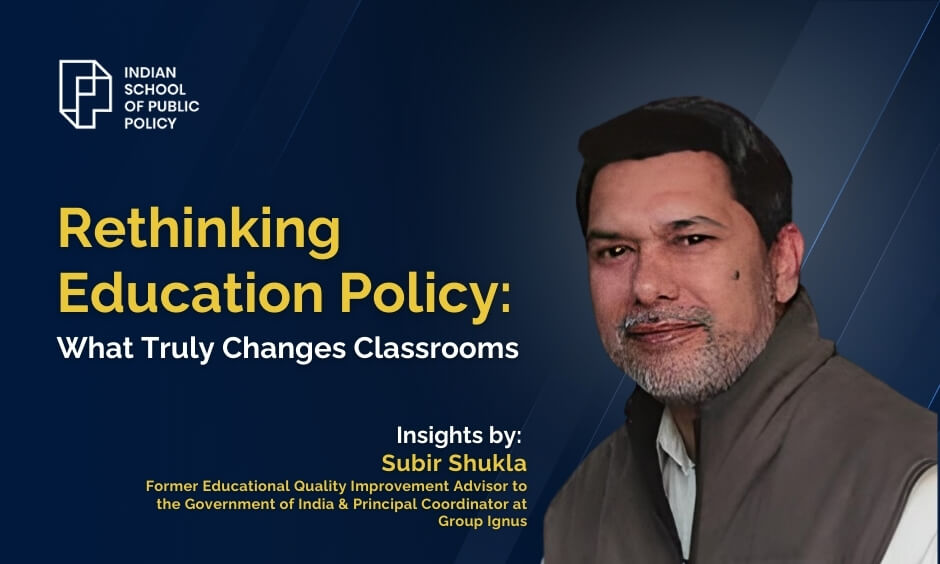

In a recent Friday Forum, ISPP invited Mr Subir Shukla, Former Educational Quality Improvement Advisor to the Government of India and Principal Coordinator at Group Ignus. With a long career that includes shaping the Right to Education implementation framework, advising the Ministry of Human Resource Development, and supporting national governments across Asia and Africa on curriculum development and teacher training, Mr Shukla stands as one of India’s eminent education reformists. His session with us made us believe that policy is not merely a set of guidelines—it is an everyday experience for learners, teachers and schools.
Education Policy Must Begin with the Learner
Mr Shukla opened his session with a simple paper-folding activity. As we tried to change the speed and direction of the pinwheel we had created, some of us struggled, some analysed, and others experimented. For Mr Shukla, this brief confusion captured the core purpose of education policy: it should generate curiosity, reflection and application. If policy does not make learners think, it fails in its most basic purpose, he explained.
He was of the view that Indian policies often focus on external elements, like buildings, forms, and infrastructure, which are emphasised much more than internal elements like relationships, engagement, and motivation. The internal dimension, he argued, is what actually determines whether true learning will happen. Without it, classrooms may appear organised from the outside, but real learning remains limited.
Teachers Change When Their Conditions Change
Drawing from his extensive work in tribal districts and urban systems in Rajasthan, Mr Shukla emphasised that teachers do not change because they are ordered to. Rather, they change when they are valued, supported and when they can see success in small but achievable steps. He shared an example where teachers, although initially resisting new practices, began adopting them.
After district officials met with them, listened to their struggles and let them choose the first set of improvements they wanted to attempt.
This shift, he explained, reflects a crucial principle: implemented choice. When teachers choose which changes to adopt first, they develop ownership. This has a more significant impact than any top-down compliance mechanism.
Recognising the System’s Hidden Purposes
Mr Shukla explained that his observations have been that education systems in India often reproduce existing inequalities. He cited an example that when a child from a marginalised background excels, it becomes “news” precisely because the system is not designed for success to be ordinary, irrespective of the student’s economic background. “Unless policymakers acknowledge these structural biases”, he warned, “future policies will keep reinforcing old hierarchies”.
He also clarified a common misunderstanding around experiential learning. Activities alone do not create learning. Learning emerges only when experience is followed by reflection, application and consolidation. Otherwise, activities remain activities or become mere performances, often staged for inspections rather than driven by learner need.
Conclusion
Mr Shukla’s session left a clear message: education policy must balance what is desirable with what is feasible, while ensuring that it touches real human experience. He added, policies must prioritise internal dimensions of schooling, treat teachers as partners in the education system rather than executors, and define clear outcomes sought at every level—student, teacher, school and system. Only then can education shift from compliance to genuine learning.