
Table of Contents


The Age of Extreme Heat: Protecting Older Adults in a Warming India
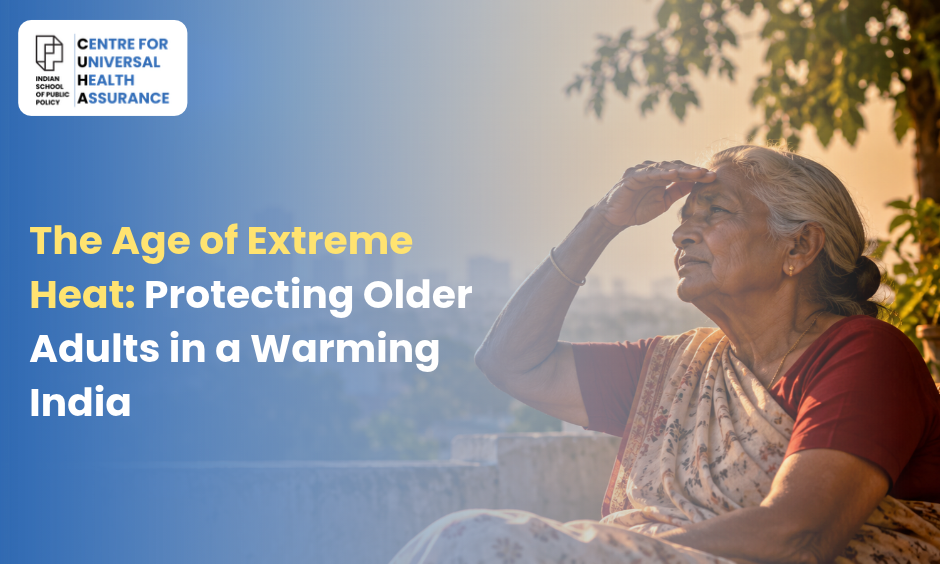

For many of us, the fondest memories of childhood are those associated with summers spent at our grandparents’ house. The lazy afternoons, juicy mangoes, games that continued until dusk, and falling asleep under the cool starry sky. The heat was a part of life, but it rarely occupied our thoughts the way it does today. Now, we plan our days around temperature forecasts, retreat indoors by noon, and wonder how long we can endure without air conditioning.
As climate change intensifies extreme heat, a season once woven into the fabric of childhood is becoming harder to live through, especially for the people who made it memorable – our grandparents. While many of us can adapt by changing our routines, older people have a different physiology and far more at stake.
The country is simultaneously experiencing two monumental transitions: a changing climate and rapid population ageing. By 2050, people aged 60 and above are projected to account for around one-fifth of India’s population. The number of people aged 80 and above is expected to grow by 279% between 2022 and 2050, with older women likely to constitute a substantial share of this oldest age group (UNFPA India).
At the same time, extreme heat is becoming a more important public-health challenge. India has rightly responded by developing Heat Action Plans (HAPs), supported by the National Disaster Management Authority and implemented across states, districts and cities. As of August 2026, HAPs had been prepared in 23 states, 195 districts and 64 cities (Press Information Bureau).
These plans represent an important evolution in the way heat is understood—from being a seasonal inconvenience to a serious, preventable public health threat requiring coordinated action. The next priority is to make these systems age-responsive, recognising the distinct physiological and social vulnerabilities of older people.
Why Are Older Adults More Vulnerable to Extreme Heat?
Ageing changes the body’s ability to respond to heat. Older adults usually have a reduced capacity to regulate body temperature, a diminished sensation of thirst and a higher prevalence of cardiovascular, renal and respiratory diseases. Medicines commonly used in older age can further influence hydration, blood pressure and thermoregulation.
But biological vulnerability is only one aspect of the story. An older person living alone may have no one to remind them to drink water or notice when they begin to feel unwell. Someone with dementia may not recognise the warning signs of heat stress. The risks are even greater for those living on a limited pension, working to support the household, or spending the day in a poorly ventilated home, escaping the heat may be a luxury rather than a choice. The same heatwave can pose very different threats to different people. Therefore, age is not an isolated risk factor; its effects are shaped by the interplay of health, disability, poverty, housing, gender and the availability of social support.
The international public-health community is increasingly recognising this. The World Health Organization’s updated 2026 guidance on heat-health action plans explicitly identifies population ageing as one of the trends converging with climate change and urbanisation to increase heat-related health risks. It recommends attention to populations at increased risk, health-system resilience, surveillance, communication and reducing heat exposure (World Health Organization).
India’s Heat Action Plans: Building on Progress
The expansion of Heat Action Plans is an important public-health achievement. Their emphasis on early warning, interdepartmental coordination, public communication and preparedness provides a valuable foundation. At the same time, India’s policy architecture for healthy ageing is also evolving.
The India Ageing Report 2023 highlights the importance of geriatric care, social protection, community support and ageing in place. One upcoming example is the 200-bed National Centre of Ageing at the Institute of Medical Sciences (BHU), being developed under the National Programme for Health Care of the Elderly. The centre is designed to bring specialised geriatric care, diagnostics, rehabilitation and other services under one roof, while strengthening training and research in geriatric medicine.
Meeting the needs of an ageing India will require more than expanding access to care. Integrating climate-risk assessment, heat-health preparedness and resilient care pathways into routine geriatric services will be essential to protecting the health and functional independence of older people.
Three Ways to Make Heat Action Plans More Age-Responsive
Include older persons in Heat Action Plans (HAP)
HAPs could include age-disaggregated assessments to identify people living alone, those with chronic illness or disabilities, limited mobility, or high-risk housing. Heat alerts should trigger outreach through primary-care teams, ASHAs, community health workers, senior-citizen groups and local governments.
Integrate Heat Preparedness into Primary Healthcare
Simple protocols can guide hydration advice, medication review, recognition of danger signs and continuity of care, without assuming every older person has family support or digital access. Facilities could proactively contact high-risk patients during heat alerts. Surveillance should track heat-related illness and deaths by age, helping identify who is missed and whether interventions work.
Strengthen Coordination Across Health, Housing and Urban Planning
Health departments must work with urban planners, housing authorities, local governments and disaster-management agencies to promote shaded streets, ventilated homes, reflective roofs, accessible cooling spaces, and reliable water and electricity. Civil-society organisations and community groups can help identify isolated older people and connect them with support.
Ultimately, a heat plan should strengthen our public systems to protect the vulnerable. The summers our grandparents once helped us cherish should not become seasons they must fear. A warming world demands more than better forecasts; it demands that we build communities where growing older does not mean becoming more vulnerable or less visible. How we protect older people from extreme heat will ultimately reflect how we value their lives.
FAQs
Sources:
- United Nations Population Fund (UNFPA) India. India Ageing Report 2023: Caring for Our Elders—Institutional Responses.
https://india.unfpa.org/sites/default/files/pub-pdf/20230926_india_ageing_report_2023_web_version_.pdf - Ministry of Housing and Urban Affairs, Government of India. Climate Resilient Cities & Urban Heatwaves. Press Information Bureau, 3 August 2026.
https://www.pib.gov.in/PressReleasePage.aspx?PRID=2293936 - World Health Organization. Heat and Health.
https://www.who.int/news-room/fact-sheets/detail/climate-change-heat-and-health - World Health Organization, Regional Office for Europe. Heat–Health Action Plans: Guidance, Second Edition. 2026.
https://www.who.int/kazakhstan/publications/i/item/9789289062930 - World Health Organization, Regional Office for Europe. Health Advice for Hot Weather. 2026.
https://www.who.int/europe/publications/health-advice-for-hot-weather
Author
Dr. Shalini Singh
Dr. Shalini Singh is a public health researcher with an MD in Community Medicine and currently serves as a Senior Research Associate at the Centre for Universal Health Assurance (CUHA). She specialises in universal health coverage, health financing, health equity, and climate health. Her work spans epidemiology and health systems research, with publications in peer-reviewed journals, policy papers, and newspapers. She focuses on translating evidence into policy and strengthening health access and financial protection.