
Table of Contents


Understanding The New Education Policy In India

Imagine a future where every Indian child is encouraged to think critically, solve real-world problems, and innovate rather than simply memorise facts. This is the vision behind the National Education Policy (NEP) 2020, India’s first comprehensive education reform in over three decades. With nearly 25 crore school students, the policy aims to transform education by making learning more flexible, multidisciplinary, skill-oriented, and aligned with the needs of the 21st century.
Developed under the chairmanship of Dr. K. Kasturirangan, former Chairman of ISRO, the National Education Policy 2020 provides a roadmap for improving the quality, accessibility, equity, and inclusiveness of education across India. Since its introduction, the policy has continued to evolve through initiatives such as the National Curriculum Framework (NCF), Academic Bank of Credits (ABC), APAAR ID, and other reforms that continue to strengthen India’s education ecosystem.
What is the New Education Policy?
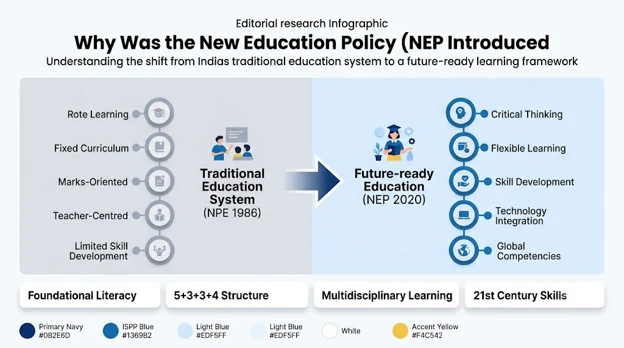
The National Education Policy (NEP) 2020 is India’s first comprehensive education policy in over three decades, replacing the National Policy on Education (NPE) 1986. Approved by the Government of India on 29 July 2020, the policy provides a roadmap for transforming the country’s education system by making learning more holistic, multidisciplinary, inclusive, and aligned with the needs of the 21st century.
NEP 2020 places a strong emphasis on foundational literacy and numeracy, critical thinking, creativity, problem-solving, experiential learning, and skill development. It also introduces significant reforms across both school and higher education, encouraging greater flexibility in subject choices, multidisciplinary learning, technology integration, and improved access to quality education for all learners.
By focusing on equity, accessibility, and lifelong learning, the policy aims to equip students with the knowledge and skills required to thrive in a rapidly evolving global economy while contributing meaningfully to India’s long-term social and economic development.
Why New Education Policy for India
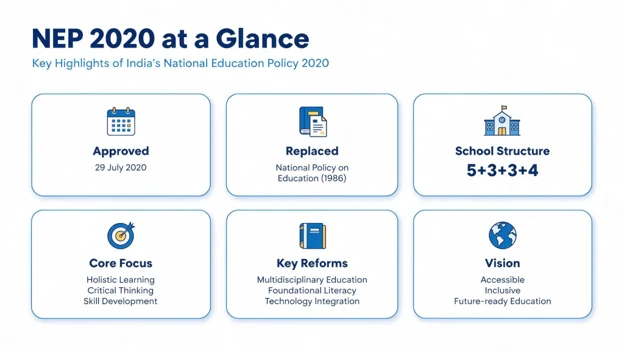
A new education policy was needed because the National Policy on Education (NPE) 1986, last revised in 1992, could no longer meet the evolving needs of India’s education system. Over the years, rapid technological advancements, changing industry demands, and the need for 21st-century skills highlighted the limitations of a curriculum that relied heavily on rote learning and traditional teaching methods. The National Education Policy (NEP) 2020 was introduced to make education more flexible, multidisciplinary, and outcome-oriented.
- Skills gap: Many students entered the workforce with limited practical, technical, and problem-solving skills, affecting their employability in an increasingly competitive job market.
- Global competitiveness: As education systems around the world shifted towards multidisciplinary learning, innovation, and critical thinking, India needed reforms to prepare students for global opportunities and emerging careers.
- Learning outcomes: Reports such as the Annual Status of Education Report (ASER) highlighted concerns around foundational literacy and numeracy, reinforcing the need for competency-based learning and improved learning outcomes.
- Changing workforce needs: The rise of artificial intelligence, digital technologies, and new-age industries created demand for graduates with adaptability, creativity, communication, and analytical skills beyond traditional academic knowledge.
Key Features of the National Education Policy (NEP) 2020
The National Education Policy (NEP) 2020 introduces a learner-centric approach that moves beyond traditional classroom teaching. It focuses on building foundational skills, promoting multidisciplinary education, integrating technology, and preparing students with the knowledge and competencies required for the 21st century. Some of the key features of NEP 2020 include:
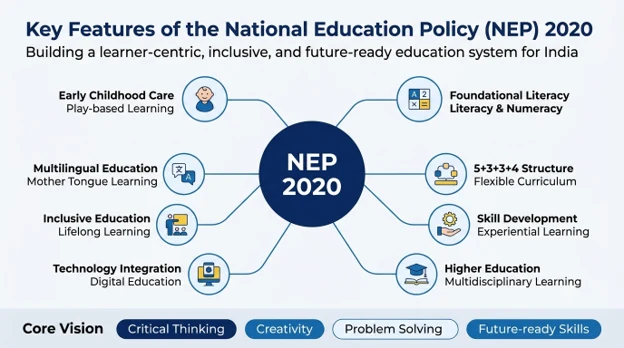
- Early Childhood Care and Education (ECCE): NEP strengthens early childhood education by promoting play-based, activity-based, and experiential learning to build strong cognitive and social foundations during a child’s formative years.
- Multilingual Education: The policy encourages teaching in the mother tongue or regional language during the early years of schooling, helping children improve conceptual understanding while preserving India’s linguistic diversity.
- Foundational Literacy and Numeracy (FLN): Achieving universal foundational literacy and numeracy by Grade 3 is one of the policy’s highest priorities, recognising these skills as the foundation for lifelong learning.
- Universal Access to Education: NEP aims to improve access, participation, and retention across all stages of education, with the long-term goal of achieving universal school education from preschool to secondary level.
- 5+3+3+4 Curriculum Structure: The policy replaces the traditional 10+2 model with a more age-appropriate 5+3+3+4 structure that aligns learning with children’s cognitive development and introduces greater curricular flexibility.
- Higher Education Reforms: NEP promotes multidisciplinary institutions, flexible learning pathways, multiple entry and exit options, and regulatory reforms to improve the quality, accessibility, and global competitiveness of higher education.
- Adult Education and Lifelong Learning: The policy encourages continuous learning through community programmes, digital platforms, and skill-based education, enabling learners of all ages to upgrade their knowledge and competencies.
- Technology Integration: NEP encourages the meaningful use of digital technologies to enhance teaching, learning, assessments, and academic administration. Initiatives such as digital learning platforms, online education, and technology-enabled classrooms aim to improve accessibility and learning outcomes across the country.
Implementation Challenges of the National Education Policy (NEP) 2020
India’s rich linguistic, cultural, and regional diversity is one of its greatest strengths. However, implementing a nationwide education reform across such a diverse ecosystem presents several challenges. While significant progress has been made since the introduction of NEP 2020, achieving its long-term vision requires sustained collaboration between governments, educational institutions, teachers, and other stakeholders.
Some of the key implementation challenges include:
- Digital Divide: Unequal access to digital infrastructure, reliable internet connectivity, and digital devices continues to affect students, particularly in rural and remote areas, limiting equitable access to technology-enabled learning.
- Teacher Capacity and Training: Successfully implementing competency-based and multidisciplinary learning requires continuous teacher training, professional development, and adequate staffing across schools and higher education institutions.
- Learning Assessment and Data: National surveys such as the National Achievement Survey (NAS) and the Annual Status of Education Report (ASER) provide valuable insights into learning outcomes. However, strengthening data collection, monitoring mechanisms, and evidence-based evaluation remains essential for measuring the long-term impact of NEP reforms.
- Investment in Education: Although public investment in education has increased, India is still working towards achieving the NEP’s long-term goal of allocating 6% of GDP to education. Adequate funding remains crucial for improving infrastructure, teacher development, and digital learning initiatives.
- Centre–State Coordination: Education is a concurrent subject in India, making effective coordination between the Central Government and State Governments essential for ensuring consistent implementation while addressing region-specific educational needs. Despite these challenges, NEP 2020 provides a long-term roadmap for transforming India’s education system. Continued policy reforms, institutional collaboration, and sustained investment will play a critical role in achieving its vision of equitable, inclusive, and future-ready education.
Latest Developments in the National Education Policy (2020–2026)
Since the launch of NEP 2020, the Government of India has introduced several initiatives to strengthen policy implementation and improve the quality, accessibility, and inclusiveness of education. Some of the major developments include:
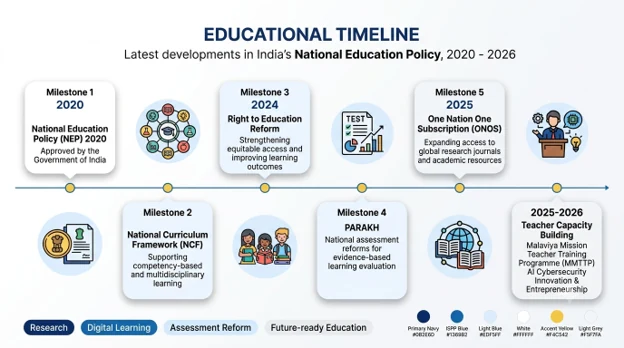
Right to Education (RTE) Amendment
In line with NEP 2020, the Ministry of Education introduced amendments to strengthen elementary education by reinforcing provisions related to student progression, learning outcomes, and equitable access to education.
Student Assessment Reforms
The launch of the PARAKH Rashtriya Sarvekshan Dissemination Portal has improved transparency by providing access to national and state-level student learning outcome data. The initiative supports evidence-based policymaking and helps monitor education quality across the country.
Research and Digital Learning
The One Nation One Subscription (ONOS) initiative provides students, researchers, and higher education institutions with access to thousands of international academic journals, strengthening India’s research and innovation ecosystem.
Teacher Capacity Building
The Malaviya Mission Teacher Training Programme (MMTTP) continues to strengthen faculty development by providing training in emerging areas such as artificial intelligence, cybersecurity, entrepreneurship, and innovative teaching practices.
Data and Governance
Recent UDISE+ reports indicate continued improvements in education data management, school infrastructure, and teacher availability, helping policymakers make more informed decisions for improving learning outcomes across India.
These developments demonstrate that NEP 2020 is an evolving reform framework, with new initiatives being introduced to strengthen implementation and prepare India’s education system for future challenges.
Role of public policy in education
Public policy plays a vital role in shaping the vision, implementation, and long-term success of education reforms. The National Education Policy (NEP) 2020 is a strong example of how evidence-based policymaking can transform an education system by addressing evolving social, economic, and technological needs.
Designing an effective education policy is only the first step. Its success depends on efficient implementation, continuous monitoring, stakeholder collaboration, and data-driven decision-making. Governments, educational institutions, teachers, researchers, and civil society organisations all contribute to ensuring that policy objectives translate into measurable outcomes.
Several initiatives launched under NEP 2020 demonstrate the role of public policy in improving education delivery. Programmes such as PM e-VIDYA have expanded access to digital learning through television, radio, and online platforms, while UDISE+ and PARAKH enable policymakers to monitor school performance, student learning outcomes, teacher deployment, and enrolment trends using reliable data.
As India’s education system continues to evolve, public policy professionals will play an increasingly important role in designing, implementing, and evaluating reforms that create equitable, inclusive, and future-ready learning opportunities for all.