
Table of Contents


Urban Heat Islands in India: Why Better Planning Matters
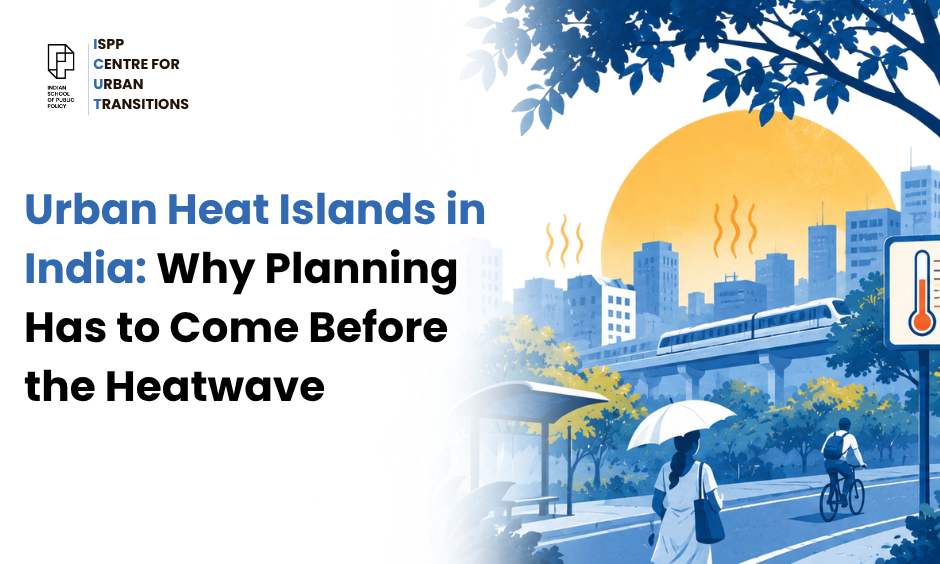

Between 2014 and 2024, Delhi’s green cover fell from 25.36 per cent to 14.14 per cent, according to the Centre for Science and Environment’s (CSE) 2026 report, Making Delhi Heat-Resilient. The report found that 75.78 per cent of the capital’s area experienced recurring heat stress. As the climate warms, losing vegetation and replacing open ground with concrete can intensify the heat residents experience.
For years, Indian cities have treated extreme heat largely as a seasonal emergency. Authorities issue warnings, set up hydration points, and alert hospitals. These measures save lives, but they cannot cool the streets where people live and work. Heat must also be addressed before it arrives, through the everyday decisions that shape urban growth.
What makes a city hotter
A city’s exposure to heat depends on its design as well as the weather. Urbanisation replaces vegetation and permeable soil with asphalt and concrete, which absorb energy during the day and release it later. Poorly planned building layouts can obstruct ventilation, while air conditioners release waste heat into surrounding streets. The result can be warmer nights, when people need relief.
A 2024 study in Nature Cities, analysing nighttime land-surface temperatures across 141 Indian cities from 2003 to 2020, found that urbanisation enhanced warming by around 60 per cent relative to surrounding non-urban areas. Average nighttime land-surface temperatures rose by 0.53°C per decade. The study also found a stronger urbanisation-driven contribution to warming in many eastern and central Indian cities. Rapidly developing cities therefore have an opportunity to avoid locking in heat-intensive development patterns.
Delhi illustrates the challenge. CSE found that 75.78 per cent of the capital’s area recorded land-surface temperatures above 45°C in at least six years of the period studied. Informal workers, people in poorly ventilated housing and those working outdoors for long hours face particular risks, often with limited access to cooling.
What policy has missed
Heat Action Plans remain essential for warnings, emergency response and protecting vulnerable people. But a 2023 Centre for Policy Research assessment of 37 plans across 18 states identified recurring weaknesses, including underfunding, weak legal foundations and inadequate identification of vulnerable groups. The answer is not to abandon these plans, but to connect them to master plans, zoning, building approvals, street design and municipal budgets.
Telangana’s Cool Roof Policy (2023–2028) offers one example. It links cool-roof requirements for covered building categories with the state’s building-regulation and permission framework. Requirements vary by category, but the principle is useful: cooling can become part of compliant construction rather than remain voluntary advice.
Three kinds of city, three kinds of fix
Historic cores: Varanasi, Lucknow, Old Delhi and walled Jaipur. Retrofitting is often more practical than rebuilding. Ward-level heat mapping can help prioritise cool-roof treatments and shade in vulnerable neighbourhoods. Where feasible, restore traditional water bodies such as kunds and baolis, and protect courtyards, jaalis, chhajjas and shaded streets in ways compatible with heritage conservation and safety. In narrow lanes where trees cannot grow, canopies and pergolas can provide shade.
High-density growth areas: Gurugram, Noida and the expanding edges of Bengaluru and Hyderabad. Enforce applicable building-energy standards and consider additional requirements for cool roofs, shading and solar-control glazing. Protect lakes, wetlands, floodplains and drainage channels through land-use plans before encroachment occurs. Building height, spacing and street layouts should account for local ventilation, while permeable paving and podium greenery can be used where appropriate. Density is not the problem in itself; poor planning is.
New urban developments and expansion corridors: Dholera, Amaravati, industrial nodes and new townships. Plan connected networks of parks, trees, water bodies and open spaces from the beginning. Larger developments should assess heat exposure, shade, and ventilation before approving layouts. Zoning can set context-specific targets for tree canopy, permeable surfaces and reflective roofing. Tree requirements should measure survival and maintenance, not just saplings planted; district cooling should be considered where local conditions make it viable.
The test every plan should pass
Every master plan, major building approval and zoning decision should consider its impact on urban heat. That means mapping vulnerable neighbourhoods, protecting natural cooling assets, setting measurable standards and monitoring whether interventions work. Municipal budgets and clear responsibility are essential; rules alone cannot deliver cooler streets.
The benefits must reach those most exposed: street vendors, construction workers, outdoor workers, tenants and low-income households. Affordable roof upgrades and shaded public spaces can reduce exposure, while safeguards should prevent neighbourhood improvements from driving residents out through rising housing costs.
India’s cities will continue to grow. Better planning cannot stop climate change, but it can reduce avoidable heat exposure and make urban life safer. Heat resilience must become a standard of good urban planning, not a response reserved for the next heatwave.
FAQs
References:
-
- Sareen, R., & Singh, M. (2026). Making Delhi Heat-Resilient: A Roadmap with the Focus on Vulnerable Groups. Centre for Science and Environment. https://www.cseindia.org/content/downloadreports/13109
- Sethi, S. S., & Vinoj, V. (2024). Urbanization and regional climate change-linked warming of Indian cities. Nature Cities, 1, 402–405. https://doi.org/10.1038/s44284-024-00074-0
- Pillai, A. V., & Dalal, T. (2023). How Is India Adapting to Heatwaves? An Assessment of Heat Action Plans With Insights for Transformative Climate Action. Centre for Policy Research. https://cprindia.org/briefsreports/how-is-india-adapting-to-heatwaves-an-assessment-of-heat-action-plans-with-insights-for-transformative-climate-action/
- Government of Telangana. (2023). Telangana Cool Roof Policy 2023–2028. Municipal Administration and Urban Development Department, Government of Telangana. G.O.Ms.No. 50, dated 31 March 2023. https://telangana.gov.in/wp-content/uploads/2023/05/Telangana-Cool-Roof-Policy-2023-2028.pdf
- Bureau of Energy Efficiency. (2017). Energy Conservation Building Code 2017. Ministry of Power, Government of India. https://beeindia.gov.in/sites/default/files/publications/files/ECBC%20book%20final%20one%20%202017_0.pdf
- Ministry of Urban Development, Government of India. (2015). Urban and Regional Development Plans Formulation and Implementation (URDPFI) Guidelines, Volume I. Town and Country Planning Organisation. https://mohua.gov.in/upload/uploadfiles/files/URDPFI%20Guidelines%20Vol%20I%283%29.pdf