
Table of Contents


What is Public Policy? What Makes It Important Now More Than Ever?

What is Public Policy?
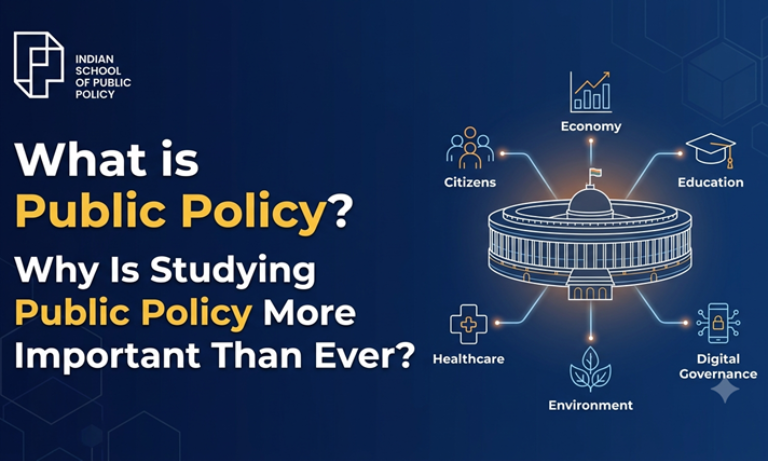
Public policy is a set of laws, rules, standards, and other guidelines through which a government, its agencies, or its representatives regulate and direct public affairs to serve the public interest. Simply stated, public policy refers to government decisions and actions that improve society’s overall well-being across areas such as healthcare, education, the economy, infrastructure, and the environment.
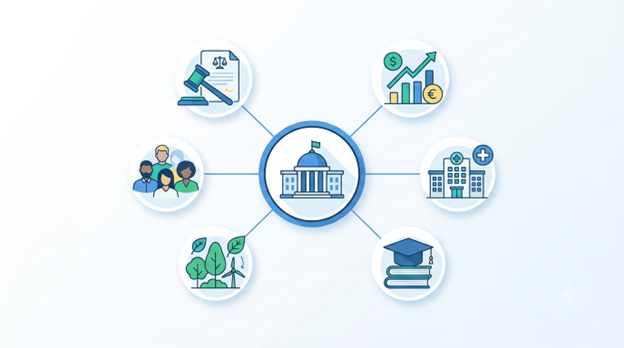
From policy initiation through implementation and evaluation, public policy follows a continuous cycle of refinement involving multiple stakeholders, public institutions, and other resources. Since it balances the competing interests of different groups and sectors, public policy continues to evolve to address society’s changing needs and emerging challenges.
Since its inception, the form, function, and nature of public policy have continuously evolved. Let’s explore its historical development and understand how it has shaped governance over time.
Speaking of evolution, let’s learn a little about the history and evolution of Public Policy.
The history and evolution of Public Policy
Public policies have been integral to the governance structure of countries over centuries. In India, the roots of policy formulation date back to the ancient universities of Nalanda and Vaishali. During the reign of Chandragupta Maurya, Chanakya, a renowned scholar, outlined state policies in his seminal work “Arthashastra“.
Ashoka the Great further emphasised peace and harmony through his policies, transitioning from an era of constant warfare. Subsequent rulers like Akbar introduced significant reforms, demonstrating the evolving nature of policy frameworks.
Post-independence, India faced numerous economic, social, and governance challenges, making robust public policies essential for nation-building. Over the decades, policy reforms such as economic liberalisation, the Right to Education Act, GST, Digital India, and the National Education Policy (NEP) 2020 have shaped India’s development and strengthened public service delivery.
The features and nature of Public Policy
Public policy serves as a strategic framework for addressing societal issues across social, economic, and political domains. It encompasses a range of policies and decision-making processes aimed at achieving specific objectives. Key features of Public Policy include –
- Purposefulness: Every public policy is designed to address a clearly identified public problem, such as improving healthcare access, reducing unemployment, or promoting environmental sustainability.
- Systematic: It follows a structured process involving policy formulation, implementation, monitoring, and evaluation, while engaging multiple stakeholders.
- Public policy is strategic. It focuses on long-term social and economic outcomes rather than short-term solutions, ensuring sustainable development and effective governance.
- Evidence-Based Decision Making: Effective public policies are increasingly based on research, data, stakeholder consultation, and evidence to ensure informed decision-making and measurable outcomes.
What are the Types of Public Policy
The government’s strategic initiatives span diverse sectors, ensuring balanced and inclusive development:
| Economic Policy | Recent initiatives such as the Production Linked Incentive (PLI) Scheme and Startup India further support manufacturing, innovation, and employment generation. |
| Social Policy | Programmes such as PM Jan Dhan Yojana and Beti Bachao Beti Padhao further promote financial inclusion and gender equality. |
| Environmental Policy | More recently, initiatives like Mission LiFE (Lifestyle for Environment) encourage sustainable practices through public participation. |
| Education Policy | Initiatives such as PM SHRI Schools and the DIKSHA digital learning platform support quality education and digital learning across India. |
| Healthcare Policy | Digital healthcare initiatives such as eSanjeevani have also expanded access to telemedicine, particularly in rural and underserved areas. |
The process of Public Policy formation
Conceptually, the life-cycle of a Public Policy involves six stages –
- Agenda-setting: In this stage, needs and priorities are identified. Multiple actors outside the government may also be involved in presenting issues or plans of action that require attention. At this stage, the policy problem to be addressed is defined. Public concerns, research findings, media coverage, and stakeholder feedback often influence this stage.
- Policy formulation: A policy intervention gets structured at this stage, including planning out implementation logistics. Civil servants are crucial to drafting policy plans. Domain experts from non-government sectors may be consulted for shaping policies, Evidence-based research, expert consultation, and data analysis play a key role in designing effective policy solutions.
- Policy adoption: The policy may require regulations or legislation to be passed so Parliamentarians get involved. If it is a national policy, state governments are required to prepare the state machinery to implement the new Public Policy.
- Implementation: Policy implementation and monitoring require clear coordination across government and non-government agencies. Media channels may be used to inform citizens of the new policy and programmes that are created to implement the policy. Successful implementation requires coordination between central and state governments, local authorities, and implementing agencies.
- Evaluation: Regular assessments follow the implementation stage to see whether policy objectives are met. Evaluations are conducted by government agencies and external actors, such as donor agencies and research firms. The findings help identify gaps and improve future policy decisions.
- Policy maintenance: Based on evaluation outcomes and changing public needs, policies may be revised, updated, or replaced to remain effective and relevant.
Importance of Public Policy
Public policy plays a vital role in addressing complex societal challenges and improving the quality of life for citizens. It provides a structured framework for governments to make informed decisions, allocate public resources efficiently, and promote sustainable economic and social development. From healthcare and education to infrastructure, climate action, and public welfare, public policy influences almost every aspect of governance.
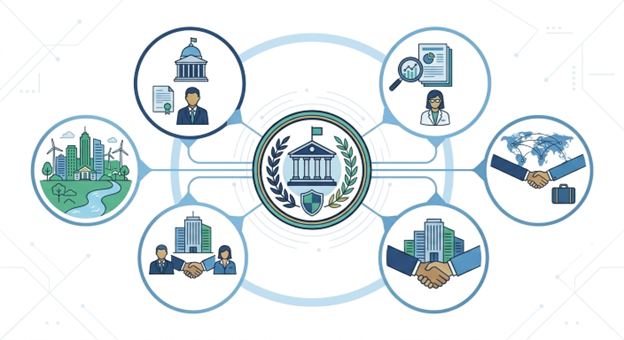
There are multiple stakeholders involved in formulating Public Policy, spanning the Sarkar (government), Bazaar (market), and Samaj (society). The three branches of the government—the legislature (Parliament), the executive (government and its Council of Ministers), and the judiciary (Supreme Court)—are the primary architects of public policies in India.
In India, state governments play a significant role in planning and implementing public policies through various programmes and schemes. Chief Ministers, elected legislators, civil servants at all levels of government, and domain experts from sectors such as health, education, and transport contribute at different stages of the policy cycle to ensure effective policy design and implementation.
Large donor agencies supporting programme implementation also play an important role in determining where resources are allocated. Non-government stakeholders, including NGOs and Civil Society Organisations (CSOs), support implementation, create public awareness through advocacy, and provide valuable feedback on the effectiveness of policies and programmes.
Opposition parties, advocacy groups, researchers, journalists, political unions, and professionals from diverse sectors—including business, law, finance, telecommunications, energy, healthcare, and consulting—also contribute to policy formulation, evaluation, and continuous improvement through their expertise and stakeholder engagement.
Public policies are developed to address issues that affect society and improve public welfare. Since these policies directly impact individuals, communities, and businesses, citizen participation is equally important. Public consultations, stakeholder feedback, community engagement, and democratic participation help ensure that public policies remain relevant, inclusive, and responsive to the evolving needs of the country.
Why are good Public Policies important now more than ever?
Over the years, nations have become increasingly interdependent for economic growth, security, public health, and environmental sustainability. As people, businesses, and resources move across international boundaries, public issues have also become more global and interconnected. The COVID-19 pandemic highlighted how countries depend on one another to protect public health and respond to shared challenges. As a result, public policy issues have become more complex and require collaborative, evidence-based solutions.
Moreover, rapid urbanisation, technological advancements, increased access to education, and digital connectivity have encouraged citizens and other non-government stakeholders in India to participate more actively in policy discussions. Emerging challenges such as climate change, artificial intelligence, and digital governance have further increased the need for well-designed and future-ready public policies. Public expectations, combined with the growing complexity of social issues, mean that poorly designed and implemented public policies can have far-reaching consequences.
As a democracy, Indian citizens have an important role in shaping public policy through their right to vote. By electing governments, citizens also influence the policy priorities and governance approaches that shape the country’s future. While political leadership may change over time, many public policies have long-term implications and cannot be easily reversed. Therefore, informed civic participation is essential to support policies that promote inclusive and sustainable development.
Ultimately, every stakeholder views public issues from a different perspective and brings unique priorities to the policy process. Successfully balancing stakeholder interests with policy objectives is what makes a public policy effective. The true measure of a good public policy lies in its ability to address citizens’ needs while safeguarding the nation’s long-term interests and sustainable development.
Register your Interest to Study at ISPP
Why Study Public Policy in India?
The scope of Public Policy in India spans the Sarkar (government), Bazaar (market), and Samaj (society). The Indian development sector has expanded rapidly over the last two decades. As a result, several educational institutions offering Public Policy courses, think tanks, and organisations specialising in policy implementation, monitoring, and evaluation have emerged. Today, the demand for skilled professionals who understand India’s governance systems, Public Policy processes, and domain-specific expertise continues to outpace the available talent.
The career scope in Public Policy is vast, and new roles continue to emerge as governance challenges become more specialised. Public policy careers can be built across both the public and private sectors. Some of the popular career options include:
- Sarkar (Government): Civil services, judicial services, military, police, regulatory services (e.g., banking and insurance), teachers, healthcare workers, and social workers.
- Bazaar (Market): Policy researchers and analysts, market researchers, policy consultants and advisers, impact assessors, monitoring and evaluation experts, journalists, public relations professionals, and lawyers.
- Samaj (Society): Programme officers, policy advocates, philanthropists, politicians, legislative aides, policy analysts, political pollsters, campaign managers, communication experts, and professionals working with NGOs and civil society organisations.
People from all academic disciplines can find their career footing in Public Policy. It is a common misconception that only students with backgrounds in social sciences—particularly economics, sociology, political science, and public administration—can thrive in this field. In reality, the expertise of engineers, architects, urban and rural planners, management professionals, lawyers, and healthcare specialists is increasingly valuable in addressing complex policy challenges, from urban infrastructure development to climate action and digital governance.
A great way to explore a career in Public Policy is through internships or fellowships with government agencies, think tanks, non-government organisations, or development institutions. Public Policy courses in India equip students with both the theoretical foundations and practical skills required to understand, design, implement, and evaluate effective public policies.
Crafting effective public policies is both an art and a science. Developing the right knowledge, analytical skills, and practical experience enables future policy professionals to create meaningful and lasting social impact.
Continue reading to learn about the two educational pathways you can consider.
Master’s in Public Policy (MPP) VS a Post Graduate Programme (PGP) in Public Policy
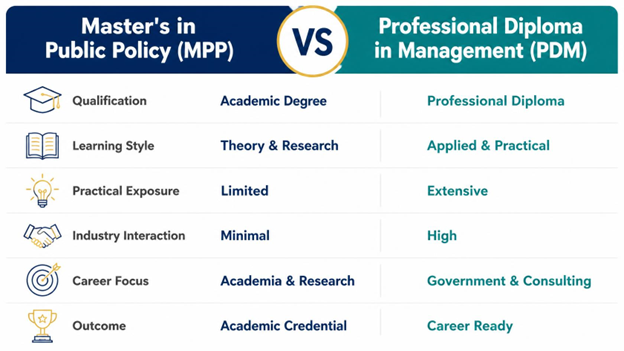
A Master’s in Public Policy (MPP) programme focuses on government policies and their impact on society. It aims to provide students with a strong foundation in policy analysis, implementation, and evaluation. The curriculum typically covers subjects such as economics, governance, political science, public administration, and research methods. Graduates often pursue careers in government, non-profit organisations, think tanks, research institutions, or international organisations.
Similarly, a Post Graduate Programme (PGP) in Public Policy is designed to develop students’ policy-making and implementation skills for careers across sectors engaged in public policy. The curriculum usually includes economics, political science, law, governance, and public policy while placing greater emphasis on analytical thinking, research methodologies, and practical problem-solving. Many PGP programmes also incorporate case studies, field projects, internships, and industry interactions to provide hands-on learning experiences.
When choosing between an MPP and a PGP, prospective students should consider factors such as programme curriculum, duration, eligibility criteria, learning approach, internship opportunities, and long-term career goals. Evaluating these aspects can help identify the programme that best aligns with individual aspirations and professional objectives.
PDM by ISPP
The Post Graduate Programme in Public Policy, Design, and Management (PDM) offered by the Indian School of Public Policy (ISPP) is designed to equip students with the knowledge and practical skills required to build successful careers in public policy and governance.
Major Subjects in this Public Policy Programme
At ISPP, scholars cover a range of subjects, including:
- Design Thinking
- Markets for Development
- Critical Thinking and Reasoning
- Economics and Statistics
- Ethics of Public Policy
- Understanding Behaviour
Apart from the core curriculum, scholars also study domain-specific subjects such as:
- Public Health
- Education and Gender
- Technology
What are the perks of enrolling at ISPP?
The Indian School of Public Policy (ISPP) aspires to develop future public policy leaders through rigorous academic training combined with communication, management, and leadership development. The career support system provides comprehensive resume-building assistance and interview preparation to help scholars become both interview-ready and industry-ready.
ISPP also has a dedicated Careers Team that encourages scholars to explore diverse career pathways aligned with their interests. The team supports students throughout their career journey by connecting them with relevant opportunities and helping them prepare for successful careers in the public policy ecosystem.
Three Es towards employment
The vibrant diversity of the Indian School of Public Policy’s cohort is reflected in their varied career aspirations.
The ‘Three Es towards Employment’ is its own career support process, to maximise the varied skill sets and domain expertise that the scholars offer, and enable them to pursue varied career opportunities.

- Interview Practice Exercises
- Industry Interviews
- Resume-Building Workshops
- Case Interview Sessions
- One-on-One Career Counselling
- Special Series on Career Development
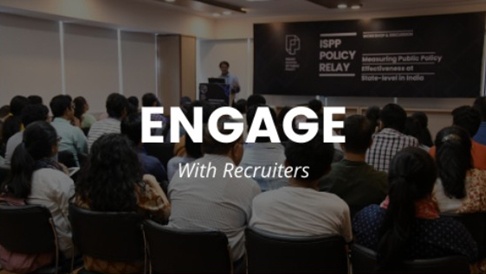
- Tea and Policy Sessions
- Policy Hackathons
- Immersive Learning Projects (ILPs)
- Short-term Internships/Projects

- Assistance in Pursuing Higher Studies
- Placement Assistance
Immersive Learning Project
Immersive Learning Projects (ILPs) at ISPP are designed to provide scholars with real-time experience working on policy projects. Undertaken by the ISPP scholars, the ILP is a remotely monitored association with a partner organisation and is offered as a part of their curriculum. During the tenure of this programme, scholars are expected to work with firms on live projects and apply their knowledge of Public Policy to solve complex challenges faced by the partner organisation. Sehgal Foundation, NITI Aayog, NSDC, BCG, EY, Safewater Network, Chase India, GRAAM, and APCO Worldwide are some of the organisations that have participated in the Immersive Learning Programme.
Thematic Areas
- Malnutrition In India
- Mainstreaming Gender In WASH
- Skill Development
- Enabling Profitable Investment In India
- Policy Advocacy
Career opportunities after pursuing a Public Policy programme from ISPP
- Government
- Think Tanks
- Public Affairs
- NGOs
- Academia
- Industry Bodies
Scholar Placements
Sector-wise break-up of scholars placed from the Class of 2024.
Recruiters
The holistic academic curriculum and robust career support system at ISPP equip scholars with the knowledge, skills, and professional development needed to pursue careers with reputed organisations across the public, private, and social sectors.
Testimonials

The ILP programme was a rich learning experience. It was an opportunity to not only connect theory with practice but also to work with a team of industry professionals who helped refine every step during the project. I am indeed grateful to ISPP for giving me this opportunity.
Arindam Upamanyu, Founding Class of 2020

The placement training was a very holistic one that prepared me for all stages of my selection process. Right from behavior interviews, technical rounds to salary negotiations all came in handy during my selection stage at Innovation mission Punjab.
Deeksha Tiwari, Founding Class of 2021

The resume and profile building activity by the placements team was a challenging process but in the end helped me highlight the key aspects of my experience and made me stand out. I believe this was an important factor in my landing a job.
Nikhil Kanakamedala, Founding Class of 2021

ISPP’s ILP was my first space to research live projects. As team coordinator, I ensured our consistent mentorship and encouraged interdisciplinary strategies for deliverables. The team’s time with the Boston Consulting Group awarded us gainful and necessary experiences.
Priyanka Mehta, Founding Class of 2020