
Table of Contents


Women in India’s Rural Workforce: From MGNREGA to VB-G RAM G

Something important has been changing in India’s rural workforce. Women now account for a larger share of the work generated through public employment programmes than they did a decade ago.
Under the Mahatma Gandhi National Rural Employment Guarantee Act (MGNREGA), women accounted for 48% of total person-days in FY 2013-14. By FY 2024-25, that share had risen to 58.15%.
The transition to the Viksit Bharat – Guarantee for Rozgar and Ajeevika Mission (Gramin) (VB-G RAM G) Act, 2025, which came into force on 1 July 2026, has so far continued this trend. In the initial phase of implementation, women accounted for 61.5% of the 11.4 crore person-days generated under the new programme.
At first glance, the numbers seem straightforward: more women are participating in rural public employment. But the story is more complicated.
A higher share of women in public employment can point to greater access to paid work and greater economic independence. It can also indicate that women have fewer alternatives in the rural labour market.
That tension is worth examining as India moves from MGNREGA to VB-G RAM G.
Women’s Participation in Rural Employment
The rise in women’s participation in MGNREGA is part of a wider change in rural labour markets.
According to the Periodic Labour Force Survey (PLFS), rural female Labour Force Participation Rate (LFPR) reached 38.8% in July 2026 under the Current Weekly Status measure, up from 36.9% in July 2025.
It is important not to treat this figure and MGNREGA participation as the same thing. LFPR measures participation in the wider labour market, while women’s share of MGNREGA person-days tells us how much women are using a particular public employment programme.
Taken together, however, the figures point to a greater presence of rural women in paid work. There are some practical reasons why public employment can be particularly relevant to women.
Work close to home
Distance matters when employment has to be balanced with household responsibilities. MGNREGA provides for employment within a prescribed distance of the worker’s residence, with additional compensation where work is provided beyond that distance.
For women who may have limited mobility or significant caregiving responsibilities, locally available work can make the difference between being able to take up employment and being excluded from it.
A predictable wage framework
Public employment also provides workers with a notified wage rate rather than leaving wages entirely to local labour-market conditions. The programme has provisions for compensation when wages are delayed, although implementation and payment delays have remained an important concern.
A fallback when other work is unavailable
MGNREGA was designed as a demand-driven employment programme and has often served as a fallback when other forms of rural employment are unavailable.
This matters for women in particular because agricultural employment is seasonal and private-sector opportunities may require workers to travel further from home. In households where men migrate or move into better-paid forms of work, women may increasingly become the main users of public employment programmes.
This can be both an opportunity and a warning sign.
What Changes with VB-G RAM G?
VB-G RAM G retains the employment guarantee framework but changes the way rural employment is structured.
The most visible change is the increase in the statutory employment guarantee from 100 to 125 days per rural household in a financial year. The new framework also places greater emphasis on water security, rural infrastructure, livelihood-related assets and climate resilience.
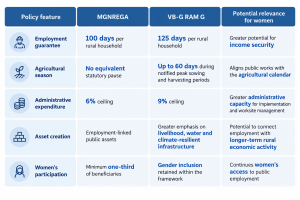
The increase from 100 to 125 days is significant, but it should not be described as a 25% increase in income for women. The guarantee applies to the rural household, not specifically to women. Actual earnings will depend on how many days of work are demanded and provided, the applicable wage rate and the availability of work.
The same caution applies to the new 60-day agricultural pause. It is intended to coordinate public works with peak agricultural seasons. Whether that ultimately benefits rural women will depend on how the pause interacts with women’s own employment patterns and household responsibilities.
Beyond Wages: What Does Employment Mean for Women?
For many rural women, the significance of public employment does not end with the wage.
Being paid for work can mean greater interaction with banks and formal financial systems. MGNREGA payments have increasingly moved towards electronic and Aadhaar-based payment systems, making the delivery of wages more direct.
But having a bank account is not necessarily the same as having control over money.
A more useful measure of financial inclusion is whether women can access their accounts, decide how their earnings are spent and use those earnings to influence household decisions.
This is also where rural employment policy intersects with the wider livelihoods ecosystem.
The Deendayal Antyodaya Yojana – National Rural Livelihoods Mission (DAY-NRLM) has brought more than 10 crore rural women into Self-Help Groups. These groups provide an institutional platform for savings, credit, livelihoods and collective action.
There is therefore an opportunity to think about rural employment as more than a short-term wage intervention.
A woman may enter through public employment, build access to a bank account, participate in a Self-Help Group and eventually gain access to credit, skills or a livelihood activity of her own.
That progression is not automatic. But it is an important policy possibility.
When Higher Female Participation Is Not Necessarily Empowerment
The rise in women’s share of rural public employment is encouraging, but it should not be treated as proof of empowerment on its own.
Consider two very different situations.
In the first, a woman chooses public employment because it offers work close to home, a predictable wage and a degree of financial independence.
In the second, her husband has migrated or found better-paid work elsewhere, private agricultural wages are low, and public employment is one of the few options available to her.
In both cases, the data would show a woman participating in MGNREGA. The economic realities behind that participation, however, are very different.
This is why the term “feminisation” of rural employment needs to be used carefully. A growing female share can reflect expanding opportunities, but it can also reflect the way rural households respond to economic pressure.
The early VB-G RAM G figures make this an especially relevant question. Women accounted for 61.5% of person-days in the initial period of the programme. That is a significant level of participation, but it is too early to conclude from this number alone that women’s economic position has improved.
We need to know what kind of work women are doing, what they earn, how long they remain in the programme and what happens after they leave it.
The Unpaid Work That Employment Data Does Not Capture
There is another part of the story that employment statistics often miss: unpaid work.
Rural women may participate in paid employment while continuing to carry most of the responsibility for childcare, cooking, elder care, water collection and other household tasks.
This creates a double burden.
The availability of a job does not necessarily mean that the conditions for taking that job are in place. Worksite facilities, drinking water, shade, childcare and appropriate task allocation can therefore have a direct bearing on whether women can participate and whether they can sustain that participation.
The increase in the administrative expenditure ceiling under VB-G RAM G, from 6% to 9%, could give implementing agencies greater capacity to manage such requirements. But the 9% should not be described as a dedicated allocation for childcare or other women’s facilities. It is an overall ceiling for administrative expenditure.
The distinction matters because good policy design is only useful when it translates into functioning systems on the ground.
Measuring Women’s Economic Agency
If the objective is to understand whether rural employment programmes are improving women’s economic position, the number of person-days generated is only one part of the picture.
A gender-responsive assessment should ask a few additional questions:
Are women earning more?
Not just how many days they worked, but what their total earnings are and how those earnings compare with other available forms of employment.
Who controls the income?
Does the wage reaching a woman’s bank account actually give her greater control over household spending?
What happens to her workload?
Does paid employment add to an existing burden of unpaid domestic work, or does it replace other forms of work?
Does public employment lead somewhere?
Can women use the experience, income, networks or assets gained through public employment to move into better-paid employment or livelihood activities?
Does participation translate into greater economic security?
Access to credit, savings, productive assets and household decision-making power may tell us considerably more about long-term empowerment than participation rates alone.
These are harder outcomes to measure than person-days. They are also more meaningful.
From Employment Guarantee to Economic Mobility
The transition from MGNREGA to VB-G RAM G comes at a time when women’s role in India’s rural economy is becoming increasingly visible.
The numbers provide a useful starting point. Women’s share of MGNREGA person-days increased from 48% in FY 2013–14 to 58.15% in FY 2024–25. In the initial implementation of VB-G RAM G, women accounted for 61.5% of person-days generated.
But the numbers do not tell us everything.
A high female participation rate can reflect economic opportunity. It can also reflect economic vulnerability. Often, both can be true at the same time.
The more important test for VB-G RAM G will therefore be whether public employment can do more than provide short-term wages.
Can it give rural women greater control over income? Can it work alongside Self-Help Groups and livelihood programmes? Can better worksite conditions make paid employment compatible with unpaid care responsibilities? And can public employment become a bridge to more productive and sustainable forms of work?
If the answer to these questions is yes, then the shift from MGNREGA to VB-G RAM G could represent more than a change in the design of a rural employment programme.
It could become part of a broader transition from employment as a safety net to employment as a pathway to economic mobility.