
Table of Contents


Regulating Right: What India’s MSME Sector Really Need

According to the 73rd Round of the National Sample Survey (NSS), the MSME sector has generated 11.1 crore (111 million) employment opportunities in India, making it the largest provider of jobs after agriculture. More recently, government data from 2025 indicates that the MSME sector now employs over 30 crore people across 7 crore registered units, underscoring the sector’s rapid expansion since the 73rd NSS survey. Its share in GVA has also steadily increased from 27.35% in FY 2021-22 to 30.1% in FY 2022-23.
These numbers reflect just how central the Micro, Small, and Medium Enterprises (MSME) sector is to India’s economic growth, contributing to job creation, manufacturing, and exports. This also presents a significant opportunity for enhancing local investment, but only if the regulatory environment is simplified enough for businesses to actually benefit from it.
Challenges
Despite the Government’s efforts to strengthen the sector, several challenges continue to hold MSMEs back from reaching their full potential.
Regulatory complexity is one of the biggest hurdles. MSMEs must comply with multiple registrations, licences, and approvals across central and state levels. Laws often overlap, compliance costs are high, and the process is time-consuming, especially for micro enterprises that do not have dedicated legal teams to handle this.
Awareness remains a serious gap. Many entrepreneurs, particularly in smaller towns and rural areas, are unaware of platforms like Udyam or the schemes they are eligible for. Even when reforms are introduced, they do not always reach the people they are meant for.
Access to credit also continues to be a challenge. Despite improvements at the policy level, documentation requirements and limited credit history make it difficult for many MSMEs to secure formal financing.
Recent Developments
Recognising these challenges, the Government has introduced several reforms in recent years to ease the regulatory burden and improve access to support.
Revised Classification Framework
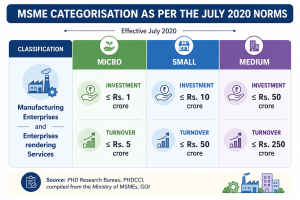
The Government revised the MSME classification framework effective July 2020, introducing a composite criterion based on investment in plant and machinery and annual turnover. Crucially, this framework unified the definition across both manufacturing and service enterprises, eliminating the earlier distinction between the two. In March 2025, the Government further revised the thresholds upward (by 2.5x on investment and 2x on turnover), signalling that the 2020 framework was the starting point of a longer, evolving reform process.
Boosting Formalisation and Credit
Several targeted initiatives have been launched to bring more enterprises into the formal economy and improve financial access. As of May 2025, over 2.69 crore informal micro enterprises have registered through the Udyam Assist Platform alone, which gives a sense of how large the gap between the informal and formal economy actually is, and why these initiatives matter.
- Udyam Assist Platform – The Government launched the Udyam Assist Platform with the aim of fostering formalisation, financial strength, and sectoral inclusion. The platform has brought informal micro enterprises into the formal fold and made it easier for them to access schemes and credit support.
- Inclusion of Retailers and Wholesalers as MSME – Retailers and wholesalers have now been classified as MSMEs, allowing them to access sector-specific schemes and formal financial support. This inclusion is expected to strengthen their operations and encourage broader participation in government initiatives.
- Credit Guarantee and Collateral-Free Loans – The government has boosted credit guarantees and collateral-free loan limits to help MSMEs access easier financing. Enterprises can now obtain higher amounts without the need for physical assets as security, making growth and expansion more achievable.
- Expanded PMEGP Project Cost Limits – The government has increased the maximum project cost limits under the Prime Minister’s Employment Generation Programme (PMEGP) for both manufacturing and service sectors. This expansion will support larger entrepreneurial ventures by enabling higher financial assistance and encouraging more ambitious MSME projects.
The Gap Between Policy and Ground Reality
Even as reforms have been introduced, a significant gap persists between policy intent and what actually reaches MSMEs on the ground. A 2025 report by TeamLease RegTech found that a typical manufacturing MSME operating in a single state faces over 1,450 compliance obligations every year, with annual compliance costs running between Rs 13 to Rs 17 lakh.
For an enterprise with modest turnover, that is not a minor administrative inconvenience, but a real drain on resources that could otherwise go toward hiring, expansion, or technology.
Regulatory complexity remains a live challenge. Laws still overlap, compliance costs stay high, and frequent policy changes leave entrepreneurs uncertain about what applies to them. Furthermore, many entrepreneurs, particularly those operating informally or in smaller towns, remain unaware of registration platforms like Udyam or their own eligibility for government schemes. As a result, a large number of MSMEs continue to operate informally or simply lose out on the support that was meant for them, limiting the real-world impact of reforms.
Way Forward
India’s MSME sector has the foundation to become an even stronger engine of growth. What it needs right now is not more policy announcements, but the discipline to make the reforms already in place work better on the ground.
A few key steps can make a meaningful difference.
The single-window system needs to work, not just exist.
The National Single Window System was launched in September 2021 with the promise of consolidating central and state approvals on one platform. As of October 2024, 7.1 lakh approvals had been applied for, and 4.81 lakh granted – real progress on paper. But three years on, the experience on the ground tells a different story. Not all state governments are fully onboarded, and some approvals still route users to separate portals. A single window that leads to multiple windows is not reform. It is rebranding. What is needed now is genuine backend integration, not just a unified front-end interface.
Awareness campaigns must be tied to real outcomes.
The more important question is not whether MSMEs know about government schemes, but whether those schemes are actually delivering value. Telling small businesses to register on Udyam or apply through NSWS makes sense only if those platforms reduce burden and deliver tangible outcomes in a reasonable timeframe. Outreach without outcome is noise. Any awareness push must therefore be paired with a feedback mechanism – district-level grievance redressal, scheme utilisation data, or periodic third-party audits – so that the government knows what is working and can fix what is not.
Credit infrastructure needs to reach deeper, with clarity on who does what.
The banking correspondent model has been RBI policy for years, but access in Tier 2 and Tier 3 cities still remains uneven. The challenge is structural: deploying correspondents in low-volume areas is often not commercially viable for banks, and many first-generation entrepreneurs lack the documentation or digital literacy to navigate even simplified loan processes. Expanding fintech partnerships and creating incentive structures for last-mile credit delivery in underserved districts, with clear accountability and monitoring – is where both government and private sector have a defined role to play.
Finally, periodic regulatory reviews – that identify and phase out outdated or overlapping rules would signal a genuine, sustained commitment to reform and not just a one-time push.
For a deeper look at how policy can support long-term resilience and inclusive growth, read
Public Policy for Sustainability and Green Economic Growth
Conclusion
India’s MSME sector does not lack ambition or policy intent. What it needs is the discipline to follow through, to measure whether reforms are working, and to fix what is not.
Policy changes by themselves are insufficient to fully unlock MSMEs’ growth potential. Additionally, significant efforts must be made to increase awareness and offer support on the ground. Simple actions like quick registration, useful workshops, and industry associations’ assistance can have a significant impact. MSMEs can expand more quickly, obtain credit more readily, and draw in more local investment when they comprehend and effectively utilise government benefits. MSMEs will be better able to support India’s economic growth with this combined strategy.
FAQs
References:
National Sample Survey Office, Ministry of Statistics & Programme Implementation. 73rd Round: Unincorporated Non-Agricultural Enterprises, 2015-16. New Delhi: Government of India, 2016.
Ministry of Micro, Small and Medium Enterprises, Government of India. Annual Report 2022-23. New Delhi: MoMSME, 2023.
Ministry of Micro, Small and Medium Enterprises, Government of India.Notification S.O. 1364(E): Revised MSME Classification Criteria. New Delhi: Government of India, March 21, 2025.
PHD Research Bureau, PHDCCI.MSME Classification Data, compiled from the Ministry of MSMEs, Government of India. New Delhi: PHDCCI.
TeamLease RegTech.Decoding Compliance for Manufacturing MSMEs in India. Bengaluru: TeamLease RegTech, 2025.
Disclaimer: The views expressed in this article are those of the scholar/guest speaker and do not necessarily represent the views of the Indian School of Public Policy (ISPP). ISPP assumes no responsibility for any errors, omissions, or opinions expressed in this blog.