
Table of Contents


Before the Curve Bends: India’s Narrowing Window on Urban Planning

India is still known as a predominantly rural economy. While that may be statistically true, the trajectory India has followed reflects a shift in its realities. The latest Census, conducted in 2011, states that around 31.16% of India’s population, accounting for nearly 377 million people, lived in urban areas (Census of India, 2011). According to our study, this 30% mark tells us far more than it appears to as a mere number.
India at the Bend in the Curve
Urbanisation is often plotted in the pattern of an S-curve, a slow rise, a steep surge, and then a gradual levelling off (Mulligan, 2013). These patterns had different drivers in different countries: some were shaped by agriculture, others by industrialisation, and still others by advances in science and technology. But despite these different starting points, the shape of the curve was strikingly similar. There is no universal mark at which every country’s growth accelerates. But it most certainly tells us which stage to watch for. The question is whether India has reached that stage, and what its own numbers reveal when set against countries that have already passed through it.
India started with an urban population of 11% in 1900. It progressed to 17% in 1951, 23% in 1981, and 28% in 2001. By 2011, it had reached 31.16%. about 14 percentage points over six decades, or roughly 2.4 points per decade on average.
What Other Countries Tell Us
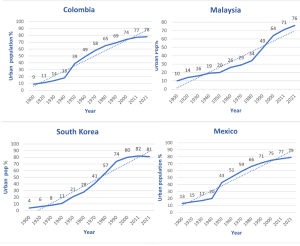
Compared with other economies at a similar stage, this steady growth appears less like stability and more like a coiled spring. South Korea was 28% urban in 1960. It then gained 46 percentage points over the next three decades. Malaysia was 29% urban in 1970 and gained 35 points by 2000. Mexico was around 20% urban in 1940 before rising to 43% by 1950 and continuing its upward trajectory in the decades that followed. Colombia was around 18% urban in 1940 and rose to 39% by 1950, before sustaining its urban expansion over the following decades. Their transitions arose from different combinations of industrialisation, demographic change, rural migration and public investment. What they shared was a sustained change in the pace of urban growth.
The comparison shows that the rapid middle stage did not begin at one universal percentage, but it did begin while these countries were still at relatively low or intermediate levels of urbanisation. Once it began, it continued for decades. India’s current position therefore makes advance planning prudent, even though its precise trajectory cannot be predicted.
India’s Urban Paradox
India has not displayed any such acceleration yet. But it now stands at approximately the same point where these four countries stood just before their curves bent sharply upwards. That is reason enough to ask what this could actually look like beyond the graphs.
Economists and policy experts have increasingly described India’s present moment as an urban paradox (Ministry of Finance, 2026a). The Economic Survey 2026 states that the country’s population scale has not yet translated into proportionate economic influence and liveability. This is partly due to inadequate infrastructure investment, which has converted the potential benefits of density into congestion and stress.
India’s cities already generate 63% of national GDP. The World Bank projects that this will rise to 75% by 2036 (Khalil et al., 2025). This indicates that, if managed well, India could advance towards its Viksit Bharat ambition of becoming a developed nation by 2047. But time is running out, and the moment is closer than we may realise.
The Numbers May Be Moving Faster Than We Think
Official figures may also struggle to capture the speed and spatial complexity of India’s urban transformation. Kerala offers an instructive example. The 2011 Census recorded the state as 47.72% urban, almost double its 2001 share of 25.96%. Kerala’s unusual settlement pattern, however, does not resemble a simple division between dense cities and clearly rural hinterlands. Urban growth has spread through smaller towns, peripheral settlements and a wider urban–rural continuum. Kerala government projections, based on Census data and the National Commission on Population’s estimates, place its urban share at 71.01% in 2021 and 81.38% in 2026 (Government of Kerala, 2026).
These are projections rather than new Census observations, but they illustrate how rapidly the character of settlement may be changing between official population counts. If similar gaps emerge in other states, this would imply that India is at a far more critical stage than the 2011 Census data alone suggests.
Planning Before the Pressure Arrives
The graphs indicate that India may be heading towards the same steep rise witnessed in other countries. What they cannot determine is what kind of rise it will be; whether it will be a planned and orderly transition, or one that places an additional burden on cities already stretched thin. That answer will depend on the choices India makes for its future.
For instance, the much of the pressure is likely to fall on India’s biggest cities: Delhi, Mumbai, Bengaluru, Chennai, Hyderabad, Kolkata and Pune, already experiencing severe infrastructure and environmental pressure. If the coming wave of urban growth continues to pile onto the same cities, the outcome may be the very congestion and urban stress that the Economic Survey 2025-2026 has warned about.
The alternative must be deliberate: building secondary cities and district-level hubs before the pressure arrives, so that migration has viable destinations. Budget 2026–27’s City Economic Regions gesture in this direction (Ministry of Finance, 2026b). Whether they move quickly enough will be the real test.
The pace of this transition will also depend heavily on the scale and timing of investment. The infrastructure South Korea and Malaysia built was often created in advance and required substantial expenditure. Indian cities, on the other hand, are currently financing barely 15% of what cities need through their own revenues (Athar et al., 2022).
Economic Survey 2025-2026 and NITI Aayog’s recent urban-reform assessments have converged on the same set of priorities: sustainable and transit-first city design, financially empowered municipal bodies, and a genuine push towards secondary cities rather than metro-centric growth (Ministry of Finance, 2026a; NITI Aayog, 2026).
None of these suggestions is entirely new. But the urgency to put them into action is greater than ever before.
India’s story need not reproduce another country’s successes or inherit its mistakes. But it must be shaped deliberately, and soon. Our study of the S-curve is not a prediction: it is a warning that India now has a narrow window to act, and that this window will not remain open indefinitely.
The choice before India is not whether its cities will grow. They will. The real choice is whether that growth continues to concentrate in cities already burdened by congestion, inadequate services and ecological stress, or whether it is directed towards stronger secondary cities, transit-linked housing, resilient infrastructure and financially empowered municipal bodies.
If planning comes too late, it loses the ability to guide growth in advance. It is then reduced to a mere response to the pressure already arrived: widening roads after congestion has become entrenched, building housing after land has turned unaffordable, and repairing ecological damage after urban expansion has already overtaken it.
India must plan before the curve bends. The window to act is narrow, but it still offers a rare opportunity to shape an urban future that matches the scale of India’s growth and ambition.
For more on how transit-oriented development can help India build more liveable and sustainable cities, see our analysis of the Transit-Oriented Development approach.