
Table of Contents


Making Cities Liveable Again: The Transit-Oriented Development Way
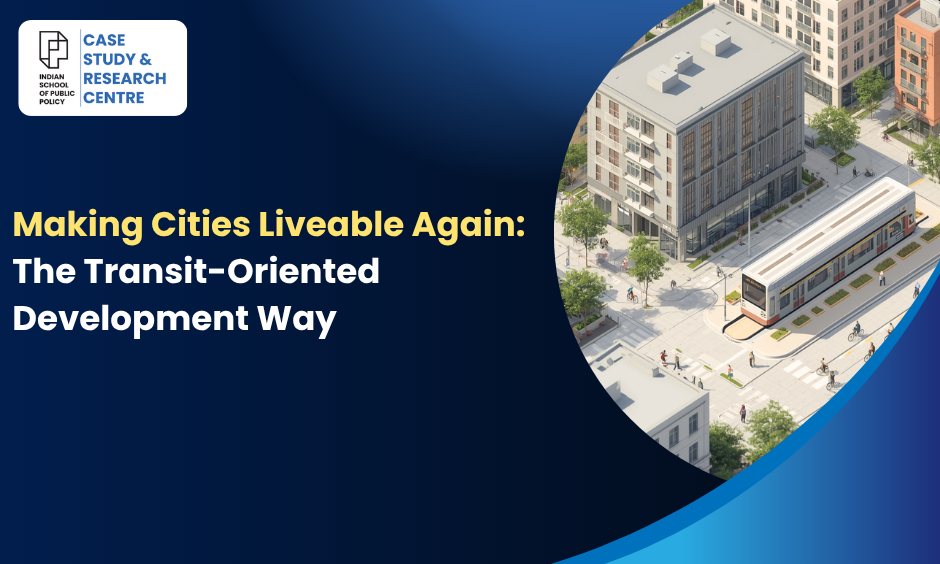

Indian cities are growing fast and expanding outward, leading to longer and longer commutes, which in turn cause choking traffic, rising pollution, and infrastructure that cannot keep pace with population growth. If that were not bad enough, financing compatible infrastructure amid poorly financed urban local bodies (ULBs) prevents sophisticated solutions from being implemented.
Now imagine stepping out of your home, grabbing coffee, walking five minutes to a metro station, and reaching work, all without touching a car or an autorickshaw. This is not a utopian dream but rather something that is possible under the Transit-Oriented Development (TOD) urban planning system.
Utopian Reality
To put it simply, TOD is an urban planning approach that builds dense, mixed-use communities within easy walking distance of public transit stations. The idea is simple: places like homes, offices, shops, schools, and parks are close together around a transit hub. This model could give people a real alternative to driving. Academically speaking, it operationalizes the integration of land-use and transport planning through the “3D framework”: density, diversity of uses, and pedestrian-friendly design, in order to maximize transit ridership and minimize vehicle dependence.
TOD flips the model of cities growing outward and spreading thin; instead, they grow smart, upward, and inward around transit hubs known as corridors. This not only makes commuting easier but also makes neighbourhoods more liveable, with better footpaths, cycling lanes, parks, and public places built right in. TOD as a concept has been operational for quite some time, with tremendous success in countries like Singapore and China.
Remember the financing dilemma? This is where TOD becomes even more interesting. Believe it or not, TOD finances itself through a mechanism called Value-Capture Financing (VCF), where the rise in property values around a new transit line is partially recovered by the government and reinvested back into the project. It is a virtuous cycle: better transit systems raise land values, and when those gains are captured, they fund even better infrastructure.
Now, you may be thinking, “Great! The rich get richer.” But one of the tenets of TOD is the principle of inclusivity, not exclusivity. Thus, most policies typically reserve 10–15% of housing in TOD zones for economically weaker sections.
India’s Journey
India took a formal step in this direction with the National TOD Policy in 2017, released by the Ministry of Housing and Urban Affairs. Cities like Delhi, Bengaluru, Ahmedabad, Uttar Pradesh, and Hyderabad have begun earmarking TOD zones in their city master plans. The Delhi-Meerut RRTS stands out as one of the first projects in India to embed TOD and innovative financing right from the drawing board. Many states have created their own version of a TOD policy that can facilitate this growth within their state.
India’s vision centres around the idea that cities are built around people by building cities around transit.