


Table of Contents


Agricultural Reform in the Digital Era: A Public Policy Perspective
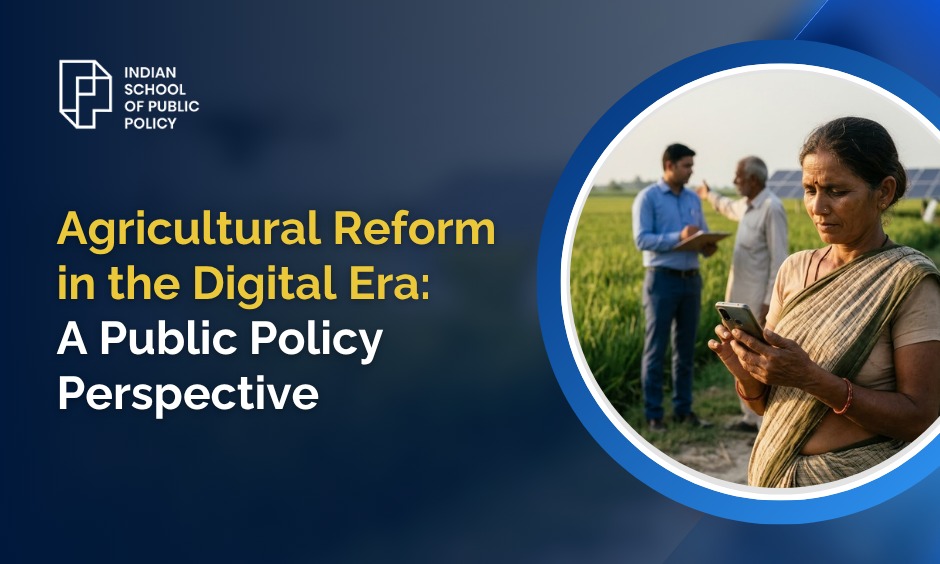

The Government of India, in the last few years, intensified a set of farming-related programmes with the objective to enhance farmers’ income and climate resilience. These initiatives, while focusing on new farming techniques, have been linked to digital infrastructure created for agriculture. Together, they help integrate incentives with good farming practices. The government highlighted this through a press note in February 2026.
The Rainfed Area Development scheme focuses on integrated farming systems for enhancing productivity and minimizing risks associated with climatic variability. Similarly, the Soil Health & Fertility scheme is to promote integrated nutrient management. Some schemes have also been consolidated under the National Mission for Sustainable Agriculture (NMSA). The Sub Mission on Agricultural Mechanization (SMAM), for instance, has been implemented since 2014-15 through States/UT governments. It is now being implemented under the Centrally Sponsored Scheme of Rashtriya Krishi Vikas Yojana (RKVY).
To enable farmers to access benefits under various schemes and to assess their progress as of February 2026, more than 8.48 crore farmer IDs have been generated across the country. Platforms under the Digital Agriculture Mission aim to organise information on farmers, land, and crops. This data can then be used across schemes such as Pradhan Mantri Kisan Samman Nidhi and Pradhan Mantri Fasal Bima Yojana.
Evolution of agricultural policy instruments
The agricultural policies of the past have relied on government programmes to improve productivity while safeguarding farmers from various hazards. The Per Drop More Crop programme, the Rainfed Area Development programme and, the Soil Health and Fertility initiative, for instance, serve as programmes that help promote water conservation and sustainable soil management practices.
Mechanisation has also been an important area of intervention. The Sub Mission on Agricultural Mechanisation supports the distribution of farm equipment and the establishment of custom hiring centres, thus allowing small and marginal farmers to access the required machinery.
Digital public infrastructure in agriculture
Alongside these programmes, digital systems are now being introduced to support agricultural administration. Under the Digital Agriculture Mission, platforms such as AgriStack are being developed to organise data on farmers, land, and crop patterns through registries maintained by state governments.
These systems also connect with existing schemes. The Farmer ID can be used for programmes such as Pradhan Mantri Kisan Samman Nidhi and Pradhan Mantri Fasal Bima Yojana. Tools such as digital crop surveys and decision-support platforms also generate data that can assist agricultural planning.
Policy design considerations
Digital systems are being introduced alongside existing robust agricultural schemes. Platforms such as AgriStack and the Farmer ID system connect farmer data with programme delivery.
In practice, this means that information collected through digital platforms can be used for schemes such as Pradhan Mantri Kisan Samman Nidhi and Pradhan Mantri Fasal Bima Yojana. The same data may also support monitoring and administrative processes.
Conclusion
Recent policy measures show that digital tools are beginning to play a larger role in agricultural programme administration. Registries, crop surveys, and advisory systems are being added to the existing framework of agricultural schemes.
How these systems function in practice will depend on how they are implemented within current institutional arrangements and government programmes.
(Source: https://www.pib.gov.in/PressReleasePage.aspx?PRID=2225993®=3&lang=1)