
Table of Contents


AI Social Scoring: What Should India Permit, Restrict and Ban?

AI-powered social scoring systems assign numerical ratings to people based on their financial, social, or digital behaviour and those ratings can then affect access to services, opportunities, or public benefits. The EU AI Act prohibits social scoring by public authorities when it leads to harmful or disproportionate treatment, while China’s Social Credit System is better understood as a patchwork of national and local programmes rather than a single unified model.
India already has the digital infrastructure that could support narrow, domain-specific scoring systems, including Aadhaar, UPI, ONDC and the Account Aggregator framework, but it has not yet drawn clear legal boundaries around such uses. The real policy question is not whether India will ever use scoring, but which kinds of scoring it should permit, restrict or forbid.
What India should not adopt
India should not adopt comprehensive social scoring in the Chinese sense. At the same time, it should not treat every use of behavioural data as equally harmful. The better approach is to distinguish between narrow, domain-specific risk assessment and broad cross-domain social scoring. The former can serve limited administrative purposes the latter creates serious risks of exclusion, discrimination and overreach.
Why the risk is real
The dangers are twofold.
First is the data-quality problem: a scoring system is only as reliable as the data it uses and India’s public datasets still contain errors, exclusions and coverage gaps. The Aadhaar-linked ration-card experience shows how these weaknesses can affect real beneficiaries.
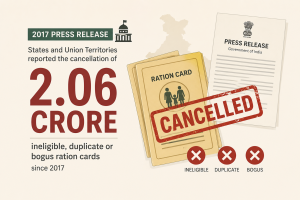
In a 2017 press release, the government said States and Union Territories had reported the cancellation of about 2.06 crore ineligible, duplicate or bogus ration cards since 2017, while also directing authorities not to delete genuine beneficiaries for technical reasons. A scoring system built on such data would risk reproducing and amplifying those errors, especially for rural households, informal workers and linguistic minorities.
The second problem is institutional: Social scoring requires a legal and regulatory architecture strong enough to provide oversight, contestation and grievance redressal. Without clear rules on transparency, explanation, appeal and human review, automated scoring can become arbitrary even when it appears efficient.
India’s Digital Personal Data Protection framework improves privacy protections, but it does not yet create a full system of rights against harmful automated decision-making law.
What should be allowed
That is why the middle of the debate should be framed around bounded scoring, not open-ended social scoring. India already uses narrow scoring or profiling tools for specific purposes: GST compliance ratings identify audit risk, CIBIL scores shape credit assessment, and SEBI-style risk profiling matches products with investor suitability. These tools are not the same as a comprehensive social scoring system, because they are limited to one domain, tied to a defined objective and capable of being reviewed or challenged. The policy task is to improve and regulate such bounded systems, not to let them expand into cross-domain ratings of citizens.
Legal guardrails
India should therefore set legal guardrails now. The Constitution already provides the legal basis: Article 14 limits arbitrary classification, Article 21 protects life and personal liberty, and the Supreme Court’s privacy judgment in Puttaswamy case makes clear that state data practices must respect fundamental rights.
Those principles support rules that prohibit cross-domain scoring, require human review for significant automated decisions, and give individuals a right to understand and contest adverse outcomes. India does not need to wait for the EU’s language to discover this logic, it needs to turn that logic into its own legal framework.
Why the EU matters
The EU AI Act is useful here not because it reacted after social scoring emerged, but because it set a prospective boundary before such practices became normalised. India should do the same: draw the line early, permit only tightly bounded and purpose-specific scoring, and prevent those systems from becoming a general mechanism for ranking citizens.
References:
EU AI Act (2024) – Article 5: Prohibited AI Practices Regulation (EU) 2024/1689 of the European Parliament and of the Council. Article 5(1)(c) specifically prohibits social scoring. Enforceable from February 2025.
Drèze, J. & Khera, R. (2017) – Aadhaar Exclusion Errors “Aadhaar and food security in Jharkhand: Pain without gain?” – documents exclusion errors of up to 20% in areas with biometric authentication requirements.
Disclaimer: The views expressed in this article are those of the scholar/guest speaker and do not necessarily represent the views of the Indian School of Public Policy (ISPP). ISPP assumes no responsibility for any errors, omissions, or opinions expressed in this blog.