
Table of Contents


Beyond Screening – India’s NCD Challenge Is Continuity of Care
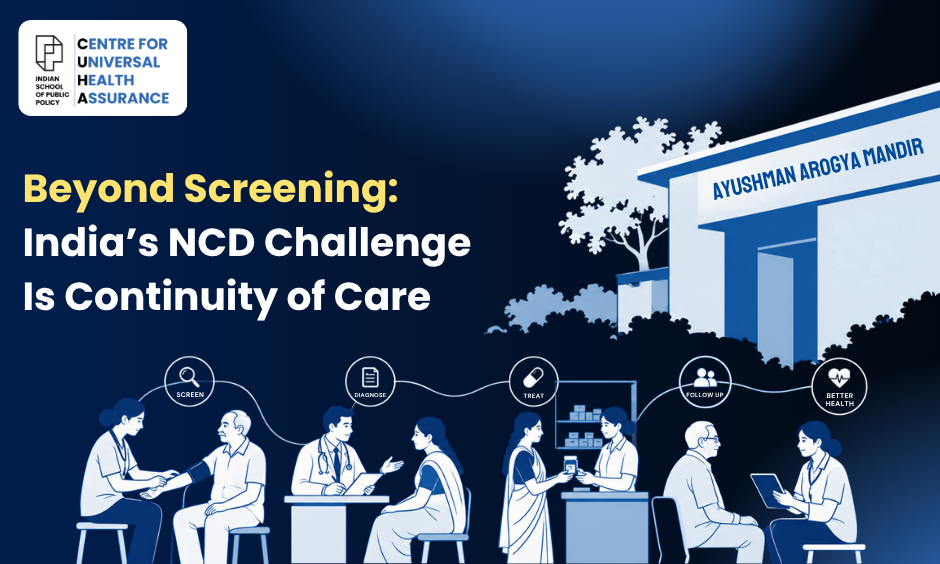
For decades, India’s health system was largely shaped around tackling infectious diseases, malnutrition and maternal and child health emergencies. These challenges remain important. But alongside them, India is facing another growing health challenge: non-communicable diseases (NCDs).
According to the WHO NCD Country Profile 2018, NCDs accounted for an estimated 63% of all deaths in India.
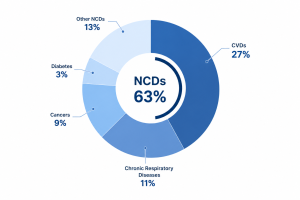
NCDs have come to account for an increasingly large share of India’s health burden. India is now dealing with a double burden: infectious diseases and malnutrition alongside the growing challenge of chronic disease.
The newly released National Family Health Survey (NFHS-6, 2023-24) shows that 17.8% of Indian women and 20.9% of men now have high or very high blood sugar or are taking medication to control it. It rose from 13.5% and 15.6% respectively for women and men in NFHS-5 (2019-21). Elevated blood pressure or its treatment affects roughly one in five adults. These are not merely projections. They are measurements from a national-level survey.
The ICMR-INDIAB study, published in The Lancet Diabetes & Endocrinology in 2023, estimated that approximately 101 million Indians live with diabetes and 136 million with prediabetes. Roughly 315 million Indians were estimated to have hypertension according to the same study. The two studies have used different methodologies and definitions, but they point towards the same direction. Hence, India’s NCD burden is not a future risk to plan for anymore.
For a broader look at these challenges, see ISPP’s Healthcare Policy: Pathways to a Healthier Nation.
NCDs break the usual urban-rural pattern as well. Urban India has higher concentration of hospitals, specialists and diagnostic labs, yet the burden is higher in urban India than in rural. Elevated blood pressure affects 23.5% of urban women versus 17.8% of rural women; elevated blood sugar, 21.9% versus 16.2% respectively. This suggests that the NCD challenge cannot be understood only through the lens of healthcare access. Chronic diseases behave differently from acute diseases. A person living with any chronic disease needs a continuum of care that involves screening, diagnosis, medicines, adherence support, monitoring, lifestyle counselling and referral when there are complications.
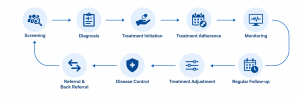
A break in care at any point can undermine any progress made. Hence, availability of medicine is equally important as availability of machines for screening. Gradually India has been adapting its health system to this shift in disease profile. The National Programme for Prevention and Control of Non-Communicable Disease (NP-NCD), previously known as the National Programme for Prevention and Control of Cancer, Diabetes, Cardiovascular Diseases and Stroke (NPCDCS), was launched in the year 2010. Initially it was launched in 100 districts across 21 states. Later it was scaled up nationwide. The focus of this policy has also shifted from prioritising only major or common NCDs to a broader package consisting of prevention, early detection, treatment, referral and follow-up.
This is where Ayushman Arogya Mandirs (AAMs) have a big role to play. By October 2025 over 180,906 AAMs were operationalised nationwide and they had conducted hypertension and diabetes screenings (387 million hypertension screenings and 360 million diabetes screenings) through the NP-NCD. Screening is only the beginning of the process; the harder part is the continuity of care. The health system must see through the entire process. According to the NP-NCD guidelines patients should receive medicines regularly and once the condition is stable medicines to be supplied at the sub-centre level. The workforce is equally important. The existence of AAMs does not ensure continuity. Here comes the role of healthcare workers. They track patients, counsel them, check whether the treatment is working, identify and escalate if the disease is not in control and also encourage patients to follow the instructions. The national NCD portal shows that approx. 93.6 million patients are under treatment for hypertension and diabetes.
This is also where robust health financing planning is extremely important. Through NP-NCD and AAMs, the public system is supposed to provide essential medicines, diagnostics and primary care. AB PM-JAY gives financial protection for secondary and tertiary hospitalisation. Both forms of financing are equally important but they address different problems in the care pathway. The issue with chronic diseases is that a patient might need regular monitoring and medicines for years before a complication requires hospitalisation. These recurring costs might appear as a small amount individually but it accumulates over time. If the essential primary care medicines and diagnostics are not available then the patient will have to pay out-of-pocket or forgo care altogether. Also, insurance protection that only covers hospitalisation does little to address the everyday cost of staying well. Therefore, for NCDs financial protection cannot be seen separately from continuity of care.
NFHS-6 has given India a clearer picture on the scale of the problem. India has built the foundations to address the issue of NCDs. The next couple of years will show whether India’s primary care has learned to treat a chronic disease and not just simply detect one. What remains to be seen is whether India can build not just infrastructure, but continue the unglamorous, unfinished work of keeping a patient in the system after the first visit.