
Table of Contents


Fragility, Conflict and Violence: What Everyday Resilience Teaches Us About Policy

When we picture the threats that could undo the world, our minds reach for the catastrophic. A great war, a big tsunami or even worse, an economic crash, and now the latest, a rogue AI. These are the threats that fill our minds. And precisely because they are so loud, they tend to drown out a seemingly unusual suspect of a catastrophe, the one already unfolding in the everyday lives of people living amid fragility, conflict and violence.
That was the provocation at the heart of a recent Harris Lecture Series session at the Indian School of Public Policy (ISPP), delivered by Dr. Mareike Schomerus. A widely published researcher on violent conflict and peace processes, with field experience stretching from South Sudan to Uganda, Schomerus has spent her career studying how societies hold together when the conditions for falling apart are hard to miss. She is also the lead author of the World Bank study Handle With Care, which gave us the framework at the centre of this talk. Before research, she was a broadcast journalist, and it shows in how she tells a story.
Her central question was simple. What changes about our policy thinking when we stop treating fragility as a distant emergency and start treating it as a set of everyday actions, behaviours and choices?
The threat we have learned to ignore
The numbers are hard to look away from. Roughly one in six people on the planet is currently exposed to conflict. And by 2030, close to 60% of the world’s extreme poor are projected to be living in countries affected by the trio of fragility, conflict and violence.
Let’s sit with that for a moment. Poverty and instability are not drifting apart. They are converging, and they are converging in exactly the places least equipped to cope. Whatever we think the global development project is for, this is the terrain on which it will succeed or fail.
So why does it stay in the background? Partly because fragility resists the kind of clean storytelling that mobilises attention usually. It has no single villain and no single fix. Which is exactly why it needs better tools to think with.
Fragility is not a snapshot
One of Schomerus’s early points was that we tend to misunderstand fragility by freezing it. We treat it as a state a country is in, like a temperature reading. In reality, she argued, fragility is cumulative and dynamic. It builds, it compounds, and it shifts. A shock that a stable society absorbs without noticing can tip a fragile one into crisis.
She pointed to the OECD’s States of Fragility work, which refuses to flatten the problem into a single score. Instead it reads fragility across six dimensions at once: economic, environmental, human, political, security and societal. It admits that a country can be holding together economically while fracturing along societal or environmental lines, and that the cracks often intersect.
The lesson for policy is uncomfortable. If fragility is multidimensional and moving, then any intervention designed for a single dimension is, at best, half a plan.
The uncomfortable truth about resilience
Here the lecture turned genuinely against the grain. In the development world, “resilience” is a feel-good word. It signals strength, recovery, and the capacity to bounce back. Schomerus asked us to be far more careful with it.
Resilience, she argued, is not automatically a good thing. A system can be remarkably resilient and also deeply harmful. A corrupt patronage network is resilient. A community that survives by entrenching the very hierarchies that oppress it is, in its own way, resilient. When policymakers chase resilience as an unqualified goal, they can end up reinforcing the structures that produced the fragility in the first place.
This is the part most likely to make a practitioner pause. It means the right question is never simply “how do we build resilience?” It is “resilience of what, for whom, and at what cost?”
ABCD Framework
To make that question workable, Schomerus offered the ABCD framework, developed through her World Bank research. It breaks resilience down into four interlocking elements:
- Actions and Actors: Who is actually doing the coping, and what are they doing?
- Behaviours and Beliefs: What norms, expectations and worldviews drive those choices?
- Contextual Characteristics: What does the surrounding environment make possible or impossible?
- Dependencies: How do all of these connect, and what happens to one element when another shifts?
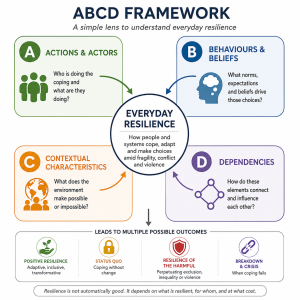
The framework’s real contribution is that last letter. Dependencies force us to see “resilience” as a web rather than a checklist. It also bakes in the earlier warning, by acknowledging that resilience can lead to several possible outcomes, and that not all of them are ones we should want.
What is worth emphasising for anyone in policy is how this framework was built. It was not assembled from intuition. It came from a systematic literature review, document analysis, expert consultations and case studies, with the method laid out transparently enough that someone else could interrogate it. That is qualitative research done with the same rigour we usually reserve for the quantitative kind.
Does research discover, or does it interpret?
Schomerus opened the session with a question to the room. Does research uncover mechanisms that already exist in the social world, or does it offer one interpretation among many? Most of the audience landed on interpretation, though the discussion also acknowledged that rigorous research could uncover mechanisms while still offering an interpretation of them.
That tension ran through the whole talk. Schomerus’s own position was that in complex policy problems, certainty is the wrong target. The honest aim is plausibility. The discussion of mixed methods in economics reinforced her core argument: numbers tell you what is happening, but they rarely tell you why, or what it means to the people living it. Good policy research needs both, and it needs to say plainly which is which.
She was also sceptical of one of development’s favourite instincts, the urge to “scale” what works by turning it into a number and replicating it everywhere. Context, she argued, does not scale cleanly. A flexible approach that names its trade-offs travels far better than a rigid model that pretends context does not matter.
Why emotions belong in policy
Perhaps the most radical claim of the evening was that emotion is not noise to be filtered out of policy. It is data.
Schomerus pointed to figures like Greta Thunberg and Frances Haugen, people who shifted entire policy conversations less through statistics than through testimony. A single credible human voice can move a debate that years of reports could not. Schomerus argued that emotional data should be approached through a discipline of multiple methods used in combination, each compensating for the blind spots of the others, rather than through a single tidy formula.
The deeper point is that interpretation is always happening anyway, even in our most “objective” statistics. Pretending otherwise does not make research neutral. It just makes the interpretation invisible.
From evidence-based to credible voices, testimonies
The most interesting thing about this lecture was that it refused to hand anyone a silver bullet. It replaced the comfortable image of policy as a straight line, research goes in, decisions come out, with something far closer to the truth: a messy, looping, deeply human process where evidence and politics keep talking back to each other.
What it asks of us is a kind of honesty. To admit that fragility is moving while we study it. To accept that resilience can do harm. To take emotion seriously without surrendering rigour. And to design policy as a set of trade-offs we own, rather than a formula we hide behind.
Which leaves the question Schomerus seemed to want us carrying out of the room. If everyday lives caught in fragility, conflict and violence are where so much of the world’s suffering will concentrate over the next decade, can we really afford to keep letting the louder threats crowd them out?
References:
-
Organisation for Economic Co-operation and Development (OECD). States of Fragility 2022. Paris: OECD Publishing, 2022.
-
Batmanglich, Sara, Catherine Defontaine, Mareike Schomerus, and Yu Rim Kim. Handle With Care: Resilience to Fragility, Conflict, and Violence (FCV Resilience). Washington, DC: World Bank, 2026.
-
World Bank. World Bank Group Strategy for Fragility, Conflict, and Violence 2020–2025. Washington, DC: World Bank, 2020.
Disclaimer: The views expressed in this article are those of the scholar/guest speaker and do not necessarily represent the views of the Indian School of Public Policy (ISPP). ISPP assumes no responsibility for any errors, omissions, or opinions expressed in this blog.