


Table of Contents


G RAM G Act for Viksit Bharat: Reforming Rural Employment Policy in India

The rate of unemployment or joblessness in the country among persons aged 15 years and above rose moderately to 5% this January from 4.8% in December 2025, according to the government’s periodic labour force survey released in February. The latest Periodic Labour Force Survey (PLFS) data also reflect a lower labour force participation rate (LFPR) as well as lower workers population ratio (WPR) across the rural and urban areas. Overall LFPR for persons aged 15 years and above reported as 55.9% in January, 2026 compared to 56.1% in December, 2025.
According to the National Statistics Office (NSO) under the Central Government the drop in LFPR and WPR, and rise in Unemployment Rate in January was primarily rural India-driven, with seasonal factors including post-harvest slack playing a key role1.
Government Response: Introduction of the VB-G RAM G Act
Considering that the Government’s focus is on reducing unemployment rate and intensifying job creation this is concerning. For instance, it has revamped its flagship employment scheme MGNREGA (Mahatma Gandhi National Rural Employment Guarantee Act) into a more promising Viksit Bharat Guarantee for Rozgar and Ajeevika Mission Gramin Act (VB-G RAM G), in December 2025. The revamped programme, VB-G RAM G is designed to plug the gaps found in MGNREGA as perceived by the government.
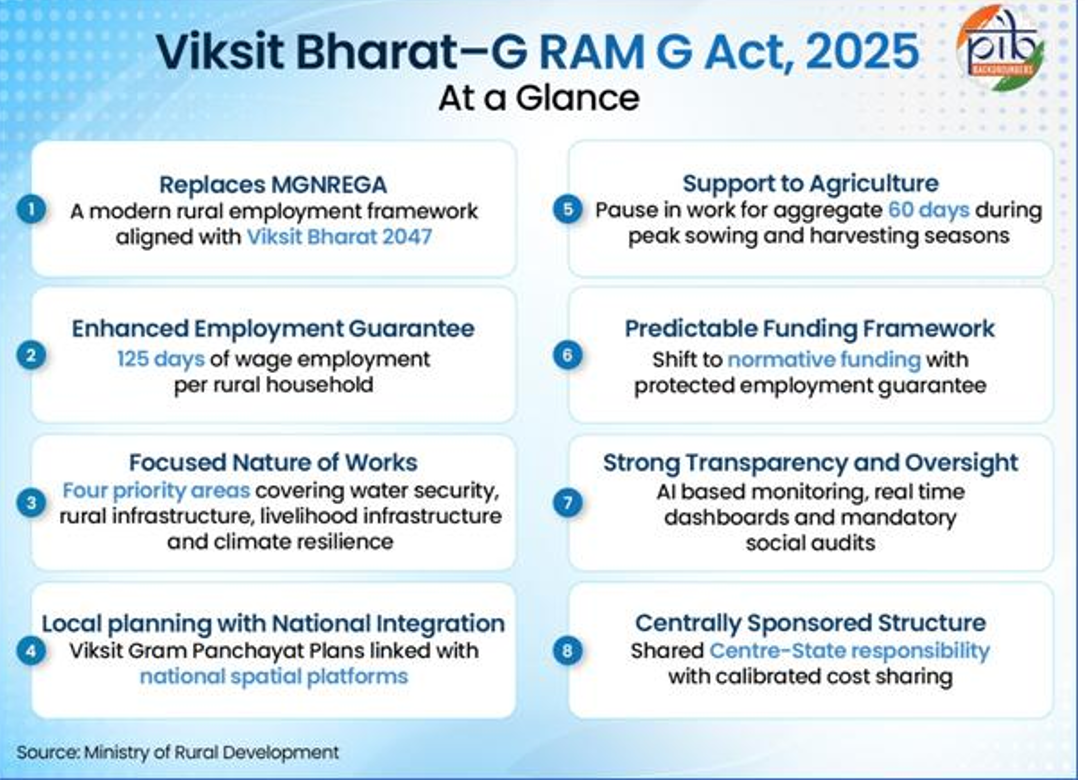
Given below are the key features of the VB-G RAM G Act:
- Enhanced statutory guarantee of not less than 125 days of wage employment against 100 days in MGNREGA
- States to notify a pause period aggregating to 60 days in a financial year to facilitate availability of agricultural labour during peak sowing and harvesting seasons
- Focus on timely payment of wages and a compensation as penalty for delays.
- Providing water security, core-rural infrastructure, livelihood- related infrastructure and providing climate resilience.
- Strengthen the implementation framework by increasing the administrative expenditure ceiling from 6% to 9% providing greater support for staffing, remuneration, training, and technical capacity.
Limitations Observed in MGNREGA Implementation
The Government felt that while delivery systems improved, the overall architecture of MGNREGA had reached its limits2. Monitoring across several states revealed gaps which included work not found on the ground, expenditure mismatched physical progress, use of machines in otherwise labour-intensive works, and bypassing of digital attendance systems. Over time, only a small proportion of households were able to complete the full one hundred days of employment in the post pandemic period3.
Historical Evolution of Rural Employment Programmes in India
It is interesting to note that since Independence, India has been focusing on rural livelihood programmes as then 80% of the Indian population lived in rural areas and depended on agriculture and related activities for livelihood. Some such programmes include the following:
- Rural Manpower Programme (1960s)
- Crash Scheme for Rural Employment (1971).
- Maharashtra Employment Guarantee Act of 1977
- National Rural Employment Programme, Rural Landless Employment Guarantee Programme in 1980s and 1990s
- Jawahar Rozgar Yojana 1993
- Employment Assurance Scheme 1993
- Sampoorna Grameen Rozgar Yojana in 1999
- Food for Work Programme 2004
- MGNREGA in 2005-06 which subsumed existing programmes into a single, legal, rights-based framework.
MGNREGA Evolution and Achievements
MGNREGA, earlier enacted as NREGA in 2005 has been a flagship programme aimed at enhancing livelihood security by providing at least 100 days of guaranteed wage-based employment each year to rural households willing to undertake unskilled manual work. The programme has been strengthened through several reforms over the years. These have shown results. For instance, women’s participation rose steadily from 48% to over 58% between FY 2013-14 and FY 2025-264. Over time the Aadhaar-Based Payment System was widely adopted, as also electronic wage payments. Monitoring of MGNREGA works also improved, with large-scale expansion in geo-tagged assets5.
However, structural issues have been found to persist as discussed earlier6.
As a result, only a small proportion of households were found to be able to complete the full one hundred days of employment, especially in the post pandemic period. For instance, according to data available in the public domain only 2% of households completed 100 days of employment in 2024-25. This was higher at 10% in 2015-16 and 2020-21 and 7% in 2023-247. On the positive side MGNREGA was there to support the unemployed during peak COVID time with 389 crore persondays of jobs in 2020-218.
Impact of MGNREGA on Poverty and Women’s Participation
One big achievement of MGNREGA has been that it has helped lower extreme poverty. India’s extreme poverty (living on less than $2.15 per day) fell from 16.2% in 2011-12 to 2.3% in 2022-23, lifting 171 million people above this line9.
Moreover, women were provided with greater work opportunities and they used these opportunities. The India Human Development Survey (IHDS) data reflect that in villages where MGNREGA was implemented vigorously, there is greater increase in women’s participation in wage work10. By providing reservations and equal wages, the MGNREGA addresses women’s vulnerability as workers in least-protected sectors11.
A lot has changed in rural India in the twenty years since MGNREGA was enacted. According to the Government VB-G RAM G has tried to address changes that have taken place since then12.
MGNREGA vs VIKSIT BHARAT- G RAM G Act, 2025
The new Act represents a major upgrade over MGNREGA, fixing structural weaknesses while enhancing employment, transparency, planning, and accountability. VB-G RAM G aims to promote cooperative partnership that improves efficiency while making states accountable in programme execution and funding13.
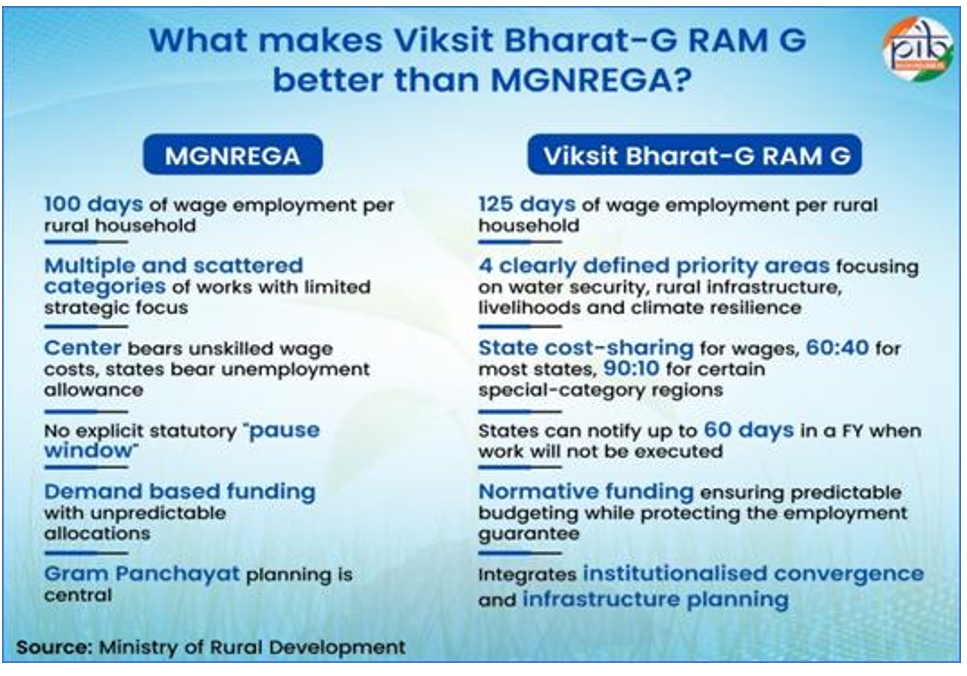
The funding structure is based on cost-sharing ratio of 60:40 between the Centre and states with enhanced support of 90:10 for North Eastern and Himalayan states, and 100% central funding for Union Territories without legislatures14. Under MGNREGA states were bearing a lower share of material and administrative costs.
Independent studies on the impact of MGNREGA
According to a study by Sekhar Bonu (From Policy to Implementation-A study of MGNRES), former Director General, Development Monitoring and Evaluation Office, NITI Aayog, despite the scale and intent of MGNREGA, evidence raises critical questions about how effectively the scheme reaches the poorest households and states that need it most15.
Using state-representative survey data (NSS 66th and 77th Rounds) and district-level administrative data (2019–2022), the study has highlighted wide disparities. Poorer states such as Bihar, Uttar Pradesh, Jharkhand, and Odisha have benefited significantly less compared to better-off Southern and North-Eastern states. It has also highlighted that richer households in some states have reported unexpectedly high participation thus raising equity concerns16.
An indirect impact of MGNREGS was observed in the India Human Development Survey (IHDS) by the National Council of Applied Economic Research and University of Maryland, USA, conducted over 40,000 households across India in 2004-5 and 2011-12.
Since MGNREGS was implemented in 2006 this survey provided data and facts to compare household well-being before and after the implementation of MGNREGS. Findings reflect better availability of formal credit during this period and reliance on moneylenders declined nationwide. It was also observed that the decline was much sharper in villages with well-functioning MGNREGS and households that could obtain work in MGNREGA17.
Conclusion: Future of Rural Employment Policy
Any policy when well conceived and well drafted is executed well for a particular time period. MGNREGA ran successfully for two decades but its limitations started showing as the developments with time could not be factored in. Besides, a complacency could have set in its execution. For that reason, the government introduced a revamped right to work programme VB-G RAM G. While this new programme has tried to plug gaps in MGNREGA a periodic monitoring and evaluation of the same is required. Gaps, if any, should be addressed almost immediately for its effective implementation.
FAQs
References:
- https://www.pib.gov.in/PressReleasePage.aspx?PRID=2228713®=3&lang=1#:~:text=Introduction,as%2055.9%25%20in%20January%2C%202026
- https://www.pib.gov.in/PressReleasePage.aspx?PRID=2207351®=3&lang=2
- https://www.pib.gov.in/PressReleasePage.aspx?PRID=2207351®=3&lang=2
- https://www.pib.gov.in/PressReleasePage.aspx?PRID=2207351®=3&lang=2
- https://www.pib.gov.in/PressReleasePage.aspx?PRID=2207351®=3&lang=2
- https://www.pib.gov.in/PressReleasePage.aspx?PRID=2207351®=3&lang=2
- Times of India, Right to Work, Success, Flaws and Fixes, 8 February 2026
- Times of India, Right to Work, Success, Flaws and Fixes, 8 February 2026
- https://documents.worldbank.org/en/publication/documents-reports/documentdetail/099722104222534584
- https://ihds.umd.edu/system/files/2020-07/October%20Newsletter%202018.pdf
- https://www.unicef.org/innocenti/stories/gendering-design-and-implementation-mgnrega
- https://www.pib.gov.in/PressReleasePage.aspx?PRID=2207351®=3&lang=2
- https://www.pib.gov.in/PressReleasePage.aspx?PRID=2207351®=3&lang=2
- https://www.pib.gov.in/PressReleasePage.aspx?PRID=2207351®=3&lang=2
- https://www.cps.iitb.ac.in/tribe_events/from-policy-to-implementation-a-study-of-mahatma-gandhi-national-rural-employment-guarantee-scheme-mgnregs/
- https://www.cps.iitb.ac.in/tribe_events/from-policy-to-implementation-a-study-of-mahatma-gandhi-national-rural-employment-guarantee-scheme-mgnregs/
- https://dmeo.gov.in/sites/default/files/2022-03/Compendium_of_Essays.pdf