
Table of Contents


Homestays in India? Boom or Bust
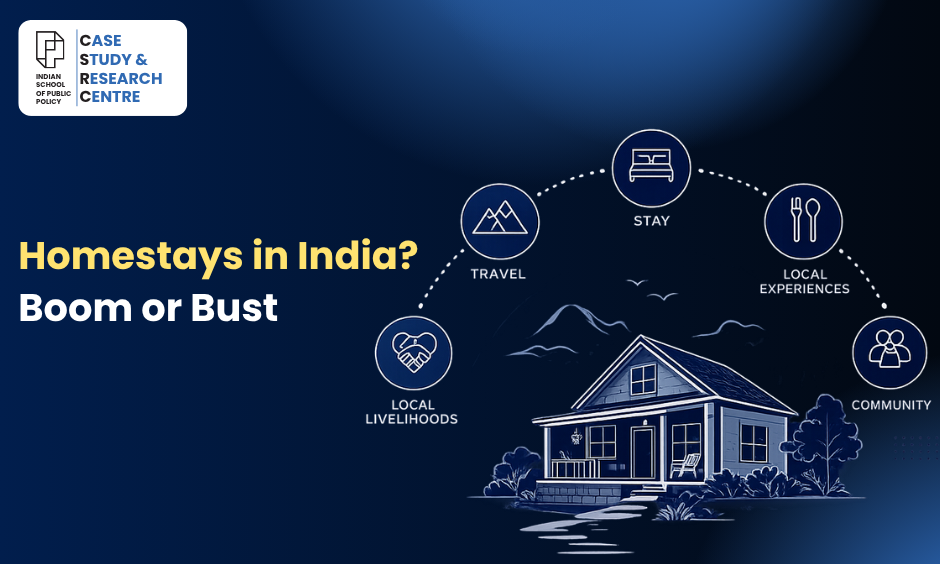

The idea of the homestay didn’t begin in India, it emerged from various countries in Europe and South Asia and travelled fast, riding the same wave that turned Airbnb into a Silicon Valley unicorn. What it offered was simple but intriguing: a way to travel without disappearing into the beige anonymity of a hotel room. Travellers wanted a story attached to their stay, not just a bed. And somewhere in that global appetite for “experiential” travel, India recognised something it had known all along.
Because homestays were never really new here. They were the old normal, dressed up in new branding. Long before glass-fronted hotel chains became the aspirational marker of “civilised” travel, staying with a stranger, a distant relative, or a family friend was simply how Indians travelled.
The country’s guiding ‘Atithi Devo Bhava’, the guest is god wasn’t a tourism slogan before but later became one. It was a household instruction. The concept of a “guest house,” by contrast, always sat a little awkwardly in the Indian imagination: a stranger under your roof, without the full weight of Indian hospitality wrapped around them, felt incomplete. Homestays closed that gap. They let families share their food, their language, their small rituals with the added, not-insignificant bonus of turning a spare room into passive income.
So when the Government of India revamped its homestay mission in 2018, it didn’t need to convince anyone of the concept. It only needed to give shape to something that already existed in spirit. And the numbers that followed suggest it worked. Post-pandemic, homestays became arguably the brightest spot in India’s tourism recovery. A ₹4,722 crore market, growing at 11% annually, with an employment multiplier higher than any other accommodation category in the country.
However, not everything was sunshine and rainbows. Turns out the very regulation designed to legitimise and protect the homestay sector has, over the years, quietly started to strangle it. Two NITI reports arrive at the same uncomfortable conclusion: homestays have grown despite their regulatory environment, not because of it. The reason is almost bureaucratically poetic.
India built its homestay rules by borrowing from hotel regulation, then simply subtracting a few requirements here and there. It was never built from scratch for what a homestay actually is: a small, informal, owner-occupied space run on trust rather than infrastructure. The result was a hybrid regulatory creature- lighter than a hotel’s rulebook, but still heavy enough to crush the very micro-entrepreneurs it was meant to enable.
The most recent NITI Aayog report tries to correct the course with two concrete recommendations. First, raise the room cap from six to nine, giving operators enough scale to actually cover costs without tipping into commercial-hotel territory. Second, building on the earlier report’s findings, do away with the No Objection Certificate requirement altogether.
The report suggested following Kerala’s lead, which had already scrapped NOCs and watched registered homestay numbers rise as a result. Fewer approvals, more rooms, less friction. Ease of doing business, tidied up and delivered.
A homestay’s appeal was never its amenity list, it was the culture leaking through the walls. The over-cooked breakfast was made specially because you mentioned you’d never tried it. The grandmother who insists on telling you the story behind the family deity in the courtyard. That experience doesn’t
survive well under a classification scheme, however well-intentioned. Push too much regulation onto something built on informality, and you risk turning a home into a home-shaped hotel, compliant, safe, but quietly soulless.
Which is really the paradox at the centre of this policy story: the more you standardise a homestay, the less like a homestay it becomes. NITI Aayog’s new gameplan is, to its credit, aware of this. It frames its recommendations as an attempt to secure safety and accountability for both host and traveller, while trying not to disturb the informal warmth that built the sector’s reputation in the first place. Whether regulation can walk that line without eventually flattening it remains an open question one that the next few years of India’s homestay boom will likely answer for us.
For more info, read “Rethinking Homestays: Navigating Policy Pathway“, a regulatory mapping by CSRC in collaboration with NITI Aayog and IAMAI.