
Table of Contents


Public Policy Education in India: Choosing the Right Credential
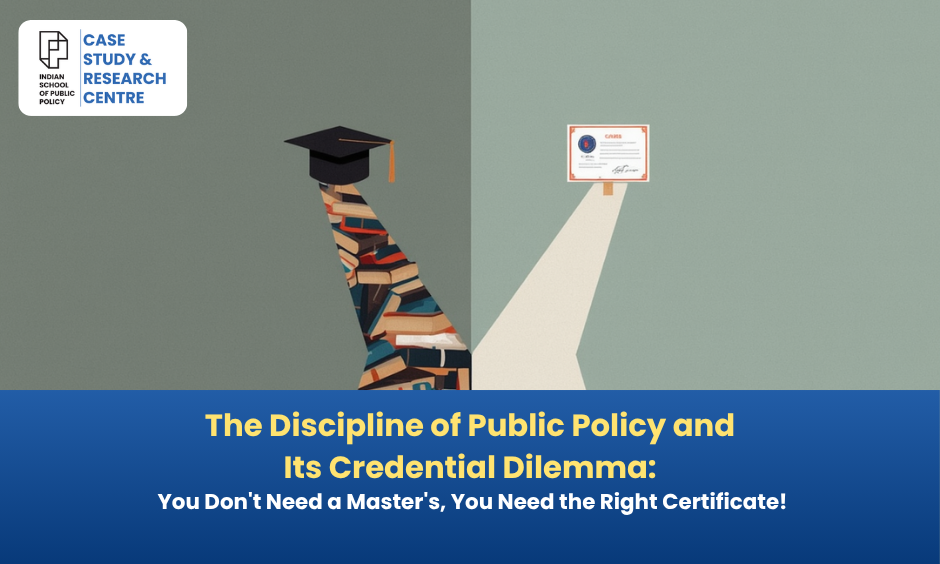

You Don’t Need a Master’s, You Need the Right Certificate!
India’s new regulatory architecture quietly makes the certificate the most agile, honest, and professionally powerful credential in public policy, if you know how to use it.
India’s Tiered Credential Architecture
India’s higher education system is undergoing a generational transformation. The UGC Regulations 2025, anchored in the NEP 2020 vision, are replacing a permission-based architecture with one built on disclosure, accountability, and institutional agility.
At the heart of this reform is a formalised hierarchy of credentials, and understanding it is essential for anyone considering a postgraduate programme in public policy.
India’s credential system now operates across three tiers: certificates, PG diplomas, and degrees, each with distinct regulatory obligations.
A master’s degree can now span between one or two years, depending on the eligibility criteria for admission. These can only be awarded by legally constituted Universities that operate within full UGC oversight, with courses mapped according to the National Higher Education Qualification Framework (NHEQF), and mandatory adherence to the Academic Bank of Credits (ABC) credit deposit.
PG Diploma can vary from 12 to 15 months and is offered by autonomous colleges and institutions affiliated with the All India Council for Technical Education (AICTE). They have moderate regulatory control but still have to adhere to NHEQF and ABC norms.
The certificate programs, ranging from 6 to 12 months in duration, have the broadest institutional access with no affiliation requirement and the greatest curricular freedom.

Compliance and Curricular Autonomy
Across all three types, compliance has become multi-dimensional. Institutions must publicly disclose programme structure, faculty profiles, credit frameworks, and delivery mechanisms. Curricula must map to the National Higher Education Qualifications Framework (NHEQF).
The ABC, now a statutory mechanism, requires all credits to be formally deposited. The compliance burden is substantial. What differs is the degree of curricular autonomy: universities and autonomous institutions enjoy relative academic freedom, while affiliated colleges face far tighter constraints.
For practitioners seeking postgraduate education in public policy, these shifts have clear implications: the certificate pathway — not the Master’s degree — is the most intellectually honest, professionally relevant, and regulatory-intelligent choice available today.
This is also true vis-à-vis other practice-based disciplines like business leadership, development management/action, urban planning, public health, data analytics, digital transformation, and environmental management and sustainability.
These programmes, including public policy, are offered by some of the most reputed institutions in India, including IIMs, IITs, TISS, Indian School of Public Policy, Takshashila Institution, Vedica Scholars, and the Madras Institute of Development Studies.
Why Public Policy Resists the Degree Format
Public policy is not a discipline in the conventional sense, as it sits at the intersection of political economy, institutional analysis, behavioural science, data analytics, law, and governance theory.
The profile of today’s public policy practitioner reflects this complexity. One may have entered the field through civil services, a development sector organisation, a corporate sustainability function, or a legislative research office. It must continuously absorb new modes of governance, demanding new conceptual vocabularies and professional competencies.
This creates a structural tension with India’s higher education regulatory architecture, which was not designed to respond to such dynamism.
The syllabi of degree programmes, shaped by faculty expertise, NHEQF mapping requirements, and institutional approval cycles, tend toward the canonical and the established. Yet the job market for public policy professionals increasingly rewards expertise in domains that did not exist as formal policy areas five years ago and lacks settled academic canons.
Their learning needs are specific, time-bound, and unlikely to be fully met by a programme designed around a fixed two-year curriculum.
Within India’s regulatory framework, certificate programmes occupy a structurally advantageous position. They are the fastest credential type to design and deploy, carry the least regulatory friction, and offer institutions the greatest degree of curricular freedom.
They can respond quickly to emergent domains of practice and can draw on faculty members from active practitioners whose knowledge cannot be certified by academic credentials alone.
The delivery mode of certificate programs also allows genuine flexibility with evening cohorts, intensive residencies, and asynchronous modules. This enables incremental building of credentials over their careers, aligning individual learning trajectories with evolving institutional accountability frameworks.
Institutional Creativity for the Emergent Job Market
The public policy job market in India is expanding rapidly and structurally diversifying, rewarding demonstrated domain expertise over generalist credentials. These include: the ability to read and interpret a regulatory document, map stakeholder interests against policy objectives, design a monitoring and evaluation framework, and navigate the political economy of policy implementation.
These are competencies, not disciplines. And competency-based education finds its most natural expression in the focused certificate, not the comprehensive degree.
The argument for certificates is ultimately an argument about epistemological honesty, about matching the form of a credential to the nature of the knowledge it is meant to certify.
The emergent regulatory architecture offers tools needed to build programmes that acknowledge the limits of any single credential and are generous with the learning pathways they provide.
For institutional leaders, the question is whether to offer certificate programs in public policy as the vanguard of a thoughtfully designed learning ecosystem or treat them as a peripheral concession to market demand. For practitioners, the certificate pathway is not the path of least resistance but of greatest integrity.