
Table of Contents


Understanding the Forest Rights Act: Why Community Forest Resource Rights Matter

Forests have been inseparable from imaginations of this country’s landscape. Forest dwelling communities across India held what may be called customary rights over forests. These were rooted in long-standing traditions, community norms, and traditional systems of governance rather than formalised legal titles. They encompassed cultivation, habitation, grazing, collection of forest produce, and most importantly, the management of common forest resources.
With the advent of colonial rule, the introduction of scientific forestry, and legislations taking the shape of Forest Acts, the relationship between forests and customary tenure was fundamentally altered. Forests were brought under state ownership, commercially exploited, and customary tenure systems were either inadequately recorded, interpreted as revocable concessions or privileges, or ignored altogether. As a result, communities of traditional forest dwellers were rendered legally invisible on lands they had occupied and managed for generations, leading to widespread dispossession and insecurity of tenure.
How the Forest Rights Act Sought to Address Historical Injustice
Colonial scientific forestry essentially collapsed the distinction between forest lands and resources by treating the forest as a commodity to be scientifically managed and exploited. When nature itself was commodified as land, it became only a factor of production. Subsequently, traditional forest dwellers became users whose access could be regulated or withdrawn altogether. This logic of commodification defied the characteristics of forests as ecological resources.
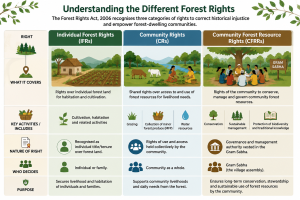
This was the ‘historical injustice’ that the Scheduled Tribes and Other Traditional Forest Dwellers (Recognition of Forest Rights) Act, 2006 (FRA) set out to correct. The FRA was a historic legislation that attempted to restore the rights that tribal communities and other traditional forest dwelling communities had lost; over land, community forest resources and habitats, and the governance and management of forests. The FRA recognised multiple rights, mainly Individual Forest Rights (IFRs), Community Rights (CRs), and Community Forest Resource Rights (CFRRs). In essence, it aimed to recognise pre-existing customary rights, grant rights to own, access, use, and sell minor forest produce, and manage and protect forests as well as traditional knowledge. It also aimed to confer the rights of livelihood upon forest dwellers who reside in, and depend on forest land and resources, for their bone fide needs.
The Missing Distinction between CRs and CFRRs
While the FRA marked a departure from the colonial frameworks by recognising pre-existing customary tenure, the act of converting customary rights into legal entitlements involved a degree of erasure. Diverse and relational customary practices were necessarily translated into standardised legal categories and evidence-based requirements, leaving aspects of customary governance and tenure beyond the scope of formal recognition. The FRA’s primary agenda was to implement the IFRs, CRs, and CFRRs.
While sound on paper, the on-ground implementation of IFRs, CRs, and CFRRs tells a different story. Claims and titles distribution data from the Ministry of Tribal Affairs (MoTA) shows that IFRs have been granted much more over CRs and CFRRs, across states. Granting IFRs has been prioritised as it generates more political mileage, and creates the impression of a ‘pro-Adivasi’ government. However, this reduces the FRA to a mere land redistribution scheme.
The granting of CRs and CFRRs highlights a different aspect. Not only does their implementation fall far short even in 20 years of the FRA being in place, there is also fundamentally no differentiation between the two kinds of rights. The FRA envisages CRs and CFRRs as separate legal entitlements, but the MoTA does not differentiate between them in its claims and title distribution data. This ambiguity has deep implications.
The Forest Rights Act sought to challenge the commodification of ecological forests by emphasising and demarcating both community rights and community forest resource rights. This would legitimise traditional forest dwelling communities having a voice in the governance and management of their forests.
Although an amendment to the FRA brought in separate claim-making forms depending on whether one was claiming CRs or CFRRs, the legal ambiguity between the two rights persisted. This has major implications; that we have not been able to free ourselves from the confines of scientific forestry. While scientific forestry limits one’s lens to the commercial or economic exploitation of forests, ecological forestry builds on the vast environmental and livelihood functions of the forest. Commodification under the FRA remaining incomplete by virtue of the ambiguity around CRs and CFRRs, points to the continued adherence to scientific forestry
Modes of forest governance remain individualised and centralised, and the embodied ecological know-how of traditional forest dwellers continues to be discredited. A clear distinction between CRs and CFRRs would recognise that forests are not merely resources to be accessed but socio-ecological commons that may be collectively governed. In doing so, it would devolve meaningful authority over forest management to Gram Sabhas, legitimising embodied ecological know-how and situated practice.
Forest Livelihoods Beyond Commodification
The persistence of this ambiguity also gives way to a certain kind of loss, especially when it comes to livelihoods. Sustaining forest livelihoods is enshrined in the FRA as a significant component. The absence of meaningful distinctions between rights renders forest livelihoods legible only through the lens of market exchange. Coupled with the prioritisation of IFRs, this fundamentally narrows the imagination of what forest livelihoods could be. Livelihoods become increasingly commodified through the ownership and cultivation of individual parcels of land. Possibilities of a multiplicity of livelihoods and traditional ecological knowledge is lost along the way.
Legal and administrative differentiation between CRs and CFRRs and implementing them accordingly would go a long way towards enabling ecological livelihoods to emerge through community-led stewardship rather than state-controlled resource extraction. Ecological stewardship over both forest lands and forest resources would also privilege the local ecological knowledge and embodied know-how of forest dwellers over imposed technocratic expertise. It would serve to overcome the alienation faced by the traditional forest dwelling communities over generations.
Overcoming the ambiguity between Community Rights and Community Forest Resource Rights is therefore essential. Not only for the full realisation of the Forest Rights Act, but also to foreground an epistemic shift. From forests as commodified resources to socio-ecological commons that are democratically governed by the community that shapes them and is shaped by them in turn. If these rights are interpreted as a way of returning to the lands that were colonised by systems of scientific forestry, then correctly translating them into practice is a crucial step towards regaining what was lost.