
X
Limited Seats Available for Academic Session 2026-27 | Join the Next Generation of Policy Leaders |
Apply Now
Will ISPP help me get into top think tanks like NITI Aayog, ORF, CPR, or Brookings India?
The academic design of the programme is rooted in research-based learning. The curriculum focuses on analytical tools such as economics, statistics, policy analysis, and governance frameworks, which are central to evidence-based policymaking. This approach is reflected in ISPP’s overall academic structure of the programme and philosophy of public policy education.
At the same time, ISPP strongly emphasises applied research. Through initiatives like the Policy Praxis Lab, students work on real-world policy problems, turning research into actionable solutions.
ISPP houses a dedicated research ecosystem supported by multiple thematic policy centres that focus on core areas of policymaking. These include the Centre for Universal Health Assurance, the Centre for Urban Transitions, the Indian Network for Economic Research, and the Case Study Center, where scholars engage in evidence-based policy research, impact evaluation, and applied policy design.
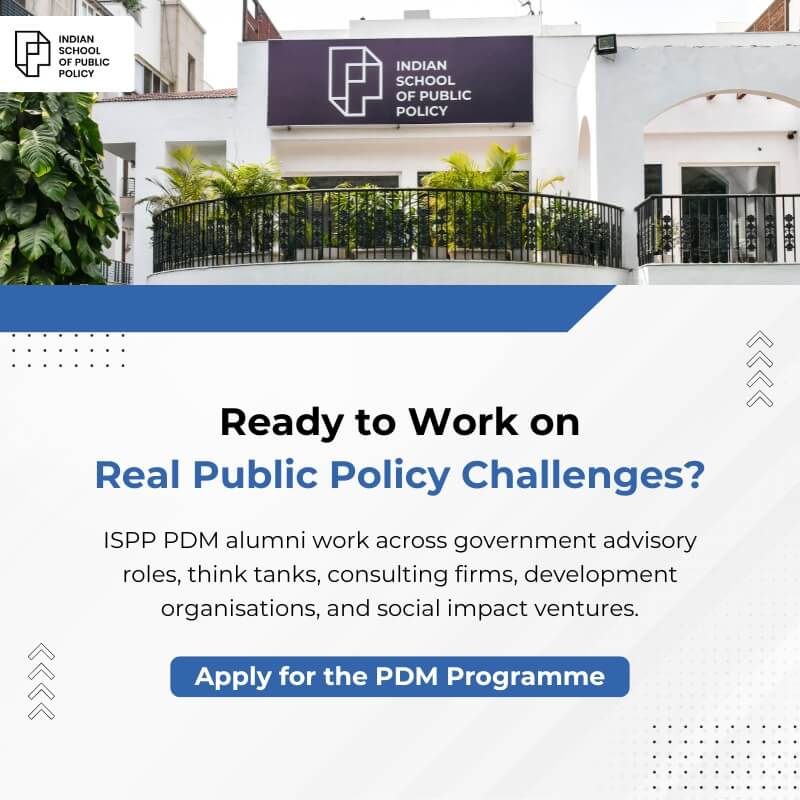
Career support outcomes further support this positioning. The school prepares students for roles in think tanks, government bodies, development organisations, and consulting firms where research skills are essential for policy design and evaluation. This is supported through its structured career development framework and broader public policy career pathways.
The faculty composition also reflects a strong research foundation. ISPP’s faculty includes economists, policy researchers, former senior government officials, and domain experts who combine academic rigour with real policy experience.
So ISPP is best described as a policy school that uses research as its foundation and real-world application as its direction.
It is not a corporate management programme, and it is not a purely academic research institute. It sits between the two, designed for students who want to build strong research capability and use it directly in policymaking, governance, and institutional decision-making.