


Table of Contents


India’s EV Policy Puzzle: Incentivising Adoption or Building a Sustainable Ecosystem?
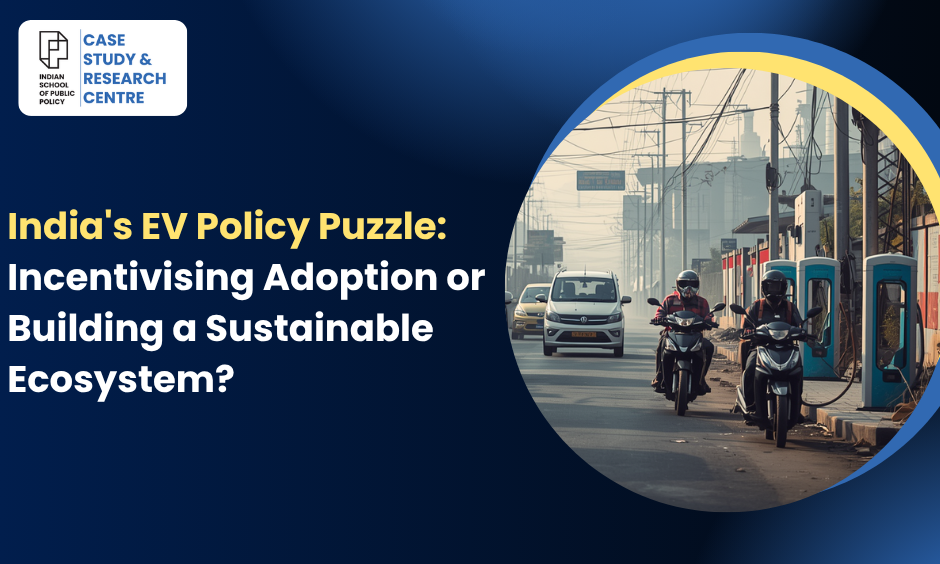

India has set itself a bold target: 30% electric vehicle penetration by 2030. We’re still far from that number. But over the past decade, the government has launched over a dozen schemes, poured hundreds of thousands of crores into the sector, and rewritten tax and infrastructure rules to speed up the transition. The idea is to use policy nudges to shift consumer behaviour toward EVs.
A Decade of Schemes: The Full Picture
India’s EV policy isn’t one big programme — it’s a stack of schemes built up over time, each targeting a different part of the market. The table below gives the full picture.
Timeline of EV Schemes in India
| Scheme | Objective | Timeline | Outlay (Approx.) |
| NEMMP 2020 | National roadmap for fuel security and EV manufacturing leadership | 2013 onwards | ₹14,000 Cr |
| FAME I | Promote electric and hybrid vehicle technology | 2015–2019 | ₹895 Cr |
| FAME II | Demand incentives; electric bus fleets; charging infrastructure | 2019–2024 | ₹11,500 Cr |
| PLI – ACC Battery | Giga-scale domestic battery cell manufacturing | 2021 | ₹18,100 Cr |
| PLI – Auto & Components | Incentivise domestic Advanced Automotive Technology products | 2023–2027 | ₹25,938 Cr |
| India Semiconductor Mission | Boost semiconductor fabrication for automotive competitiveness | 2021 | ₹76,000 Cr |
| Go Electric Campaign | Encourage EV adoption via tax holidays and fee waivers | 2021 | N/A |
| PM-eBus Sewa | Deploy 10,000 e-buses via PPP model | 2023–2033 | ₹20,000 Cr |
| EMPS 2024 | Rapid adoption of e-2W and e-3W vehicles (transitional) | 2024 | ₹778 Cr |
| PM E-DRIVE | Accelerate EV adoption; public charging infrastructure | 2024–2026 | ₹10,900 Cr |
| PSM Scheme | Mitigate payment delay risks for e-bus operators | 2024 | ₹3,435 Cr |
Source: Ministry of Heavy Industries; NITI Aayog
The Flagship Schemes: From FAME to PM E-DRIVE
The backbone of India’s EV policy has been a series of demand-oriented programmes. FAME, launched in 2015, was the first real attempt to bring electric and hybrid vehicles to mainstream buyers. Modest in scale, ₹895 crores, but it served as a blueprint, helping the government gauge how willing consumers were to switch and how big a push they would need.
This was followed by FAME II, With an outlay of ₹₹11,500 crores, it extended subsidies across more vehicle categories and supported the deployment of 16.15 lakh EVs and 6,862 electricbuses. It locked in the core logic of demand-side incentives subsidies tied to battery capacity and purchase decisions that still defines policy today. But even with that success, India remained well short of its targets.
That’s where PM E-DRIVE stepped in. Launched in 2024, it marked a subtle shift, it still focused on adoption, targeting 24.79 lakh E-2Ws, 3.16 lakh E-3Ws and 14,028 buses, but also dedicating ₹2,000 crores to building public charging infrastructure.
Taken together, these three schemes trace how the EV market has matured. But they still lean heavily on demand-side incentives, with limited attention to the supply chain or broader ecosystem.
The Supply Side: The younger sibling
Alongside the demand schemes, the government has also rolled out supply-side measures, though their impact is harder to pin down, and the research on them is still thin.
The PLI Scheme for Advanced Chemistry Cell (ACC) Battery Storage, with an outlay of ₹18,100 crores, aims to build 50 GWh of domestic battery cell manufacturing. The companion PLI Scheme for Automobiles and Auto Components (₹25,938 crores) supports domestic production of advanced auto tech, including EVs and hydrogen fuel cell vehicles. Together, they tackle one of India’s biggest weak spots: a near-total import dependence (95–100%) on critical battery materials like lithium and cobalt.
The Phased Manufacturing Programme (PMP) takes a more hands-on approach, requiring progressive localisation of EV components and withholding incentives from vehicles that don’t meet those norms effectively pushing OEMs to invest in domestic battery and motor production. Even so, the supply-side story remains underdeveloped. Policy intent hasn’t yet translated into measurable industrial change, a gap that NITI Aayog and independent researchers have flagged repeatedly.
Charging Infrastructure: The Persistent Bottleneck
No EV policy works without a reliable charging network. The Ministry of Power and Bureau of Energy Efficiency have put out detailed guidelines, but implementation is where things get stuck.
The Revision of Consolidated Charging Guidelines (September 2024) sets clear targets: at least one charging station per 1 km × 1 km grid in cities, and one every 20 km on highways by 2030. Heavy-duty vehicles need stations every 100 km. Connector standards are defined — CCS for fast charging, Bharat DC-001 and AC-001 for domestic use. Public charging tariffs are capped at the Average Cost of Supply until March 2028, with service charge ceilings of ₹3–4 for AC chargers and ₹11–13 for DC chargers.
It’s a solid framework on paper. In practice, two problems keep getting in the way: charger standards aren’t consistently followed across operators and regions, and uptime — how often a charger is actually working — remains low in many areas. A driver who pulls up to a dead charger on a long trip isn’t going to be an EV convert. Charging infrastructure shapes consumer confidence just as much as it shapes logistics.
Nudge through Taxation
The tax story is straightforward: EVs and chargers carry a 5% GST (cut in 2019 from 12% and 18% respectively), while ICE vehicles face 18%. The Section 80EEB income tax deduction of up to ₹1.5 lakh on EV loan interest is no longer available to new borrowers, but existing borrowers still get the benefit. A 100% customs duty exemption on 25 critical battery minerals, including lithium and cobalt, helps keep manufacturing costs in check. Over 16 states have also waived or reduced road taxes on EVs.
The Public & the policy
Governments aren’t just regulators, they’re also big buyers. India has used that purchasing power to anchor the EV bus market in ways private demand alone couldn’t have. The PM-eBus Sewa Scheme targets the deployment of 10,000 electric buses through a PPP model, with an outlay of ₹20,000 crores over a decade. The companion Payment Security Mechanism (PSM) a dedicated fund of ₹3,435 crores — exists to cover payment obligations from State Transport Undertakings to private e-bus operators. It’s a quiet but important move: it lowers the counterparty risk that has long made private investors wary of financing bus fleets in Indian public transport.
Environmental Regulations: Building the Long-Term Architecture
Demand and supply incentives can get adoption moving. But keeping an EV ecosystem going for decades needs a different kind of framework, one that covers the full lifecycle of the technology. India has started building this out. The Battery Waste Management Rules bring in Extended Producer Responsibility (EPR), requiring manufacturers to collect, recycle, or refurbish used batteries — heading off what could become a serious environmental problem as the EV fleet grows. The Carbon Credit Trading Scheme (CCTS) looks further ahead. Building on the Perform, Achieve and Trade (PAT) Scheme run by the Bureau of Energy Efficiency, it aims to bring carbon trading into the transport sector. EV fleet operators and renewable-powered charging providers could earn revenue by monetising their emission reductions money that could fund more green investment and, over time, open up better access to international carbon markets.
What Needs to Change: A Policy Diagnosis
The policy so far has done a lot to push demand but hitting 30% EV penetration will take more than subsidies. It needs a proper value chain: stronger public-private partnerships, real investment in EV and battery manufacturing, and a rethink of the whole ecosystem. That means looking at road laws, charging station rules, the second-hand EV market, making ownership less of a headache for everyday buyers, and a proper battery disposal system. The goal isn’t just to get people to buy EVs — it’s to build something that actually lasts, ecologically and socially. Current regulations are mostly about getting people to switch from ICE vehicles. What’s needed now are regulations that make EVs genuinely work for everyone, long term.
References:
Bain & Company and Blume Ventures. India Electric Vehicle Report 2023. 2023.
India Brand Equity Foundation (IBEF). Electric Vehicle. August 2025.
Ministry of Housing and Urban Affairs. Guidelines for PM-eBus Sewa Scheme – Part I. New Delhi: Government of India, 2023.
NITI Aayog. Overview of State Electric Vehicle Policies.
Redseer Strategy Consultants. Electric 2W – Adoption from 0 to 100. January 2023.
The India Watch. Indian EV Sector Overview: A Comprehensive Market Analysis.