
Table of Contents


Risk of Rapid Delivery
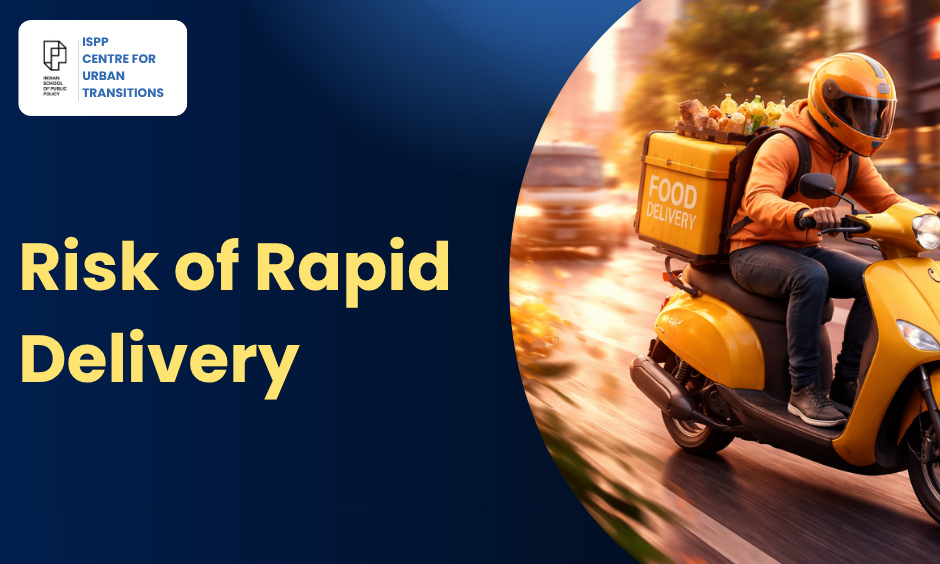

On 3 April 2026, the Delhi edition of The Indian Express carried a tragic news item. A young food delivery agent, while completing his last delivery around 2 am, was hit by a reportedly speeding Mercedes and was killed on the spot. A young life was prematurely lost.
The Rise of Rapid Delivery Culture
Unfortunately, such instances are likely to increase as multiple online delivery platforms seek to attract customers by offering near-impossible delivery times. Offers of 10-minute deliveries are attractive to customers, as they get what they want almost immediately. While Blinkit was a pioneer, others like Zepto and Swiggy’s Instamart have also entered the fray. As competition grows, these offers will become even more aggressive.
The Hidden Costs and Risks
This rapid growth, however, comes with significant risks. In order to meet extremely tight timelines, delivery agents are often compelled to drive recklessly, especially by cutting corners at traffic intersections. Most of them use two-wheelers, which are by far the most vulnerable to road accident fatalities. Reckless driving is not just a risk to the delivery agent but to all other road users as well.
Apart from this, it represents a sub-optimal use of infrastructure, as a 10-minute delivery often means only one delivery per trip. Imagine the waste of energy when 150 kgs of combined weight (the motorbike and the rider) moves across a city to deliver 5 kgs of goods, often no more than just 0.5 kgs.
Rethinking Delivery Timelines
Let us consider what would happen if the assurance of a 10-minute delivery were modified to a 30-minute delivery. Would it make a significant difference to the customer? In most cases, it would likely make little to no difference.
However, this shift would have several public benefits. First, it would allow safer driving and reduce the risk of accidents. Second, it would enable multiple deliveries to be made in a single trip, thereby reducing energy consumption, greenhouse gas emissions, and local air pollution. It would facilitate a far more efficient model of online delivery. It could also reduce costs for delivery platforms, which may then require fewer delivery agents and a smaller number of storage points across the city.
A Call for Regulation and Responsibility
The clear message to regulators, therefore, is to consider the safety and environmental impact of emerging rapid delivery services and limit delivery timeline assurances to something more reasonable. Perhaps a 30-minute or even a 60-minute delivery window would suffice in most cases.
To address rare situations where something is genuinely required within 10 minutes, a steep delivery charge could be levied—regardless of the value of the goods ordered so that customers do not insist on ultra-fast delivery when a 30- or 60-minute window would suffice.
The Larger Urban Reality
Our cities are already facing serious challenges, including high rates of road accident fatalities and severe local air pollution. This could be one effective way of reducing the risk of delivery agents losing their lives in the rush to meet unrealistic timelines, while also lowering the extent of air pollution caused by excessive vehicle movement for rapid deliveries.