
Table of Contents


Urbanization in North-East India: A New Frontier for Growth
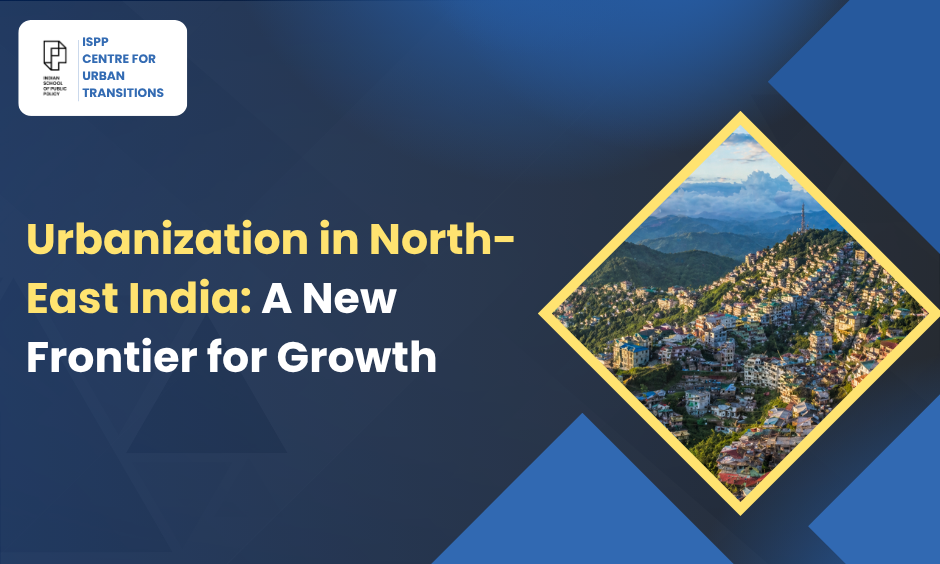

The North-East is urbanising differently than the rest of India, and this distinction is its greatest opportunity. Across India’s eight North-Eastern states, a consequential shift toward urban life is underway. The region is home to 45.7 million people, spread across challenging terrain with a population density of just 175 per sq km, less than half of India’s average of 368. Its economy, valued at ₹5.75 lakh crore (FY 2021-22), has grown at a Compound Annual Growth Rate (CAGR) of 8.17% between 2015 and 2022. Yet, urbanisation here tells a story distinct from the rest of the country.
The most striking feature of North-East urbanisation is its uneven nature. Mizoram, a hilly state, is 53% urban, surpassing most Indian states in urbanisation levels. Meanwhile, Assam, the region’s most populous state, sits at just 14.1% urban. This is not a failure; it reflects the region’s diverse geography, history, and economy. Guwahati alone accounts for nearly 4.4 million of Assam’s urban population. Cities like Shillong, Imphal, Agartala, and Kohima have grown steadily for decades. Agartala, for instance, has evolved significantly since 1971, though these cities remain small by national standards. The region is defined by dozens of small and medium towns forming a cohesive urban fabric.
The drivers of urbanisation in the North-East are shaped by its unique political and geographic context. State formation served as a primary catalyst: when Nagaland (1963), Meghalaya (1972), and others became separate states, their capitals became instant hubs for government services and jobs. Public sector employment remains a cornerstone of urban economies here more than anywhere else in India.
Beyond government employment, the region’s natural attractions are quietly powering growth. Connectivity improvements are the most recent gamechanger. New rail links to Agartala and Itanagar, upgraded national highways, and airports like Pak’yong in Sikkim and Lengpui in Mizoram are steadily reducing historical isolation, making the region more attractive for trade, tourism, and investment.
The Hidden Opportunity
The North-East’s urbanisation opportunity is anchored by the “6 Ts” -Tourism, Trade, Textiles, Tea, Temples, and Timber & Bamboo, which, if explored strategically, can drive long-term economic growth.
-
Tourism: In 2024, the region attracted 12.78 million domestic and 0.24 million foreign tourists. While this represents only 0.43% of India’s total domestic visits, the potential is vast, given the region’s assets like Kaziranga, the Hornbill Festival, and the living root bridges of Meghalaya.
-
Temples and Culture: The region is an epicenter of wellness and cultural tourism, boasting unique festivals and tribal traditions. With targeted promotion, it can capture a larger share of the spiritual and experiential travel market.
-
Tea: Tea has shaped the urban character of cities like Dibrugarh, Jorhat, and Silchar. Assam accounts for roughly 80% of India’s tea production, and Guwahati has emerged as a global auction hub, creating demand for processing, packaging, and logistics services.
-
Timber & Bamboo: The North-East holds 38% of India’s bamboo stock. Reclassified as “grass” in 2017 to remove transit restrictions, bamboo now sits at the intersection of sustainability, construction, and rural industry.
-
Textiles: The textile and handloom sector is a major economic pillar. Exports of silk textiles grew 31% in FY 2019-20, with 1,500 manufacturers registered under the Silk Mark Organisation. Connecting GI-tagged products like Muga silk to global design pipelines is a major urban-economic opportunity.
-
Trade: The region’s geographical location is an asset for increasing India’s trade with ASEAN countries. By developing food processing industries for surplus agricultural produce, the region can transition from a producer to an exporter.
Targeted interventions like the National Bamboo Mission, the UDAN regional airport scheme, and the North-East Industrial Development Scheme are essential steps in closing the infrastructure deficit.
North-East India’s urbanisation is distinct, smaller in scale, driven by unique forces, and shaped by a geography that demands context-sensitive planning. With the right investments in connectivity and value chains, these towns can become engines of a new kind of growth, rooted in culture, ecology, and cross-border trade.
FAQs
References:
Ministry of Development of North Eastern Region (MDoNER). (2022). North East India: Economic and Development Report. Government of India, New Delhi.
Tea Board of India. (2022). Annual Report 2021–22. Ministry of Commerce & Industry, Kolkata.
NITI Aayog. (2022). North-East Vision 2047: Unlocking the Potential of India’s Eight States. Government of India, New Delhi.
Author
Aryan Dixit
Aryan Dixit works as an Research Associate at ISPP Centre of Urban Transitions. Before this his previous experience involved working in sectors of education and governance. His work focuses on research in urbanisation, growth and governance challenges.