Making Cities Livable Again: The Transit-Oriented Development Way

By
Himansh Raj Bhatia
Published Apr 24, 2026
Indian cities are growing fast and expanding outward, leading to longer and longer commutes, which in turn cause choking traffic, rising pollution, and infrastructure that cannot keep pace with population growth. If that were not bad enough, financing compatible infrastructure amid poorly financed urban local bodies (ULBs) prevents sophisticated solutions from being implemented.
Now imagine stepping out of your home, grabbing coffee, walking five minutes to a metro station, and reaching work, all without touching a car or an autorickshaw. This is not a utopian dream but rather something that is possible under the Transit-Oriented Development (TOD) urban planning system.
Utopian Reality
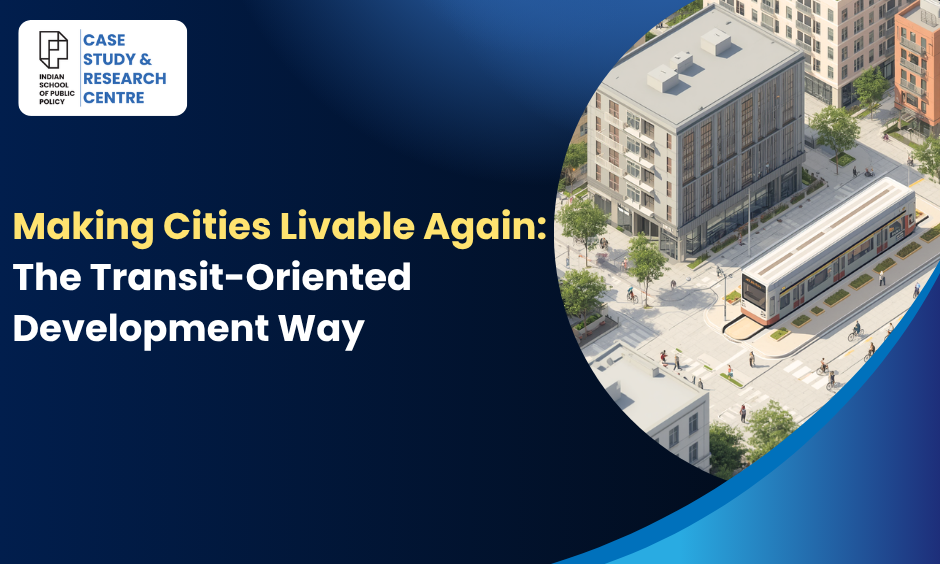
To put it simply, TOD is an urban planning approach that builds dense, mixed-use communities within easy walking distance of public transit stations. The idea is simple: places like homes, offices, shops, schools, and parks are close together around a transit hub. This model could give people a real alternative to driving. Academically speaking, it operationalizes the integration of land-use and transport planning through the “3D framework”: density, diversity of uses, and pedestrian-friendly design, in order to maximize transit ridership and minimize vehicle dependence.
TOD flips the model of cities growing outward and spreading thin; instead, they grow smart, upward, and inward around transit hubs known as corridors. This not only makes commuting easier but also makes neighbourhoods more liveable, with better footpaths, cycling lanes, parks, and public places built right in. TOD as a concept has been operational for quite some time, with tremendous success in countries like Singapore and China.
Remember the financing dilemma? This is where TOD becomes even more interesting. Believe it or not, TOD finances itself through a mechanism called Value-Capture Financing (VCF), where the rise in property values around a new transit line is partially recovered by the government and reinvested back into the project. It is a virtuous cycle: better transit systems raise land values, and when those gains are captured, they fund even better infrastructure.
Now, you may be thinking, “Great! The rich get richer.” But one of the tenets of TOD is the principle of inclusivity, not exclusivity. Thus, most policies typically reserve 10–15% of housing in TOD zones for economically weaker sections.
India’s Journey
India took a formal step in this direction with the National TOD Policy in 2017, released by the Ministry of Housing and Urban Affairs. Cities like Delhi, Bengaluru, Ahmedabad, Uttar Pradesh, and Hyderabad have begun earmarking TOD zones in their city master plans. The Delhi-Meerut RRTS stands out as one of the first projects in India to embed TOD and innovative financing right from the drawing board. Many states have created their own version of a TOD policy that can facilitate this growth within their state.
India’s vision centres around the idea that cities are built around people by building cities around transit.
FAQs
1. What does it mean when cities grow ‘outwards’ and why is it a problem?
When a city grows outwards, also called urban sprawl, it means the city keeps expanding further and further away from its central hub to accommodate a rising population. New neighbourhoods, colonies, and commercial zones keep getting built on the outskirts, far from where jobs, schools, and services are concentrated. This creates serious transit problems: people have to travel longer distances, public transport struggles to reach these areas efficiently, roads get congested, and commute times shoot up. Essentially, the city grows bigger in size but harder to live in.
2. What is the 3D Framework in urban planning?
The 3D Framework is an urban planning concept where the three Ds stand for Density, Diversity, and Design. Density refers to having more people and activities concentrated in a given area. Diversity means mixing different uses, housing, offices, shops, parks, in the same neighbourhood rather than separating them. Design focuses on making streets and public spaces easy and safe to walk through. When all three work together, the result is a city where the built environment naturally complements the public transport system, making it less car-dependent, more walkable, and more liveable for everyday residents.
3. What is a City Master Plan and how often is it updated?
A City Master Plan is an official long-term blueprint that guides how a city should grow and develop over the coming decades. It covers key decisions around land use, housing, roads, public transport, green spaces, and infrastructure, essentially laying out a vision for what the city should look like in the future. In India, Master Plans are typically revised every 20 years, though reviews and amendments can happen every 5 years to reflect changing ground realities. They are one of the most important policy tools that shape whether a city ends up well-connected and liveable or chaotic and congested.
______________________________________________________________________________________________
References:
Asian Development Bank. 2022. Realizing India’s Potential for Transit-Oriented Development and Land Value Capture: A Qualitative and Quantitative Approach. Manila: ADB.
Ibraeva, Anna, Gonçalo Homem de Almeida Correia, Cecília Silva, and António Pais Antunes. 2020. “Transit-Oriented Development: A Review of Research Achievements and Challenges.” Transportation Research Part A: Policy and Practice 132 (February): 110–130.
Ministry of Housing and Urban Affairs. 2017. National Transit Oriented Development (TOD) Policy. New Delhi: Government of India.
Ministry of Urban Development. 2017. Value Capture Finance Policy Framework. New Delhi: Government of India.
Mouratidis, Kostas. 2021. “Urban Planning and Quality of Life: A Review of Pathways Linking the Built Environment to Subjective Well-Being.” Cities 115 (August): 103229.
Himansh Raj Bhatia
Himansh is a Research Associate at the Case Study and Research Centre (CSRC), ISPP, with experience in research and report writing for institutions such as NITI Aayog, and in developing case studies for organisations including NCRTC and IDFC. His work focuses on regulatory analysis and public policy research, with an emphasis on solving complex policy challenges.