In Delhi, air pollution has been a major, documented problem since the 1990s. Delhi’s toxic air has become a full-blown public health emergency, with local emissions and the winter air trapping pollutants driving the worst Air Quality Index (AQI) levels in years. The winter spike in the AQI is caused by a variety of factors.… Continue reading From Sarkaar to Bazaar: Can Market-Based Solutions Solve Delhi’s Air Pollution Crisis?
Category: Policy Hub
Explore Policy Hub at ISPP, where India’s top minds converge to drive impactful public policy. Stay informed on research, events, and policy insights
From Sarkaar to Bazaar: Can Market-Based Solutions Solve Delhi’s Air Pollution Crisis?
What Urban Research in India Really Takes
In the autumn of 2021, a research team working in Ajmer quietly packed up their equipment and left the field. Their work was not complete, but worsening law and order conditions had made it unsafe to continue. The team waited, sought formal permission from the District Collector, and only then returned to resume their research.… Continue reading What Urban Research in India Really Takes
Forgone Care: The Missing Metric in India’s Health System
India’s healthcare discourse has, for good reason, focused on expanding insurance coverage, improving service availability and strengthening health outcomes. One critical dimension remains underexamined: forgone care. Forgone care refers to situations in which individuals who need healthcare delay, avoid or do not seek it at all. This gap between health need and healthcare utilisation is… Continue reading Forgone Care: The Missing Metric in India’s Health System
From UHC to UHA: Re-imagining the Right to Health
Universalising access to and attainment of the highest levels of health standards has been a long-cherished goal. This “right to health” (RtH) was defined in the constitution of the World Health Organisation (WHO) as the enjoyment of the highest attainable standard of physical and mental health. It was further reinforced by Article 12 of the… Continue reading From UHC to UHA: Re-imagining the Right to Health
Multimorbidity in India: Why Chronic Care Needs Urgent Reform
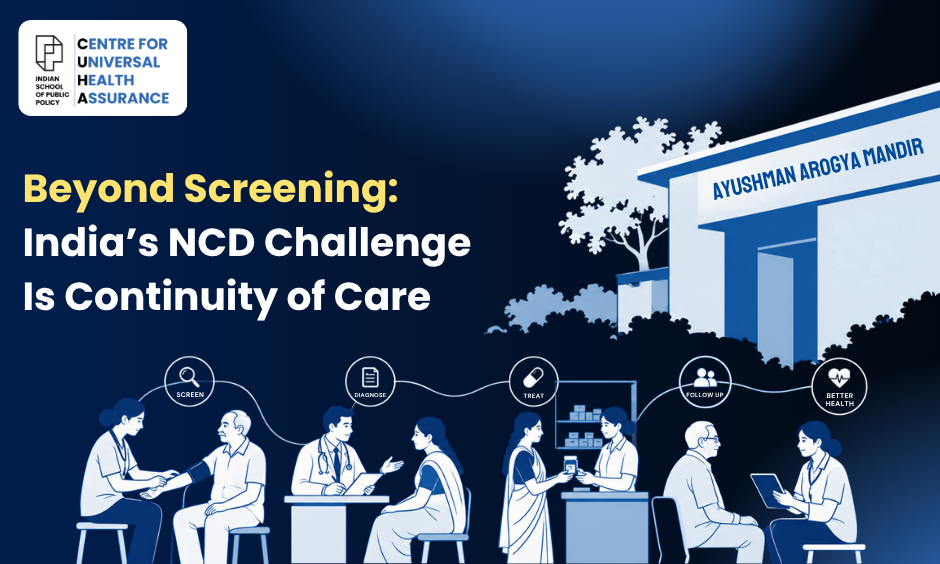
India is no longer battling only infectious diseases. A muted, more complex crisis is unfolding, one where millions are living not with a single illness, but with several chronic conditions at the same time. Diabetes, hypertension, cardiovascular disease, chronic respiratory illnesses, and metabolic disorders are ascending sharply across the country, notably after the age of… Continue reading Multimorbidity in India: Why Chronic Care Needs Urgent Reform
India’s Urban Growth Is Moving Beyond Metro Cities
India’s cities are projected to contribute nearly 70% of national GDP by 2036, according to a World Bank estimate. This number is striking, but India’s metropolitan tier 1 cities still contribute the most and receive the most policy attention. Public investment, grants, and schemes often follow the same pattern. Mumbai, Delhi, Bengaluru, Chennai, Hyderabad, Kolkata,… Continue reading India’s Urban Growth Is Moving Beyond Metro Cities
Public Policy Education in India: Choosing the Right Credential
You Don’t Need a Master’s, You Need the Right Certificate! India’s new regulatory architecture quietly makes the certificate the most agile, honest, and professionally powerful credential in public policy, if you know how to use it. India’s Tiered Credential Architecture India’s higher education system is undergoing a generational transformation. The UGC Regulations 2025, anchored in… Continue reading Public Policy Education in India: Choosing the Right Credential
How AI Detects Bias in Children’s Books and Textbooks
Professor Anjali Adukia’s Fifth Harris Lecture: A Recap What comes to mind when you think of “a scientist,” “a leader,” or even “a hero” from a fairy tale? For many of us, those images were shaped long before we consciously reflected on them, through the books we read as children. These early narratives quietly shape… Continue reading How AI Detects Bias in Children’s Books and Textbooks
A System That Works: Or One That Makes People Work?
Public Service Delivery in India: Are Systems Working for Citizens? India measures public service delivery by outputs: hospitals built, schemes launched, beneficiaries enrolled. But citizens judge the state by their daily experience, not outputs. Yet for citizens, the state is not endured through outputs; it is experienced through processes. The wait at a clinic, the… Continue reading A System That Works: Or One That Makes People Work?
Public Policy Formulation in India: Process, Steps & Role of Parliament (2026 Guide)
Public policy is a set of laws, regulations, directives, and budget allocations that governments or their representatives put in place to achieve public good goals. This process is an iterative one, with many players involved, leading to a policy determined by various interests and options. This also means that government policies are continually changing. As… Continue reading Public Policy Formulation in India: Process, Steps & Role of Parliament (2026 Guide)